A keyword list is not a strategy. Most SaaS teams I talk to have a spreadsheet with hundreds of terms, a few columns of volume and difficulty, and no clear rule for which ten get written this month. The list exists. The decisions behind it do not.
This explainer covers the decision layer: how a keyword research strategy turns raw demand into a publishing order, why the logic changed once AI assistants started answering buyer questions, and where gap analysis fits. I assume you already know how to pull keywords from a tool. The focus here is what to do with them.
A keyword research strategy is the set of rules a team uses to decide which searches to target, in what order, with what kind of page, and how to measure whether it worked. It matters most to founders and small marketing teams who cannot afford to publish pages that never earn traffic or an AI citation.

Research, Strategy and Plan Are Different Things
Keyword research finds and measures demand. Strategy decides which demand is worth winning and why. A plan schedules the pages. Teams that merge these three usually end up with research outputs pretending to be a plan.
The practical test is simple. If someone asks why a specific article is next in your queue and the answer is "it had decent volume," you have research without strategy. A strategic answer names the buyer stage, the business reason, the competitor you are displacing, and the evidence that you can win.
Basic keyword research for SEO identifies the phrases your audience types into search engines and AI assistants so you can build pages that match them. That definition is the starting point. Everything below is about the rules layered on top of it, which is where a keyword seo strategy separates teams that compound traffic from teams that publish into a void.
The Demand Layers a SaaS Strategy Has to Cover
B2B SaaS demand sits in distinct layers, and each one needs a different share of your publishing budget. A strategy that covers only one layer either brings traffic that never converts or targets buyers too few to sustain growth.
Problem-aware searches
These are searches from people who feel a pain but have not named a product category yet: "why are our trial users churning in week one" or "how to reconcile Stripe payouts with invoices." Volume is often low and tools frequently report zero. The value is that you reach the buyer before they have a shortlist. In AI assistants, these questions are where the assistant frames the problem, and the sources it cites shape which categories the buyer looks at next.
Solution and category searches
Here the buyer knows the category: "subscription analytics software" or "SOC 2 automation tool." Competition is heavier and the ranking pages are usually listicles and category pages from established players. For a startup, the winnable versions are the modifiers: by company size, by stack, by use case. "Subscription analytics for usage-based pricing" is a narrower fight than the head term.
Comparison and alternative searches
"X vs Y" and "X alternatives" searches come from buyers at the end of evaluation. They convert well and they are where AI assistants most often name specific vendors. If an assistant answers "best alternatives to [incumbent]" and your product is absent, you lose a buyer who was ready to switch. These pages need honest positioning, because readers at this stage can tell a fair comparison from a sales page.
- Problem-aware: low reported volume, early reach, shapes the shortlist
- Solution and category: high competition, win through narrow modifiers
- Comparison and alternative: highest buying intent, most vendor naming in AI answers
- Integration and workflow: "connect X to Y" searches that bring users already on adjacent tools
- Branded and post-purchase: documentation and how-to queries that protect retention
How Intent Decides the Page, Not Just the Keyword
Intent decides the format of the page that can win. The same topic can need a tutorial, a comparison table, a template or a product page, depending on what the searcher wants at that moment. Choosing the wrong format is one of the most common reasons a well-written article stalls.
Look at the pages that already win a query before you commit. If every result is a step-by-step tutorial, a thought-leadership essay will not displace them. If the results are a mix, intent is split, and you can often win by covering the dominant intent first and answering the secondary one lower on the page.
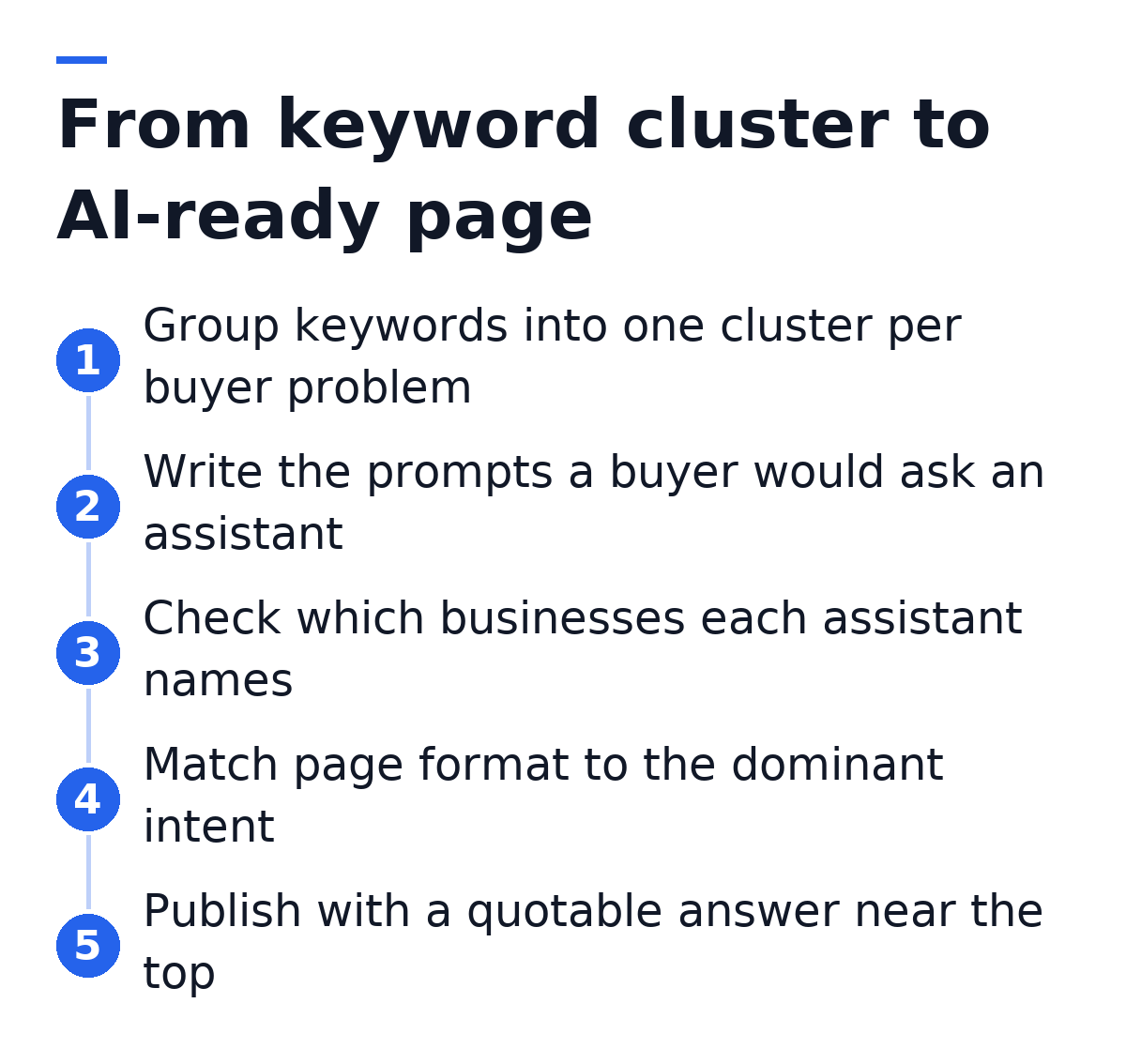
AI assistants add a second check. When I read how ChatGPT or Perplexity answer a query, I note whether they give a definition, a ranked set of vendors or a procedure. A page built to supply that exact shape, with a short quotable answer near the top, is easier for an assistant to extract and cite.
Why AI Assistants Change the Unit of Research
In classic SEO, the unit of research is the keyword. In AI search, the unit is the prompt: a longer, conversational request that often carries context like company size, budget or stack. A strategy for 2026 has to track both.
A buyer might type "CRM" into Google but ask an assistant "what CRM works for a five-person B2B SaaS sales team that lives in Slack." No keyword tool reports volume for that prompt. It still maps to a cluster you can own: CRM for small SaaS teams, Slack-native sales workflows, lightweight pipeline tools.
- Prompts are longer and include constraints keywords rarely carry
- Assistants answer with a short set of named vendors, so being absent is binary
- Citations go to pages that state facts plainly and can be quoted on their own
- The same prompt can produce different answers across ChatGPT, Gemini, Perplexity, Claude and Google's AI features, so one check is not enough
The strategic consequence is that keyword clusters need a prompt layer attached. For each cluster, write down the three to five questions a buyer would ask an assistant, then check which businesses each assistant names. That turns a vague goal like "get cited by AI" into a list of specific answers you are missing from.
Where Keyword Gap Analysis Fits in the Strategy
Gap analysis is the prioritization engine inside a keyword strategy. It compares the demand you cover with the demand your competitors cover and shows where buyers find them instead of you. Without it, a strategy relies on intuition about what matters.
There are two gaps to measure in 2026. The ranking gap is the set of queries where competitors hold Google positions and you hold none. The citation gap is the set of buyer prompts where AI assistants name competitors and leave you out. They overlap, but not fully. I regularly see brands that rank well in Google yet go unmentioned in assistant answers on the same topic, because their pages bury the direct answer or lack the comparison context assistants draw on.
Gaps also need grouping before they become pages. Ten gap keywords might be one article or ten, and getting that wrong creates pages that compete with each other. Understanding what is keyword clustering is what keeps a gap list from turning into cannibalization.
A gap only matters if the missing query reaches a buyer you want. Filter every gap list by fit with your product before you score it, or you will spend the quarter chasing a competitor's audience instead of your own.
How to Prioritize When Every Keyword Looks Good
Prioritization comes down to a few weighted factors, scored per cluster rather than per keyword. Scoring clusters means one page decision covers many related searches, which is closer to how both Google and assistants judge topical coverage.
Business fit. How directly does the cluster lead to your product? A cluster about the exact problem your product solves outranks a loosely related, higher-volume topic every time. I score this first because nothing downstream fixes poor fit.
Winnability. Can your site realistically compete? Look at the authority of the current results, whether they are dedicated pages or passing mentions, and whether your site already has related pages. A topic where the top results are thin forum threads is more winnable than one held by deep vendor guides.
AI citation exposure. Do assistants name vendors for this cluster's prompts, and are you absent? Clusters where assistants actively recommend competitors carry extra weight, because each missing answer is a buyer pointed elsewhere.
Time to value. Some pages win quickly because the competition is weak or because you already rank just off page one. Others are long campaigns. A healthy strategy mixes quick wins that build momentum with slower bets on high-value clusters.
The table below shows how these factors usually play out across demand layers. The conclusion: comparison and integration clusters tend to give small SaaS teams the best mix of fit and winnability.
| Demand layer | Business fit | Winnability for a startup | AI vendor naming |
|---|---|---|---|
| Problem-aware | Medium | Often high | Low to medium |
| Category head terms | High | Low | High |
| Category with modifiers | High | Medium to high | Medium |
| Comparison and alternatives | Very high | Medium | Very high |
| Integration and workflow | High | High | Medium |
Why a Strategy Has to Include Refreshing Old Pages
A keyword strategy that only plans new pages leaves value on the table. Pages that sit just off page one already have relevance signals. A focused rewrite often moves them faster than a new article would move from scratch.
Search Console shows the queries each page appears for, including ones you never targeted. Those unplanned queries are research data. They tell you which subtopics Google already associates with the page and where a new section or a sharper answer could lift it. A repeatable content optimization strategy treats these pages as part of the keyword plan, not as a separate maintenance chore.
Freshness matters for AI citations too. Assistants that search the web favor pages with current facts and clear dates. A comparison page that still describes an older pricing model loses citation chances even if it keeps its Google position.
Manual Workflows vs. Autonomous Execution
The weak point of most keyword strategies is execution, not research. A strategy that needs twenty articles a quarter fails when the team can produce six. Planning ends up shaped by writing capacity instead of by demand.
Manual stacks split the work across tools. Teams often pair a research suite like Semrush with an optimization editor like Clearscope, then write, publish and track by hand. That works when you have writers and an editor. For founder-led teams, every handoff is a point where the strategy stalls.
Autonomous execution changes the structure. With ai content automation, the gap list feeds directly into researched articles that get published to your CMS and refreshed later, so output follows the strategy instead of the team's calendar. That is the model we built Gofylo around: it tracks how six assistants (ChatGPT, Google AI Overviews, Google AI Mode, Gemini, Perplexity and Claude) answer your buyers' searches, shows where they name competitors instead of you, and writes and publishes 10, 20 or 30 articles a month depending on plan, then refreshes them from your Search Console data.
Related: SEO Content Gap Analysis: Find and Close Ranking Gaps
Frequently Asked Questions
Is SEO still relevant in 2026?
Yes. Google still sends a large share of B2B discovery traffic, and AI assistants that search the web draw heavily on pages that are already well structured and indexed. In 2026, SEO covers both: ranking in Google and being the source an assistant cites when it answers a buyer's question.
How many types of keyword research are there?
There is no fixed official count, but most SaaS teams use five working types: seed and category research, intent research, competitor and gap research, long-tail and question research, and performance research from Search Console data. In 2026, many teams add a sixth, prompt research, which checks how AI assistants answer buyer questions and which businesses they name.
Want to see which competitors AI assistants recommend for your buyers' searches? Run the free AI Visibility report from Gofylo, then start a 7-day free trial (plans from $149 a month) to have articles aimed at those gaps researched, written and published to your CMS.