
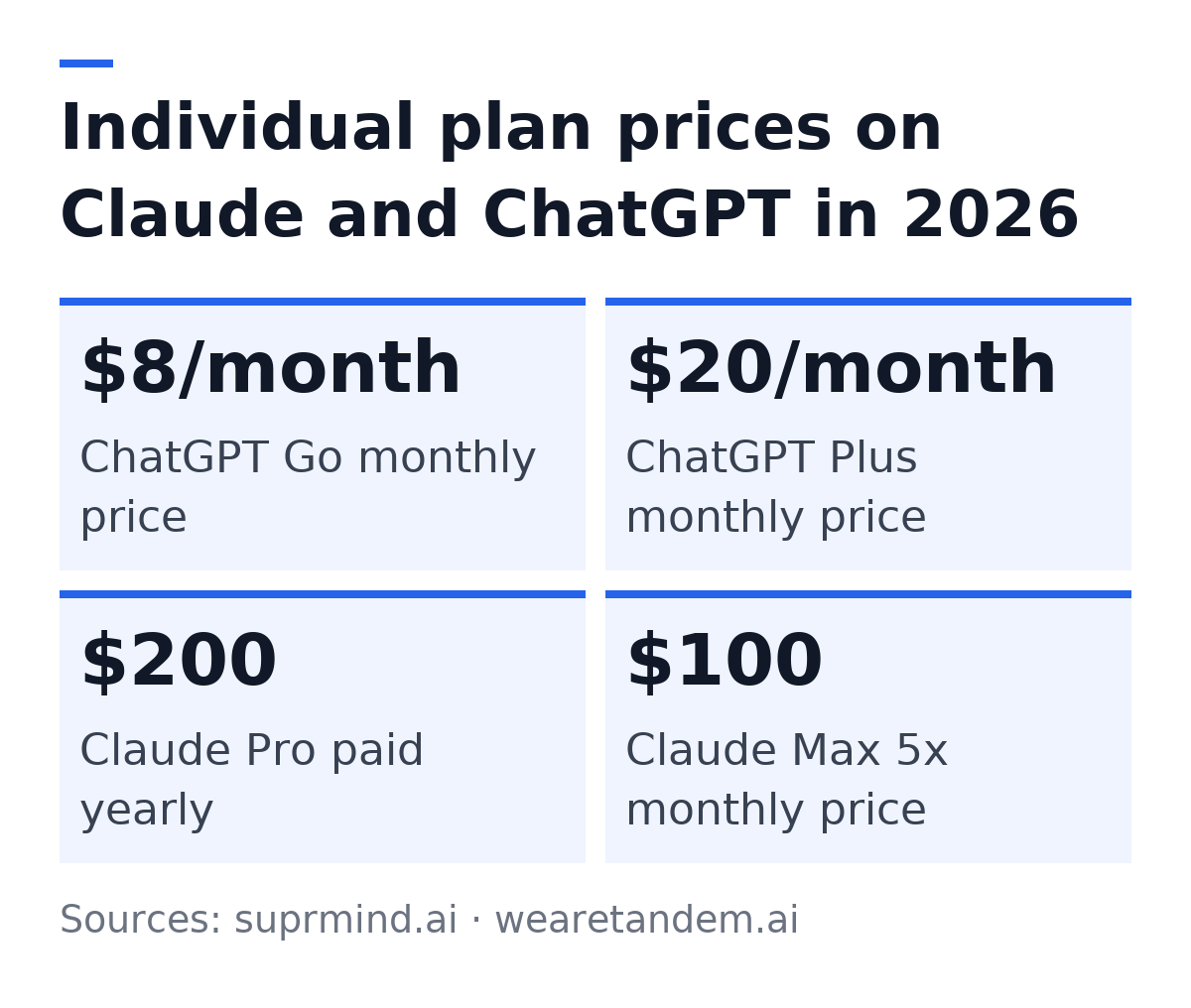
In 2026, Claude vs ChatGPT pricing looks identical at the front door. Claude Pro costs $20 a month in October 2026, or $200 paid yearly, and OpenAI lists ChatGPT Plus at the same headline price, with Go at $8/month, Plus at $20/month, and two Pro tiers at $100 and $200/month. Once you look past that $20 match, the two price ladders split. They differ in where the cheapest paid plan starts, how team seats are billed, how many power-user tiers exist, and what the flagship API costs per million tokens. For a B2B SaaS team, those differences decide the real monthly bill.
I run content and growth for a SaaS product, and our team pays for both tools. This comparison is written for founders, marketing leads, SEO managers and solo builders who already know what each assistant does and want to know which bill makes sense. I compare four axes: individual plans, team seats, API token rates, and the cost per published piece of content once you account for the human time each tool still needs. Every price below comes from published October 2026 pricing data, and I link the source in the same sentence.
Quick verdict: ChatGPT wins on entry price thanks to its $8 Go plan and its wider tier ladder. Claude wins for long-document writing and research at the $20 level, and its Max tiers match ChatGPT Pro on price. For API-driven pipelines, the flagship rates are the same in October 2026, so the model you prefer for output quality should decide.

At a Glance: How the Two Price Ladders Compare
The short answer is that ChatGPT has more rungs and Claude has fewer, larger ones. As of 29 September 2026, ChatGPT has ten plans, from Free and the $8 Go plan up to a Pro 500 tier, two Business seat types, and custom Enterprise and Edu deals. Claude runs a tighter ladder: Free, Pro, two Max tiers, Team seats in standard and premium flavours, and Enterprise. At the $20 level the two are priced the same. At the $100 and $200 levels they are priced the same again. The differences sit at the very bottom, where ChatGPT Go has no Claude equivalent, and at the very top, where ChatGPT adds a $500 tier. Team seats match almost exactly in 2026, and the flagship API rates match too. That means the decision for most SaaS teams comes down to output fit and usage limits more than sticker price. The table summarises each axis.
| Option | Cheapest paid plan | Power-user tiers | Team seats | Flagship API rate | Best fit |
|---|---|---|---|---|---|
| Claude | Pro at $20 a month, or $200 paid yearly | Max at $100 (5x) and $200 (20x) | $25 monthly or $20 yearly; premium $125 or $100 | Opus 5.5 at $4 input / $20 output per million tokens | Long-form writing, research, document-heavy work |
| ChatGPT | Go at $8/month | Pro at $100, $200 and $500 | Business at $25 monthly or $20 annual; 2-seat minimum | GPT-5.6 Sol at $4 input / $20 output per million (promotional) | Mixed daily use, multimodal tasks, budget entry |
Two details in that table are easy to miss. First, the ChatGPT API figure is promotional, so it may move. Second, Claude's yearly Pro price is the only individual annual discount in this comparison, which matters if you know you will keep the tool for the whole annual term. If you want the capability side of the decision (context windows, coding and multimodal differences), our breakdown of Claude vs ChatGPT covers that ground. This article stays on the money.
Individual Plans: From Free to $200 a Month
For one person paying out of pocket, ChatGPT is cheaper to start and Claude is cheaper to commit to. ChatGPT Go at $8/month has no direct Claude counterpart, so a solo founder who only needs drafting help and quick answers spends less with OpenAI. At $20, ChatGPT Plus and Claude Pro cost the same per month, but Claude lets you pay $200 paid yearly, which works out cheaper than twelve monthly payments. Above that, Max costs $100 a month for the 5x tier and $200 for 20x, lining up with ChatGPT's Pro 100 and Pro 200 tiers. ChatGPT then adds Pro 500 for people who hit limits even at $200. The tier names describe usage headroom, so the right plan depends on how often you hit a cap in a normal working week, not on which features sound appealing in a pricing page.
Claude Claude's individual ladder is Free, Pro, Max 5x and Max 20x. Pro is where most marketers land, and it is the plan I recommend for anyone who writes long drafts, edits whole documents, or pastes in research PDFs and transcripts. The yearly option on Pro is the cheapest way to get a frontier assistant for a full annual term in this comparison. The Max tiers exist for people who run Claude for most of the working day: developers using it for coding sessions, analysts running long research threads, and content leads who draft and revise many pieces in one sitting. The names tell you the multiplier: Max 5x and Max 20x describe how much more usage you get relative to Pro. If you hit Pro limits once or twice a week, stay on Pro. If you hit them daily, the 5x tier usually solves it.
ChatGPT ChatGPT's individual ladder has more steps: Free, Go, Plus, Pro 100, Pro 200 and Pro 500. Go is the notable rung. At $8/month it is the cheapest paid frontier assistant in this comparison, and for a bootstrapped operator who wants better models than the free tier without a $20 commitment, it is a sensible starting point. Plus is the general-purpose plan, and it bundles image generation, voice and a wide set of tools under one subscription. The three Pro tiers scale usage for heavy users. Pro 500 has no Claude equivalent, which matters only if you are running the assistant so intensively that $200 still leaves you rationed. Very few marketing teams are in that position.
In practice, the individual decision for a marketer usually turns on writing style and document handling. On our team, the people who write long-form content prefer Claude Pro and the people who mix writing with images, data analysis and quick lookups prefer ChatGPT Plus. Both pay $20. Nobody on the team has needed a $100 tier for writing alone. The heavier tiers start to pay for themselves when the assistant is also doing coding or agentic work across a full workday.
Team and Business Seats for Small SaaS Teams
For a team of two to ten people, the seat prices are close to identical in 2026. On Claude, a Team seat costs $25 a month or $20 billed yearly, a premium seat $125 or $100. On ChatGPT, OpenAI cut the standard seat in April 2026, and Business now runs $20/user/month on an annual plan or $25/user/month monthly, with a 2-seat minimum. ChatGPT also lists a Business Premium seat at $125 per seat per month, mirroring Claude's premium seat. So a five-person marketing team pays the same on either platform for standard seats. The variables that change the bill are the seat mix (how many people need premium usage), whether you commit to annual billing, and the admin features each workspace includes. The 2-seat minimum on ChatGPT Business rarely matters for a team, but it does rule out a solo founder who wants business-grade data controls on a single seat.
Claude Claude Team splits seats into standard and premium. Standard seats suit marketers, writers and support staff who use Claude for drafting, summarising and research. Premium seats suit the people who live in it: engineers using Claude for code, analysts running long data or document threads, and the content lead who reviews everything. The useful move is to buy mostly standard seats and a small number of premium ones. A team of six with five standard and one premium seat on annual billing pays far less than six premium seats, and the heavy user still gets the headroom they need. Team workspaces include shared projects, which help when several people work from the same brand guidelines, product docs and style references.
ChatGPT ChatGPT Business uses the same two-tier logic with Standard and Premium seats. After the April 2026 price cut, a standard seat on annual billing matches Claude's yearly Team seat exactly. Business workspaces include shared custom GPTs, which some marketing teams use to package brand voice instructions, ICP notes and formatting rules into a reusable assistant. Enterprise and Edu are custom-priced, so any team above the Business tier needs a sales conversation. For a growth-stage company that expects to grow from five to fifty seats inside a year, it is worth asking about Enterprise terms early, because the custom price is negotiated rather than published.
Seat math tip: buying premium seats for everyone is the most common way a small team overspends on either platform. Start everyone on standard seats, track who hits limits in the first month, and upgrade only those people.
A broader point sits behind the seat discussion. Behind the common question, will marketers be replaced by these tools, sits a simpler budgeting reality: a $20 or $25 seat buys an assistant, and the person using it still does the research, structuring, editing and publishing. The seat price is the smallest line item in any content operation. The salary of the person prompting it is the largest.
API Token Rates for Content and Product Pipelines
On the API, the two flagships cost the same per token in October 2026. According to Opslyft, "Claude Opus 5.5, released September 22, 2026, costs $4 per million input tokens and $20 per million output, undercutting Opus 5 at $5/$25." On the OpenAI side, the flagship GPT-5.6 Sol API bills $4 per million input tokens and $20 per million output under promotional pricing as of October 2026. Identical headline rates mean the API decision rests on three other factors: how many output tokens each model uses to finish the same task, whether the promotional OpenAI rate holds, and which model produces output your team needs to edit less. For content pipelines, output tokens dominate the bill, because a long article costs far more to generate than the brief that prompts it. A model that writes tighter drafts is cheaper in practice even at the same rate card.
Claude Claude's API pricing has moved down with each flagship generation. Opus 5.5 is cheaper per token than Opus 5, which helps teams that built pipelines on the earlier model. Claude's long context window matters for cost in a specific way: you can pass a full brand guide, a competitor article and a keyword brief in one call, which avoids chaining several smaller calls together. The trade-off is that every token in that large context is billed as input on every call. If your pipeline sends the same 50-page style guide with every request, input costs add up faster than you expect. Prompt caching, where available, reduces that repeat cost and is worth enabling on day one.
ChatGPT ChatGPT's flagship API rate matches Claude's, but the promotional label is the detail to watch. A pipeline budgeted on a promotional rate can see costs change when the promotion ends, so I budget OpenAI usage at a buffer above the listed figure. OpenAI's broader platform includes image generation and speech models under the same account, which is convenient if your content workflow also produces featured images or audio. For teams that already run product features on OpenAI, keeping content generation on the same account simplifies billing and key management.
Here is a worked example of how output tokens drive cost. The figures below are illustrative token counts, multiplied by the published flagship rates, so you can adapt them to your own pipeline.
rate_input_per_million = 4.00
rate_output_per_million = 20.00
input_tokens_per_article = 6000
output_tokens_per_article = 3500
articles_per_month = 30
input_cost = 6000 * 30 / 1000000 * 4.00
output_cost = 3500 * 30 / 1000000 * 20.00
monthly_model_cost = input_cost + output_cost
The first two lines set the flagship rates that both providers publish in October 2026. Lines three and four are assumptions for a single article: a brief, a few reference passages and instructions as input, and a full draft as output. Line five sets volume. The last three lines show that output tokens account for most of the spend even though input tokens are more numerous, because output is billed at five times the input rate. Rerun the same math with your own token counts, and add revision passes, since each rewrite is another full output charge. The model cost is small. The engineering time to build, monitor and maintain the pipeline is the real expense, which is where the next section picks up.
True Cost Per Published Article, Including Human Time
The real cost of a published article is the subscription or token spend plus every human hour around it, and the human hours dwarf the model cost on both platforms. A $20 Claude Pro or ChatGPT Plus seat produces a draft. Someone still researches keywords, checks the live results, builds an outline, writes the prompt, edits the output, adds internal links and schema, sources images, formats for the CMS and publishes. That person then has to monitor Google Search Console and refresh pages that slip. There is also a second visibility channel in 2026: AI assistants such as ChatGPT, Claude, Perplexity and Gemini now answer many buyer questions directly, and they cite pages that are structured for extraction. Neither consumer subscription formats content for AI citation or measures whether your brand appears in those answers. That gap is why the Claude vs ChatGPT pricing question is only half of a content budget.
Claude Claude is strong at the drafting and editing steps. It holds long instructions well, follows a brand voice document closely, and produces long-form drafts that need less restructuring. For an SEO manager doing four to eight articles a month by hand, Claude Pro is a good writing partner. The steps it does not do are the ones outside the chat window: keyword clustering against competitors, publishing to WordPress or Webflow, adding schema, internal linking across your existing library, and refreshing pages based on Search Console data. Those remain manual or need separate tools.
ChatGPT ChatGPT covers a wider spread of tasks inside one subscription. A marketer can draft an article, generate a featured image, analyse a CSV export of keyword data and build a quick outline without switching tools. That breadth saves time on mixed workflows. Like Claude, it stops at the edge of the chat window. Publishing, interlinking, schema, refresh cycles and AI visibility tracking still sit with a person or another product.
This is where purpose-built content platforms enter the comparison. They wrap model access in the workflow around it, and they price per outcome instead of per seat or token. A few that SaaS teams commonly evaluate, described on their own terms:
- Writesonic is an AI writing and marketing platform that has expanded into generative engine optimization, with tools for content creation and for tracking brand presence in AI answers.
- Clearscope is a content optimization tool that grades drafts against the terms and topics that top-performing pages cover, used by teams that write in-house and want an editorial quality check.
- Semrush is a broad SEO suite covering keyword research, rank tracking, site audits and competitive analysis, with AI writing features added on top of its data.
- Outrank generates and publishes SEO articles automatically to connected sites, aimed at teams that want hands-off blog output.
- Gofylo is our own product, so weigh this line accordingly: it researches keywords from competitors and live results, writes 30 articles a month in your brand voice, each in a few minutes, and publishes them to your CMS for a single $79/month plan.
I built Gofylo around the gap described above, so here is the mechanism without the pitch. Agents group keywords into topic clusters, write articles with schema markup, internal links, FAQ blocks and verified source citations, generate images in 5 styles, and publish in 18+ languages to WordPress, Webflow, Shopify, Wix, Ghost, Framer, Notion or a webhook. They then rewrite articles that sit just off page one using Search Console data, keeping the earlier version to restore. An AI visibility score shows how ChatGPT and Claude see your brand. Compared with a $20 assistant seat, the price is higher. Compared with the human hours a seat still needs to produce 30 published, linked, schema-ready articles, the cost per article is a different calculation entirely. If you are also weighing how is perplexity different from both assistants on price and citation behaviour, the same logic applies: the subscription is the input, and the published, cited page is the output you are paying for.
Verdict: Which Subscription Fits Which Team
On price alone, Claude and ChatGPT are close to tied in 2026, so the right choice depends on who is paying and what they produce. ChatGPT is the cheaper entry for a bootstrapped solo operator thanks to Go, and it has the widest tier ladder for extreme usage. Claude is the better value at $20 for long-form writing and research, and its yearly Pro price is the cheapest twelve-month commitment in this comparison. Team seats cost the same on both after OpenAI's April 2026 cut, so team decisions should follow output preference and admin features. API rates for the flagships are identical in October 2026, with the caveat that OpenAI's is promotional. For a content operation that needs published, interlinked, AI-citable articles at volume, neither subscription is the whole answer, because the human workflow around the model costs more than the model. The list below maps each reader to a choice.
- Choose ChatGPT Go if you are a bootstrapped solo builder who wants a paid frontier model for the lowest monthly price.
- Choose Claude Pro if you write long drafts, edit full documents or run research threads, and you can commit to the yearly plan.
- Choose ChatGPT Plus if your day mixes writing with images, data files, voice and quick lookups in one tool.
- Choose Claude Team or ChatGPT Business on mostly standard seats if you have a team of two or more, then upgrade only the heavy users to premium.
- Choose either flagship API if you are building a pipeline, and pick the model whose drafts your editors change least, since output tokens drive the bill.
- Choose an autonomous content platform such as Gofylo if the goal is published, schema-ready articles at volume without a content team.
Verdict: ChatGPT wins for budget entry and mixed daily use. Claude wins for long-form writing and research value at $20. For teams and APIs, the prices match in 2026, so output quality decides. For compounding organic and AI search traffic, the winner is whichever setup removes the most human hours per published article.
FAQ
How much is Claude Design Pro?
Anthropic's published October 2026 plan list does not include a standalone tier called Design Pro. Design and visual work in Claude runs on the standard plans, and the main individual plan, Claude Pro, costs $20 a month in October 2026, or $200 paid yearly. Heavy users can move to the Max tiers for more usage.
Which is better for research, ChatGPT or Claude?
Claude is usually the better pick for research that involves long documents, transcripts or several PDFs at once, because it handles large context well and writes careful summaries. ChatGPT is stronger when research mixes web lookups, data files and charts in one session. At $20 a month the price is the same, so pick by the shape of your research.
What are the key differences between ChatGPT Plus and Claude Pro?
Both cost $20 per month, but Claude Pro has a yearly option at $200 and ChatGPT Plus bundles a wider set of tools such as image generation and voice. Claude Pro tends to suit long-form writing and document work, while ChatGPT Plus suits mixed daily tasks. Their upgrade paths differ too: Claude moves to Max, ChatGPT to three Pro tiers.
How much do different Claude models cost?
On the API, Claude Opus 5.5 costs $4 per million input tokens and $20 per million output, down from Opus 5 at $5/$25. Smaller Claude models are priced lower per token and suit high-volume tasks such as classification or short summaries. Inside the chat apps, all models are covered by your plan, with usage limits set by the tier.
Is it worth paying for both Claude and ChatGPT?
For a single marketer, paying for both subscriptions is worth it only if you use each for different jobs, such as Claude for long drafts and ChatGPT for images and data. Most small teams standardise on one for shared projects and give a second seat to the one or two people who need it. Track usage for a month before doubling up.
Does either subscription help my brand appear in AI answers?
No. A Claude or ChatGPT subscription helps you write content, but it does not structure pages for AI citation or measure how assistants describe your brand. That requires content formatted for extraction, consistent publishing and a way to track visibility, such as an AI visibility score.
If your Claude or ChatGPT seat is producing drafts that still wait on research, linking, schema and publishing, try Gofylo for 3 days free. Connect your CMS, and it will research your competitors, write and publish articles in your brand voice, and show your AI visibility score on ChatGPT and Claude. One plan, $79/month, cancel any time.
Sources
- Claude Pricing October 2026: Pro, Max, Team, Enterprise - wearetandem.ai
- Claude Pricing 2026: Plans, API Rates and Hidden Costs - opslyft.com
- ChatGPT Pricing for Plus, Pro & Business Subscription Plans - suprmind.ai
- ChatGPT Enterprise Pricing Guide 2026 - Beam Cloud - beam.cloud
- ChatGPT Pricing: Every Plan Compared October 2026 - AIToolsReview - aitoolsreview.co.uk