How do AI checkers work? They run your text through a statistical model that estimates how predictable each word is, then compare the resulting pattern against a classifier trained on known human and machine writing. As of 2026, most B2B SaaS teams I work with publish some AI-assisted content, and at some point a founder pastes an article into a detector, sees a high AI score and panics. This guide shows you how to take that panic apart. By the end, you will understand the signals a checker reads, run a controlled test on your own content, interpret the score correctly and decide what (if anything) to change for Google and for AI assistants like ChatGPT, Claude, Perplexity and Gemini.
I have run this exact process on our own content at Gofylo, and the lesson is consistent: a detector score is a probability estimate about writing style. It says nothing about accuracy, usefulness or whether an AI engine will cite the page. Once you know what the score measures, you stop rewriting good articles to satisfy a tool that was never built to judge them. What you need:
- Two or three free AI detectors to compare against each other (GPTZero is a common starting point, and many teams also try Turnitin through an academic contact)
- A known human-written sample of at least a few hundred words, such as an old blog post written before AI tools
- A known AI-generated sample on the same topic, produced with a plain prompt
- One or two of your published articles that you want to evaluate
- A spreadsheet to log scores per tool, per sample and per run
- Access to Google Search Console for the articles you test, so you can compare detector scores with real performance

Step 1: Learn the Signals a Detector Actually Measures
Start by learning the two families of signals every mainstream detector relies on, because every later step depends on reading them correctly. The first family is statistical: the tool measures how predictable your text is to a language model. The second family is learned: a classifier trained on labelled examples decides which bucket your text resembles. According to G2's breakdown of detector mechanics, detectors look for two specific aspects, perplexity and burstiness, and the lower both values are, the more likely the text was machine-generated. That single sentence explains most false positives. Clear, conventional B2B writing (short definitions, standard phrasing, consistent sentence length) is naturally low in both. A careful human technical writer can therefore score as more machine-like than a sloppy one. Knowing this before you test keeps you from reading a high score as proof of anything other than predictable style.
Perplexity and burstiness
Perplexity measures surprise. The detector feeds your text to a language model token by token and asks how likely each next word was. If the model would have guessed most of your words, perplexity is low. Burstiness measures variation in that surprise across sentences. Humans tend to mix a long, winding sentence with a blunt four-word one. Models, left to defaults, produce evenly paced sentences. Grammarly's explainer puts it plainly: AI-generated text often follows consistent patterns with repeated phrases, whereas human writing tends to be more varied and unpredictable.
Trained classifiers
The second layer is a supervised model. Per the same Grammarly guide, detectors use machine learning models trained on large datasets that contain both AI-written and human-written text. Academic work shows how strong simple classifiers can be under lab conditions: a 2026 study in the International Journal for Educational Integrity found SVM consistently achieved the highest and most stable performance, with accuracy values above 95% across models and a peak QWK of 0.972. The catch is that a classifier only knows the models and writing styles it was trained on. New model releases and edited drafts fall outside that training distribution.
Step 2: Build a Controlled Test Set From Known Samples
Build a small test set where you already know the true origin of each text, because a score on an unknown article tells you nothing until you have calibrated the tool. I use four buckets. A pure human sample is something your team wrote before generative tools existed, ideally on a topic close to what you publish now. A pure AI sample is a draft produced with a single generic prompt and no edits. A hybrid sample is an AI draft that a person then edited for voice, added examples to and restructured. The final bucket holds the published articles you actually want to evaluate. Keep every sample at a similar length, since short passages give detectors too little signal and produce erratic results. Strip boilerplate like author bios, navigation text and code blocks, which distort the statistics. Label everything in your spreadsheet before you run a single check, so you cannot rationalise the results afterwards.
- Pull one pre-AI human article from your archive and paste the body text only
- Generate one plain AI draft on the same topic with a single short prompt
- Create one hybrid by editing a copy of that AI draft for voice and adding a real customer example
- Select two to four published articles you want scored
- Trim every sample to roughly the same length and remove headings, bios and code
- Record the true origin of each sample in a column before testing
Tip: include a sample written by your most precise technical writer. In my tests, disciplined human writing with consistent sentence length is the sample most likely to be flagged as AI, which is the clearest demonstration of how the perplexity signal behaves.
Step 3: Run Each Sample Through Multiple Checkers
Run every sample through at least two or three different detectors, and run each one more than once, because single-tool, single-run scores are unreliable enough to mislead you. Detectors differ in the reference model they use for perplexity, in their training data and in the threshold where they flip from human to AI. GPTZero, Turnitin and Originality.ai can return quite different verdicts on the same paragraph for exactly these reasons. Paste the identical text into each tool, record the overall score and any sentence-level highlights, then rerun a day later. Note which sentences each tool flags. You will usually find agreement on the pure AI sample and disagreement on the hybrid. That disagreement is the most useful data you collect: it shows the region where detectors are guessing. Log everything in the spreadsheet with tool name, date, sample label and score, so patterns become visible.
Pay attention to the sentence highlights more than the headline number. Flagged sentences tend to be the generic ones: definitions, transitions and summary lines that any writer would phrase the same way. That tells you the tool is reacting to predictability, which is something you can evaluate on editorial grounds.
Step 4: Interpret Scores as Probabilities, Not Verdicts
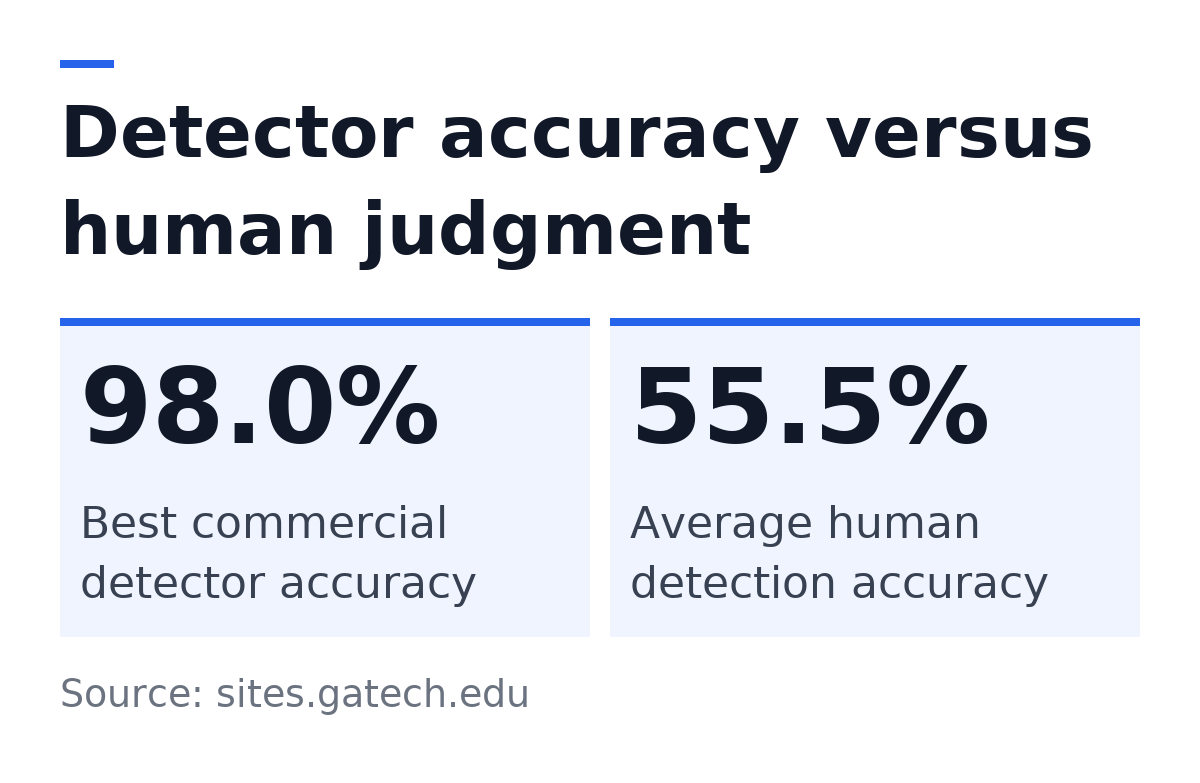
Read each score as the tool's confidence that the text statistically resembles its AI training examples, nothing more. A high AI score does not mean that the same proportion of the text was machine-written, and it does not mean the content is wrong or low quality. Researchers at Georgia Tech found the best commercial detector reached 98.0% accuracy with a 0% false positive rate, yet tools vary widely, and the same research notes that accuracy and accessibility move in opposite directions. Humans are no better referees: across a meta-analysis of 56 papers and 86,155 participants, average human detection accuracy was 55.5%, close to a coin flip. So neither your gut nor one free tool should decide an article's fate. Compare scores for your published articles against your calibration samples. If a published piece scores like your human control, move on. If it scores like the raw AI draft, look at why.
Editing also scrambles the signal. The 2026 Springer study showed that paraphrasing severely degrades detector reliability, though a proposed synonym-replacement tokenization strategy recovered up to 30 percentage points in accuracy. In practice this means a lightly edited AI draft and a heavily edited one can score very differently, and future detectors may score both differently again. Treat any single number as a snapshot.
Warning: do not set an internal rule like "nothing ships above X% AI." Teams that adopt one end up degrading clear writing with forced quirks, which hurts readability and makes passages harder for AI assistants to quote cleanly.
Step 5: Decide What to Change for Google and AI Search
Decide changes based on what search engines and AI assistants reward, and use the detector only to locate generic passages. Google has said its systems reward helpful, reliable, people-first content regardless of how it was produced, and its guidance on AI-generated content states that appropriate use of AI is not against its guidelines. AI assistants work similarly in practice: ChatGPT, Claude, Perplexity and Gemini cite pages that answer a question directly, carry specific facts and come from sources they consider credible. None of them runs your page through a detector before citing it. So the edits worth making are the ones a good editor would make anyway. Replace generic definitions with your own data or a customer example. Add a named source to every claim. Put a direct answer under each heading. Cut filler transitions. Those changes often lower a detector score as a side effect, but the reason to make them is citation and ranking value.
- Swap flagged generic sentences for a specific example, number or product detail you can source
- Add an answer-first paragraph under each heading so an AI assistant can quote it alone
- Cite primary sources inline instead of paraphrasing unnamed claims
- Add first-hand experience: what you tried, what broke, what you changed
- Check Search Console for articles sitting just off page one and prioritise those for edits
This is also where workflow matters more than any single score. Manual teams usually run one detector, rewrite in a panic and publish less. An autonomous system works from different inputs. Gofylo, for example, researches keywords, writes 30 articles a month in a few minutes each, adds schema, internal links, FAQ blocks and verified source citations, and then refreshes pages from Search Console data. Its AI visibility score shows how ChatGPT and Claude actually see your brand, which is the outcome a detector cannot measure. If you are weighing monitoring-only tools against that model, Profound AI vs. Autonomous GEO covers the trade-off, and Your Guide to LLM visibility tools explains the wider category. Technical access files are a separate layer; What llms.txt Actually Does addresses that question.
Troubleshooting
Most problems with AI checkers come from three sources: samples that are too short, a single tool treated as ground truth, and edits made to satisfy the score instead of the reader. When results look strange, go back to your calibration set first. If your known human sample scores as AI, the tool is miscalibrated for your writing style, and its verdicts on your other articles deserve little weight. If scores swing between runs, you are probably testing short passages or a tool that updates its model often. If stakeholders insist on a pass mark, show them the human control result alongside the AI draft result, because seeing a real human article flagged usually ends the debate faster than any argument. The fixes below cover the issues I see most often when SaaS teams run this process for the first time, and each one keeps the focus on content quality and citation value, which are what Google and AI assistants respond to.
Human writing flagged as AI This is a false positive driven by low perplexity. Check whether the passage is a definition or standard explanation that any expert would phrase the same way. If it is accurate and useful, leave it. If it is filler, replace it with a concrete example, which improves the page and usually changes the score.
Scores change between runs Lengthen the sample, strip headings and code, and test again. Detectors also update their models, so record the date of each run. Use the average of several runs across several tools, and report a range to stakeholders instead of one number.
Tools disagree completely Expect this on edited hybrid drafts. Disagreement means the text sits in the zone where classifiers guess. Treat the content as ambiguous and judge it on editorial grounds: sources, specificity and whether each section answers its heading.
Rewrites made rankings worse Forced quirks, odd synonyms and broken sentence rhythm reduce readability and quotability. Restore the earlier version, then make targeted edits that add facts and examples. Track the result in Search Console over the following weeks.
FAQ
These answers cover the questions SaaS teams ask most once they start testing detectors on their own content, including how the underlying technology works and where detection fits into broader software testing.
What does an AI scanner do?
An AI scanner estimates whether text was written by a language model. It measures predictability signals such as perplexity and burstiness, then passes the result to a classifier trained on human and AI examples. The output is a probability, often with sentence-level highlights.
How does artificial intelligence (AI) work?
Most modern AI systems learn patterns from large datasets and use them to make predictions. A language model, for example, predicts the next word in a sequence based on patterns learned in training. AI detectors exploit this by measuring how closely a text matches what such a model would predict.
What is AI in testing?
AI in testing usually means using machine learning to generate test cases, spot anomalies or prioritise which parts of software to test. AI content detection is a related idea applied to text: a model classifies inputs instead of a human reviewer checking each one. Both depend on training data that matches real conditions.
How to outsmart AI checkers?
Trying to trick a detector is the wrong goal for a business site, because neither Google nor AI assistants use detector scores to rank or cite pages. Adding specific data, real examples, named sources and varied sentence structure tends to lower scores naturally. Those edits also make the content more useful and more quotable.
Does a high AI score hurt Google rankings?
Google's published guidance says it rewards helpful content regardless of how it is produced. A high detector score is not a ranking factor. Thin, generic or unsourced content can underperform, whoever or whatever wrote it.
Want content that earns rankings and AI citations instead of chasing detector scores? Start a 3-day free trial of Gofylo: 30 researched, cited articles a month published to your CMS, refreshed from Search Console, with an AI visibility score showing how ChatGPT and Claude see your brand. Prefer a quick baseline first? Run the free AI Search Grader on your domain.
Sources
- How Do AI Detectors Work: Cracking the Code on AI Content - learn.g2.com
- How Do AI Detectors Work? Key Methods and Limitations - grammarly.com
- The Accessibility Gap in AI Content Detection - sites.gatech.edu
- Evaluating the accuracy and reliability of AI content detectors in academic contexts - link.springer.com