As of 2026, a growing share of B2B buyers start their research not in Google but in AI engines — typing a question into ChatGPT, Perplexity, Claude, or Gemini and accepting whatever those systems surface as authoritative. That shift has created a category gap: traditional rank trackers tell you where you appear in a list of ten blue links, but they say nothing about whether an LLM names your brand when a prospect asks 'what's the best [your category] tool?' Those are two completely different signals, and conflating them is why many marketing teams are flying blind on AI-driven pipeline.
An LLM rank tracker — sometimes called an AI rank checker or AI visibility tracker — is the instrumentation layer built specifically for this new search reality. It doesn't scrape Google SERPs. Instead, it submits queries directly to large language models and records how, when, and how prominently your brand appears in the responses. Understanding what these tools actually measure, how they differ from one another, and what the data means for organic growth strategy is what this article is about. We'll also look at where autonomous content platforms fit into the picture, because in 2026, visibility in AI engines is less about luck and more about content volume, structure, and citation density.
Thesis: An LLM rank tracker measures brand citation frequency and position across AI engines — a metric that is structurally uncorrelated with traditional SERP rankings and increasingly predictive of top-of-funnel pipeline for B2B SaaS companies.
What an LLM Rank Tracker Actually Is
An LLM rank tracker is a software tool that programmatically submits a defined set of queries to one or more large language models, records the full text of each response, and extracts signals about whether a target brand — or its competitors — appears in those responses, in what context, and with what sentiment. The 'ranking' analogy comes from traditional SEO, but the mechanism is fundamentally different. In Google, ranking is positional: you're slot 1, 3, or 12 on a results page. In an LLM response, ranking is more nuanced — it's about whether you're mentioned at all, whether you're mentioned first, whether you're framed as a category leader or a niche alternative, and whether the model cites a URL that traces back to your domain. A sophisticated LLM rank tracker captures all of these dimensions, not just binary mention or no-mention. This makes the data richer but also harder to interpret without a clear framework, which is why understanding the underlying mechanics matters before you start pulling dashboards.
How LLM Rank Tracking Differs From Traditional Rank Tracking
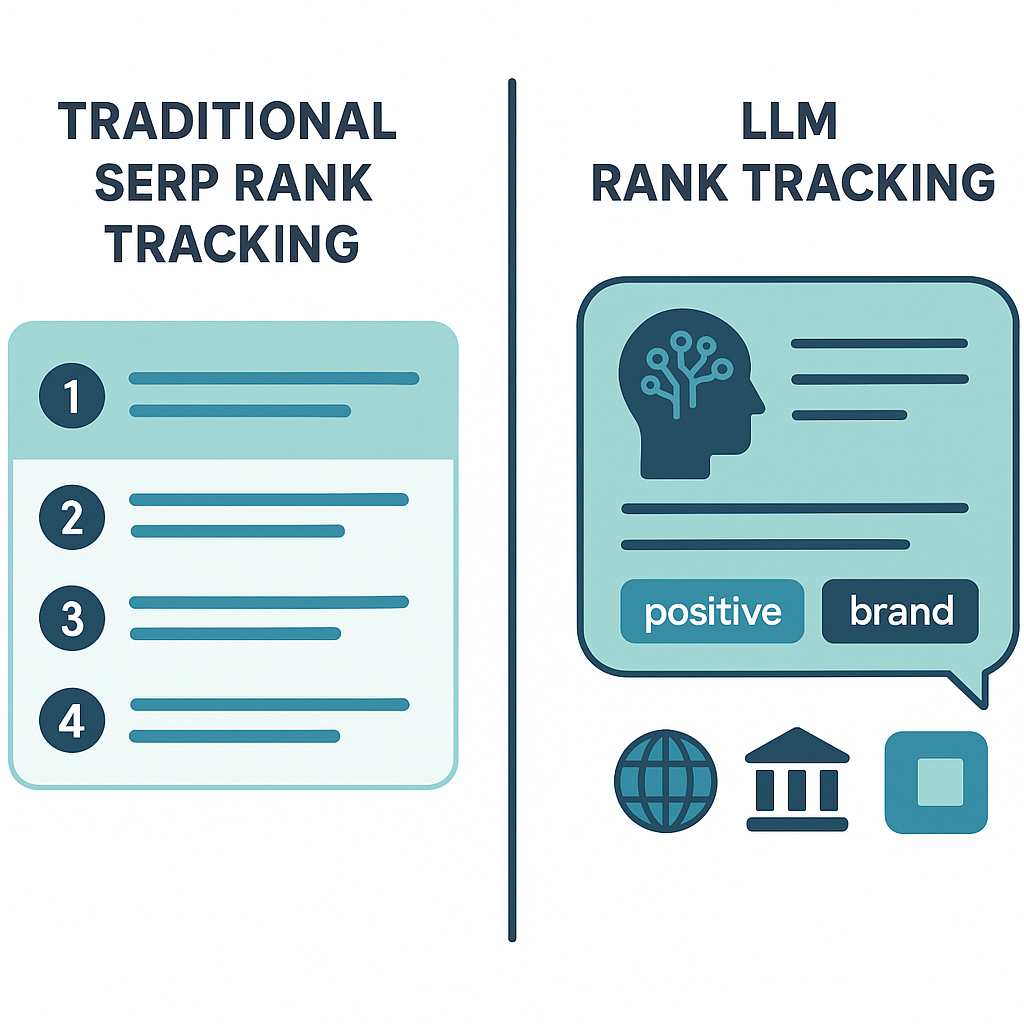
Traditional rank tracking, as covered in depth in our overview of rank tracking tools and what rank tracking fundamentally is, operates on a deterministic model: a crawler submits a query to a search engine, reads the ranked list of URLs, and logs which position your domain occupies. The input and output are both structured — a keyword in, a position number out. LLM rank tracking operates on a probabilistic model. Language models are non-deterministic by design; two identical queries submitted minutes apart can produce different responses, different brand mentions, and different citation structures. This means a credible LLM rank tracker must submit each query multiple times, aggregate responses, and surface statistical patterns rather than single-point snapshots. It also means that query design — the specific phrasing, the persona implied, the topic framing — dramatically affects what gets returned, which introduces a methodology layer that doesn't exist in traditional rank tracking at all.
- Traditional rank tracking: deterministic, positional, SERP-based, keyword-level granularity
- LLM rank tracking: probabilistic, citation-based, response-level, query-cluster granularity
- Traditional tools measure where you appear in a list; LLM tools measure how you're described in a narrative
- SEO rank data is available in near real-time; LLM rank data requires query batching and response aggregation
- Traditional rankings correlate with click-through rate; LLM mentions correlate with brand trust signals baked into model training and retrieval
- Competitor benchmarking in SEO uses shared SERP pages; in LLM tracking, competitors must be explicitly tracked per query
The Engines Being Tracked — and Why Coverage Matters
Not all AI engines behave the same way, and which engines your LLM rank tracker covers directly determines the relevance of the data you're collecting. Each major AI engine has a different retrieval architecture, different training cutoffs, different real-time web access behavior, and different user demographics. ChatGPT and Claude tend to draw heavily from training data supplemented by retrieval; Perplexity is explicitly retrieval-augmented and will cite live web sources; Google AI Overviews and AI Mode are tightly integrated with Google's index and ranking signals. Tracking brand presence across all of these engines simultaneously gives a much more complete picture of AI search share of voice than any single-engine view. According to data published by Mangools, as of 2026 their AI Search Watcher tracks eight AI engines: ChatGPT, Google AI Overviews, Google AI Mode, Gemini, Claude, Grok, Mistral, and Llama — covering the full spectrum from proprietary closed models to open-weight deployments.
ChatGPT and Claude These two engines dominate enterprise B2B research queries. ChatGPT has the largest user base; Claude is increasingly preferred for longer, more analytical queries. Both are high-priority tracking targets for SaaS brands targeting technical buyers.
Gemini and Google AI Mode Google's AI search surface is uniquely important because it sits inside the world's highest-traffic search engine. A brand that appears prominently in Gemini responses and AI Overviews captures attention at the exact moment of commercial intent — often without the user ever clicking to a results page.
Perplexity and Grok Perplexity's citation-heavy format makes it especially relevant for brands with strong content footprints — your articles and documentation pages are visible as cited sources. Grok's integration with X (Twitter) data makes it a useful signal for brands with active social presence.
Mistral and Llama Open-weight models running on Mistral and Llama are increasingly deployed in enterprise internal tools and industry-specific AI applications. Tracking visibility here is a leading indicator of brand penetration in vertically-integrated AI workflows.
What the Underlying Data Looks Like
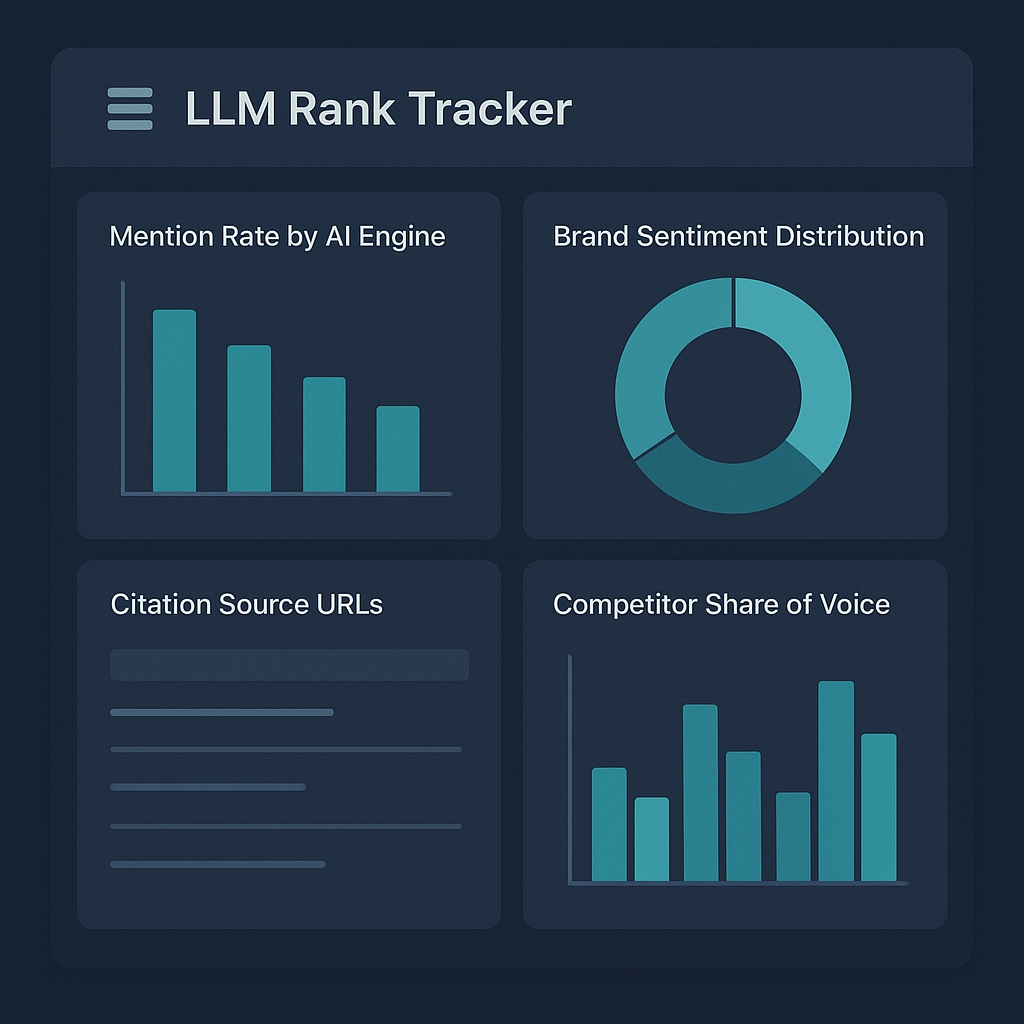
The raw output of an LLM rank tracker is a corpus of AI-generated text responses annotated with metadata: the query submitted, the engine queried, the timestamp, the full response text, and structured extraction of any brand mentions detected. From this corpus, the tracker computes aggregated metrics — mention rate (what percentage of responses for a given query cluster include your brand), mention position (first mention, second mention, etc.), sentiment classification (positive, neutral, comparative, cautionary), citation presence (does the response include a URL pointing to your domain), and share of voice relative to tracked competitors. The richest trackers also extract the context around each mention: are you described as a market leader, a budget option, a niche tool, or a risky choice? That qualitative framing is often more strategically actionable than the raw mention count.
Brand Mention Tracking vs. Citation Tracking
These two concepts are related but distinct. A brand mention means the LLM named your company or product in its response — it might say 'Gofylo is an autonomous content platform' without linking anywhere. A citation means the LLM's retrieval layer pulled a specific URL from your domain as a source and surfaced it as evidence for a claim. Citations are the stronger signal because they indicate your content is being treated as authoritative source material, not just a known brand name. For B2B SaaS companies, citation tracking is particularly valuable because it identifies which specific articles, landing pages, or documentation pages are being used as training or retrieval anchors — giving you a direct feedback loop between content investment and AI search visibility.
Prompt Architecture and Query Diversity
The quality of an LLM rank tracker's data is heavily dependent on the quality and diversity of the queries it submits. A tracker that only submits exact-match category queries ('best project management software') will miss the long-tail conversational queries where AI engines are increasingly influential ('I'm running a remote team of 12 engineers, what should I use to manage sprints without a PM?'). The best LLM SEO tools generate prompt clusters that span informational, comparative, and decision-stage queries — mirroring the actual variety of how real users interact with AI search engines. This is also where the concept of an AEO tracker overlaps: answer engine optimization is about ensuring your content answers the specific question structures that AI engines receive, and tracking those answers requires query diversity by design.
What Drives LLM Ranking — and How to Improve It
Understanding what an LLM rank tracker measures is only useful if you also understand what levers actually move those metrics. LLM visibility is driven by a combination of training data presence, retrieval-augmented content quality, and citation network density. Training data presence means your brand, product, and key claims appeared in text that was used to train the model — which is a lagging signal you can't directly control in the short term. Retrieval-augmented content quality is more actionable: when a model queries the live web to augment its response, the content it retrieves and cites tends to be well-structured, semantically rich, and hosted on domains with strong authority signals. Citation network density means other credible sources are linking to and referencing your content — the same backlink and citation logic that drives traditional SEO, but operating through a different scoring mechanism inside retrieval pipelines.
- Publish high-volume, semantically complete content that directly answers category-level questions
- Structure content with clear headings, FAQ blocks, and schema markup that retrieval systems can parse
- Build citation density by earning mentions and links from authoritative third-party sources in your category
- Maintain consistent brand framing across all content so models learn a coherent definition of what you do
- Monitor which competitor content is being cited and reverse-engineer its structural and topical characteristics
- Track changes in mention rate after publishing new content to establish a content-to-visibility feedback loop
The core insight from 2026 monitoring data: brands that publish structured, high-frequency content with consistent topical authority tend to accumulate LLM citations compoundingly — each new article reinforces the signal that a model uses to evaluate brand authority in a category.
LLM Rank Tracker Tools Worth Knowing in 2026
Several dedicated LLM rank tracker tools have emerged to address this visibility gap. Arvow tracks brand mentions across AI engines and surfaces citation frequency data. Rankscale.ai focuses on AI presence across ChatGPT and AI Overviews with a competitor analysis layer. Mangools' AI Search Watcher provides brand monitoring across eight AI engines with prompt suggestion features. LLMrefs positions itself as a generative AI search analytics platform with competitor benchmarking and citation source identification. Each tool takes a somewhat different approach to query design, engine coverage, and data presentation — the right choice depends on how many engines you need to cover, whether you need competitor benchmarking, and how deeply you need to inspect citation-level data versus high-level mention rates. For teams already invested in traditional SEO performance monitoring, an LLM rank tracker ideally sits alongside — not replacing — existing rank tracking infrastructure, because the two datasets answer fundamentally different questions.
Where Autonomous Content Platforms Change the Equation
Tracking LLM visibility is valuable. But tracking without the ability to systematically improve visibility is just observation. This is where autonomous content platforms enter the picture as a structural complement to any LLM rank tracker. The mechanism is straightforward: if LLM citation frequency is driven by content volume, topical coverage, and structural quality, then a platform that autonomously generates, optimizes, and publishes high-quality content at scale directly moves the metrics that an LLM rank tracker measures. Gofylo, for example, writes and publishes articles in a few minutes — each with schema markup, internal links, FAQ blocks, and AI-generated images included — and ships 30 articles per month on the standard plan. That volume of structured, E-E-A-T-compliant content, published consistently across a domain, creates the kind of topical authority footprint that retrieval-augmented AI engines treat as citation-worthy. Rather than manually auditing why your LLM mention rate is flat, autonomous content platforms create a flywheel: more content → more retrieval surface area → more citations → higher LLM rank tracker scores.
Gofylo includes an AI visibility score that reflects how ChatGPT and Claude see a brand, based on asking those two engines about it directly. It is a single number that consolidates what would otherwise require stitching together data from multiple standalone LLM rank tracker tools. For teams that want both the measurement and the content engine driving improvement, that integrated loop is structurally different from buying a tracker and a content tool separately. The free AI Search Grader is also available as a zero-commitment entry point for any brand that wants to understand where they currently stand across AI engines before committing to a full tracking and content workflow.
A note on tooling strategy: LLM rank tracking without a content improvement loop produces dashboards, not growth. The compounding advantage comes from connecting visibility data to content production — whether that's manual, assisted, or fully autonomous.
Frequently Asked Questions
Is there a free LLM rank tracker available?
Several tools offer free tiers or standalone free features. Gofylo's AI Search Grader grades your brand's current AI search visibility at no cost and without requiring a credit card. Some dedicated LLM tracking platforms like LLMrefs and Mangools' AI Search Watcher offer limited free query volumes. For a full-featured LLM rank tracker with competitor benchmarking and multi-engine coverage, paid plans are generally required.
How is an LLM rank tracker different from an AEO tracker?
An AEO (answer engine optimization) tracker focuses on whether your content is being surfaced as a direct answer in response to specific question-format queries — often with a focus on featured snippets and structured data. An LLM rank tracker is broader: it measures brand citation frequency, mention sentiment, and citation URLs across the full range of AI engine response types, not just question-answer pairs. The two concepts overlap but address different layers of AI search visibility.
How often should I run LLM rank tracking queries?
Most teams running active content programs benefit from weekly query batches — frequent enough to detect changes after new content is published, but not so frequent that API costs become prohibitive. For high-competition categories where competitors are publishing aggressively, daily or near-daily tracking for a core set of high-priority queries is justified. Monthly snapshots are the minimum viable cadence for any brand actively investing in AI search visibility.
Which AI engines should I prioritize tracking?
For B2B SaaS companies, ChatGPT and Claude should be first-priority targets given their penetration among technical and commercial buyers. Google AI Overviews and AI Mode are second priority because of their integration with commercial-intent search behavior. Perplexity is worth tracking for any brand with a strong content footprint since it surfaces citations visibly. Mangools' research confirms eight engines worth tracking in 2026, including Grok, Mistral, and Llama for broader coverage.
What content changes actually improve LLM ranking?
The highest-impact changes are structural: adding FAQ sections with schema markup, writing direct-answer lead paragraphs under each heading, increasing topical coverage density within a content cluster, and building internal links that signal topical authority. Volume matters too — a domain with 200 well-structured articles on a topic will accumulate LLM citations faster than a domain with 10 excellent articles, because retrieval systems weight coverage breadth alongside depth. Google's guidance on E-E-A-T signals remains directionally relevant here, as many retrieval pipelines use similar quality heuristics.
Can an LLM rank tracker integrate with my existing SEO stack?
Most standalone LLM rank tracker tools offer API access or CSV exports that can be piped into existing BI tools, dashboards, or Slack workspaces. Gofylo's AI visibility score asks ChatGPT and Claude how they see a brand and sits within the broader Gofylo platform. For teams using SEMrush or Ahrefs for traditional rank tracking, LLM tracking data sits best as a parallel data stream — same dashboard, different metric set — rather than a replacement.
According to Gartner (2024), by 2026, more than 80% of enterprises will have used generative AI APIs or deployed generative AI-enabled applications in production environments, underscoring why tracking brand and product visibility inside large language models has become a urgent priority for SEO and marketing teams investing in LLM rank tracker tooling.
According to Search Engine Land (2023), AI-powered conversational search features drove a measurable shift in zero-click behavior, with studies showing that over 60% of Google searches now end without a click to any external website, a trend that makes monitoring how LLMs surface and rank brand mentions a critical complement to traditional keyword rank tracking strategies.
Ready to see where your brand actually stands in AI search? Gofylo's free AI Search Grader gives you a visibility score from ChatGPT and Claude. And if you want to start moving that score, Gofylo's full platform ships the content engine, keyword research from competitors and live search results, and an AI visibility score for how ChatGPT and Claude see your brand, in a single $79/month plan with a 3-day free trial. Start your trial at gofylo.io.