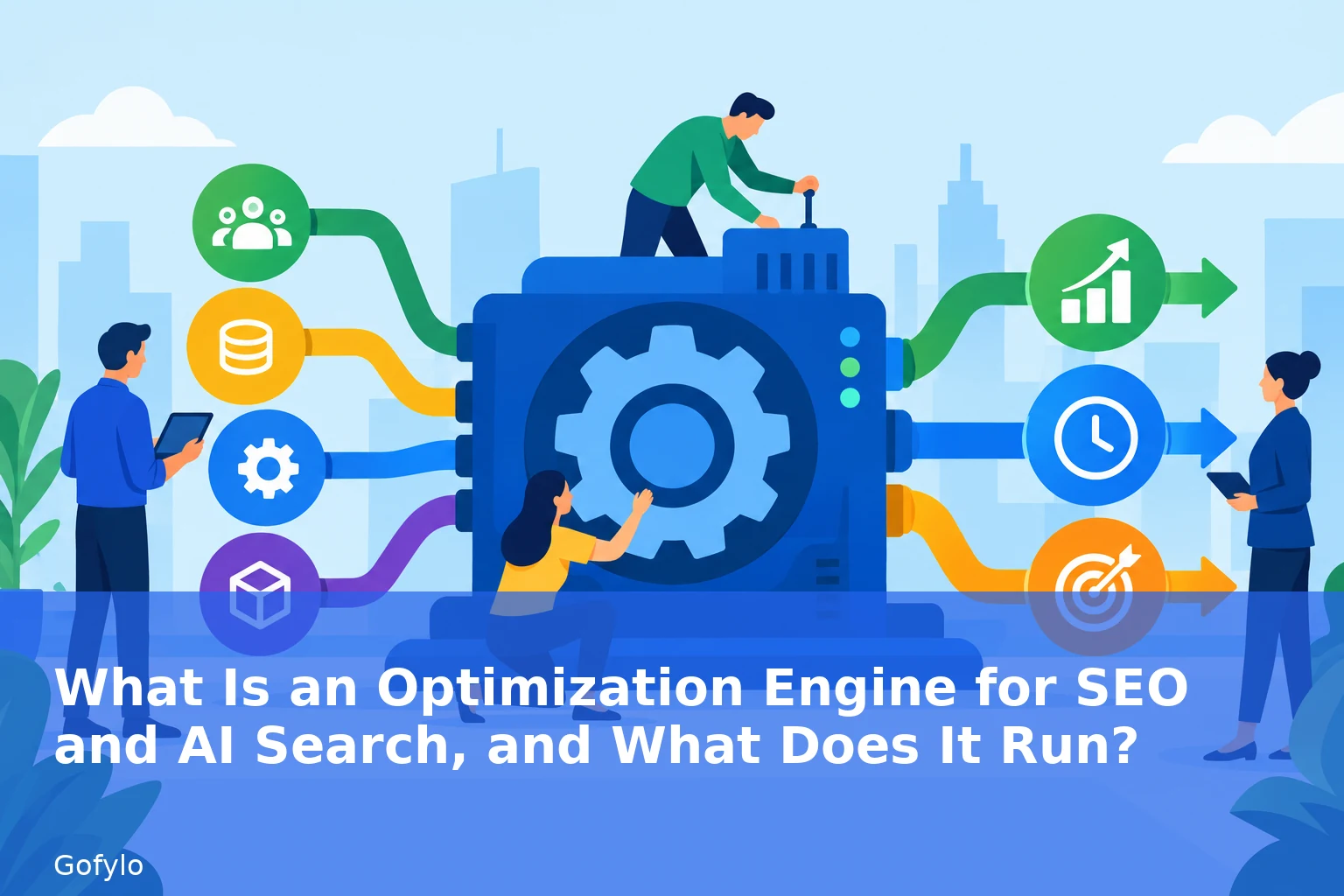
An optimization engine for search is a system that runs the full content loop for you. It measures where you appear, finds the gaps, produces pages aimed at them, publishes them, and reworks them when the data says they are slipping. The word engine is literal here. The system keeps the loop running on a schedule, and a person does not have to start each step.
Most B2B SaaS teams we talk to already have the parts of this loop. They have a rank tracker, a content brief template, a writer or an AI drafting tool, a CMS and a Search Console account. The problem is that a human connects every part, so the loop runs as often as someone has a free afternoon. In 2026 that pace is too slow. Six AI assistants (ChatGPT, Google AI Overviews, Google AI Mode, Gemini, Perplexity and Claude) now answer the same buyer questions your pages target, and each one decides on its own which vendors to name.
This article explains what an optimization engine is, the loop it runs, what it optimizes against on Google and in AI answers, and where these systems fail. It is written for founders, marketing leads, content and SEO managers, and solo builders who already know what GEO is and want to understand the machinery behind it.
An optimization engine is software that continuously measures your visibility on Google and in AI assistants, decides which pages to write or rework, produces and publishes them, and repeats the cycle without manual prompting. It matters most to small teams that need organic and AI search growth but cannot staff every step of the content process.

Where the Term Optimization Engine Comes From
The phrase comes from engineering and operations research. There, an optimization engine is a solver that searches a space of possible settings for the one that scores best on an objective, called a fitness function. It tries a setting, scores it, adjusts and tries again until the score stops improving.
A mechanical example shows the idea plainly. In a study on tuning combustion engines for performance and emissions, two algorithms named DTBO and EBOA converged to a global fitness function value of 0.94, with DTBO reaching it more efficiently. The point for us is the structure. Each algorithm had a clear objective, a set of variables it could change and a feedback signal that told it whether a change helped.
A search optimization engine borrows the same structure and applies it to content. The objective is visibility: pages that rank on Google and brands that AI assistants name and cite. The variables are which topics you cover, how each page is shaped, what it links to and when it gets reworked. The feedback signals are Search Console data and the answers AI assistants give to your buyers' questions.
There is one large difference. An engine tuning a motor works on a stable system. A content engine works against systems that change under it, since Google updates ranking and every AI assistant updates its models and retrieval. The feedback loop never reaches a final answer. It has to keep running, which is why the continuous part of the definition matters more than the generation part.
The Loop an Optimization Engine Runs
Every optimization engine for search runs some version of the same loop. The stages are:
- Measure where your brand and pages appear on Google and in AI answers.
- Decide which gaps are worth closing and in what order.
- Produce pages built for those gaps.
- Publish them to your CMS with schema, internal links and metadata in place.
- Refresh published pages when the data shows they are close to winning but not there yet.
The gap between a tool and an engine is which of these stages run without a person starting them. A grader such as Clearscope scores a draft against a target, and a human still picks the topic, writes, publishes and comes back later. An engine connects the stages so the output of one becomes the input of the next.
Measure: Visibility on Google and in AI Answers
Measurement has two halves. On Google, the signals are familiar: impressions, average position, clicks and the queries each page appears for, all available in Search Console. In AI search, there is no console. The engine has to ask each assistant the questions your buyers ask and record what comes back.
An AI answer contains three things worth recording. The first is which businesses the assistant names. The second is which sites it cites as sources. The third is how it describes your category. If Perplexity cites a competitor's comparison page and ChatGPT names three vendors that are not you, those are two separate gaps with two separate fixes. For a fuller grounding in how these assistants choose sources, GEO AI Search Explained covers the background.
Because AI answers vary between runs, a single check proves little. A useful engine samples the same search repeatedly over time and reports patterns, such as a competitor named in most runs of a buyer search, instead of a single screenshot.
Decide: Turning Gaps Into a Page Queue
Measurement produces far more gaps than any team can close. The decision stage ranks them. In our experience the gaps worth closing first share a few traits:
- The search comes from a buyer close to purchase, such as a comparison or a use-case question.
- AI assistants name competitors for it, so the slot clearly exists and you are missing from it.
- You have no page that answers it, or your page answers a different question.
- Your product genuinely fits the answer, so a page can be specific instead of generic.
The decision stage is where many manual workflows break. A content manager with a spreadsheet of a few hundred keywords and a separate list of AI prompts has no consistent way to merge them. An engine scores both on the same queue.
Produce and Publish: Pages Built to Be Cited
Production in an engine follows the same research a good writer does: what the top pages cover, what AI answers say, which sources they lean on, and what is missing. The output is a page shaped for both audiences. That means a direct answer under each question heading, short declarative sentences that can be quoted alone, verified source citations, an FAQ block, schema markup and internal links to related pages on your site.
Publishing is the step teams underrate. A finished draft in a document is not visibility. An engine pushes the page to the CMS, whether that is WordPress, Webflow, Shopify, Ghost or another platform, with the metadata and structured data already set. Removing the handoff between draft and live page is often where the largest time saving sits.
Refresh: Reworking Pages That Sit Just Off Page One
Refresh closes the loop. Search Console shows pages with plenty of impressions and an average position just past the first page. Those pages already have Google's attention, and a focused rework is cheaper than a new article. A careful engine keeps the earlier version so a rework that performs worse can be rolled back.
Refresh matters for AI search too. Assistants that retrieve live web results lean on pages that answer the question clearly and cite current sources. A page written once and left alone drifts out of both rankings and AI answers as competitors publish newer material.
What the Engine Optimizes Against: Google Signals and AI Signals
An optimization engine serves two objectives that overlap heavily but are scored differently. Google ranks pages. AI assistants compose answers and decide which brands to mention and which sources to cite. The table below shows where the inputs and outputs differ, and why one engine can serve both if it measures both.
| Point | Google search | AI assistants |
|---|---|---|
| What wins | A ranking position for a page | A brand mention or a source citation in an answer |
| Feedback source | Search Console impressions, position and clicks | Repeated sampling of assistant answers |
| Signal stability | Fairly stable between checks | Varies from run to run |
| Page traits rewarded | Relevance, links, intent match, structure | Quotable answers, clear entities, cited sources, structure |
| Typical fix | Rework an existing page near page one | Publish a page for a search where rivals are named |
The overlap is larger than the differences. A page with a clear answer under a question heading, accurate sources and schema helps on both fronts. That is the practical case for running SEO and GEO Together through one engine, instead of buying a separate workflow for each.
The differences still change priorities. On Google, a page at position eleven is a refresh candidate. In AI answers, being absent entirely from a buyer question where three competitors are named is a new-page candidate. An engine that only reads Search Console will never see the second kind of gap, and an engine that only samples AI answers will miss the cheap wins sitting just off page one.

Where Optimization Engines Fail
Optimization engines fail in predictable ways. Most of the failures we see come from a broken link in the loop, not from weak writing. The common ones are:
- Generation without measurement. The system writes articles on a schedule but never checks whether they rank or get cited, so it repeats the same mistakes.
- Measurement without action. A dashboard shows that AI assistants name competitors, and nothing turns that finding into a page.
- Optimizing for the wrong objective. The engine chases keyword volume while buyer-stage questions, where AI assistants decide shortlists, go unanswered.
- Single-sample conclusions. One AI answer is treated as the truth, and a team rewrites a page because of a run that was never repeated.
- No rollback. A refresh replaces a page that was working, and the earlier version is gone.
- Generic output. Pages say what every other page says, so neither Google nor an AI assistant has a reason to prefer them.
The tool-stack trap. Many teams assemble an engine from separate products: a rank tracker, an AI visibility monitor, a grader, a writer and a CMS plugin. Each part works. The engine does not, because the parts only connect through a person. Comparisons of generative engine optimization tools often score each product on its own features, while the question that decides results is whether findings flow into published pages without waiting on someone.
The service trap. The opposite route is hiring an agency or a managed service. That removes the labour, but the loop slows to the pace of a monthly report and a review call. For a small team comparing affordable search engine optimization services with software, the useful question is how often the loop completes, not how many hours are billed.
A well-built engine avoids these failures by keeping its objective explicit and its feedback honest. It reports which assistants name you and which name competitors, it ties each new page to a gap it found, and it keeps the version history of every page it touches.
Frequently Asked Questions
What is optimization in AI?
Optimization in AI has two meanings. In machine learning, it is the process of adjusting a model's settings to improve a score, the same structure as the engine tuning example above. In marketing, it means shaping your content and brand presence so AI assistants such as ChatGPT, Gemini, Perplexity and Claude mention and cite you when buyers ask about your category.
What is aio vs SEO?
AIO (AI optimization) aims to get your brand named and your pages cited inside AI-generated answers, while SEO aims to rank your pages in Google's results. Both reward clear, well-sourced, well-structured pages. They differ in how success is measured: SEO has Search Console data, while AIO requires sampling assistant answers repeatedly.
What is SEO and how to implement it?
SEO is the practice of making pages that Google ranks for the searches your buyers make. Implementing it means researching those searches, publishing pages that answer them better than existing results, linking those pages internally, adding structured data and reworking pages based on Search Console data. An optimization engine is one way to run those steps continuously.
If you want an optimization engine running for you, Gofylo tracks how six AI assistants answer your buyers' searches, shows where they name competitors instead of you, and researches, writes and publishes 10, 20 or 30 articles a month to your CMS, then refreshes them from your Search Console data. Plans start at $149 a month. Start with the free AI Visibility report to see which businesses AI assistants name for your buyers' searches, or begin a 7-day free trial.