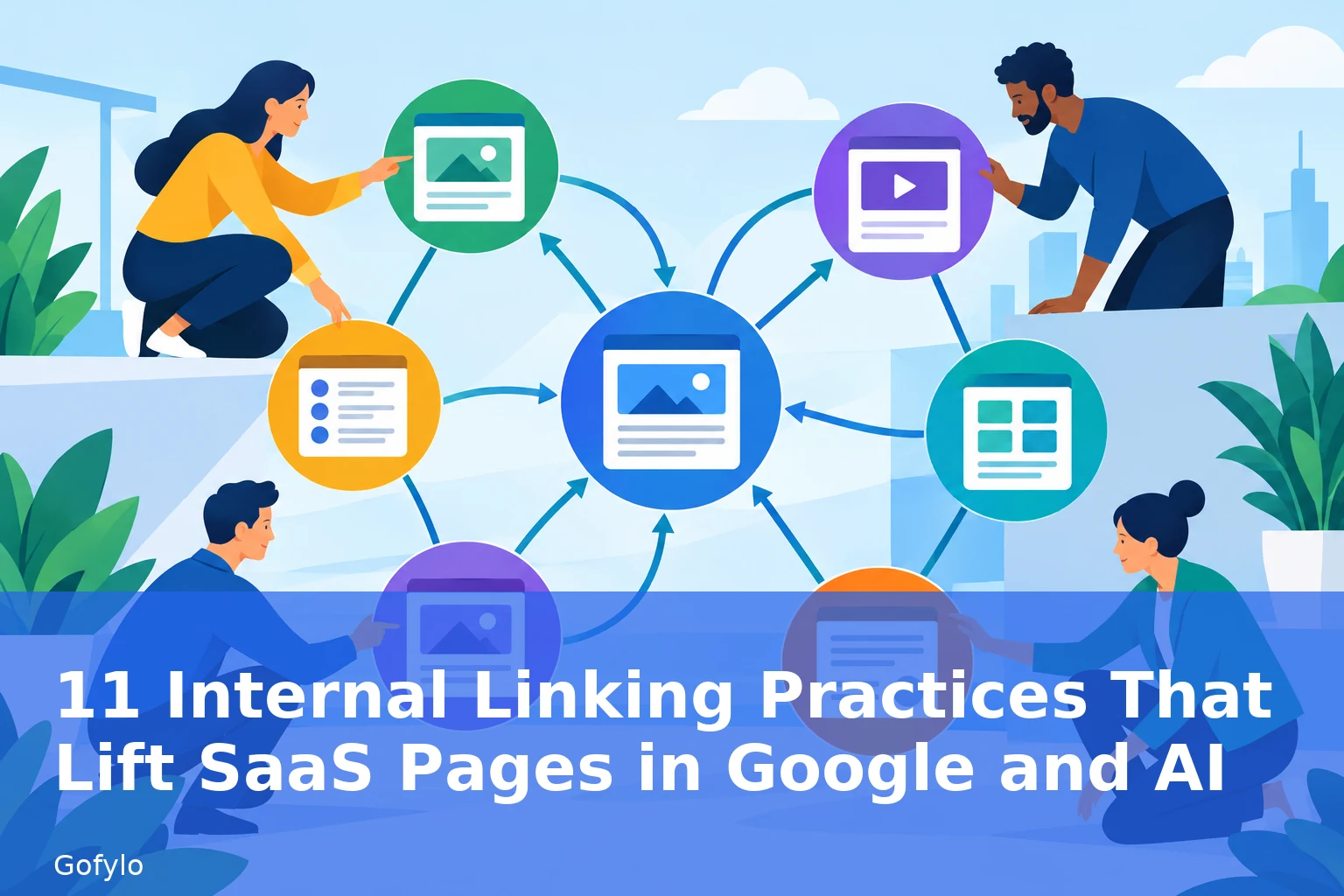
Internal links are the one ranking lever a SaaS team fully controls. You cannot force another site to link to you, but you decide every link between your own pages: which pages point where, with what words, and from which part of the page. Most teams I talk to treat that decision as an afterthought, added in a quick pass after the article is written.
This round-up is for founders, marketing leads, SEO managers and solo builders who already publish content and want the internal links to work harder. It skips the definition of internal linking and the general case for why links matter. Every practice below is a specific change you can make to an existing site, with a reason it works for Google and a reason it works for AI assistants such as ChatGPT, Perplexity, Gemini and Claude.
Both lenses matter in 2026. Google uses links to discover pages, understand how they relate and decide which page on your site is the main one for a topic. AI assistants that browse the web or draw on a search index lean on the same structure: a page that sits at the center of a well-linked set of related pages is easier to find, easier to read in context and more likely to be treated as the authoritative answer from your domain.

Act on this first: choose a single target URL for each topic you want to rank for, then point every relevant internal link at that URL with consistent anchor text. Most other fixes in this list depend on knowing which page each link is supposed to strengthen. Without that decision, your links spread signal across several competing pages and none of them wins.
1. Pick One Target Page per Topic Before You Link Anything
Every topic needs one owner page. Before you add a single link, decide which URL on your site is the answer for each topic you care about. Write it down in a simple sheet: topic, target URL, primary anchor phrase. That sheet becomes the reference every writer and every editor checks before linking.
This works because links are a vote. When three blog posts all talk about onboarding metrics and each links to a different one of the other two, Google sees three pages with equal claims and no clear winner. AI assistants face the same ambiguity when they pull pages from your domain: the page they quote may be the thinnest of the three. A single owner page collects every vote and gives both systems one obvious candidate.
- List the topics you want to rank and be cited for, one row each.
- Assign the strongest existing URL as the owner, or mark the topic as a gap.
- Merge or redirect weaker pages that compete for the same topic.
- Share the sheet with anyone who writes or edits content.
2. Write Anchor Text That Describes the Destination
The clickable words should tell a stranger what the next page covers. Anchor text such as "click here", "this post" or "learn more" tells a search engine nothing about the destination. Descriptive anchors, such as "SOC 2 compliance checklist for startups", carry topical meaning straight into the target page. Vary the wording naturally across pages so it reads like a person wrote it, while keeping the core phrase recognizable.
Google uses anchor text as a signal for what the linked page is about, and internal anchors are the only ones you write yourself. For AI assistants, a descriptive anchor makes the relationship explicit in plain language: a model reading your page sees that the phrase and the destination belong together. The thinking behind this is laid out more fully in how internal linking shapes both search and AI visibility, but the practical rule is short: if the anchor would make sense as a heading on the target page, it is a good anchor.
- Replace generic anchors on your top 20 traffic pages first.
- Avoid using the exact same anchor phrase for two different target pages.
- Keep anchors short: the noun phrase, not the whole sentence.
3. Put the Important Links in the Body Copy
A link inside a paragraph outweighs the same link in a footer. Navigation, sidebars and footers repeat on every page, so they tell search engines little about which pages relate to which. A link placed in the body, inside a sentence that explains why the reader should go there, is an editorial choice. Give your most important targets contextual links early in the article, where readers actually reach them.
Search engines weigh links by their context and position, and boilerplate links are easy to discount. AI systems that split a page into passages often read the body text and ignore template elements entirely, so a link that lives only in the footer may never be seen in the passage they use. Body links survive that extraction.
4. Link From Pages That Already Have Authority
Send links from your strongest pages to the ones that need a push. Your homepage, pricing page and a handful of posts that earned external backlinks hold most of your site's authority. A link from one of those pages to a new or struggling article passes far more weight than a link from another new article. Pull your top pages by backlinks and by organic clicks, then look for natural places to link from them.
Link equity flows through internal links, so placement at the source matters as much as the target. The same pages tend to be the ones AI assistants already find and cite from your domain. A good rank tracker (the category is compared in our look at the best rank tracking tools for SEO and AI visibility) shows which pages hold positions, and those are the pages to link from.
- Export pages with the most referring domains from your backlink data.
- Export pages with the most clicks from Google Search Console.
- Add one or two relevant body links from each to priority targets.
- Recheck the targets' positions after Google recrawls the source pages.
5. Find and Fix Orphan Pages
A page with no internal links pointing to it barely exists. Orphan pages are reachable only through the sitemap or a direct URL. They are common on SaaS sites: old landing pages from a campaign, feature pages added outside the main navigation, posts that were never linked once the blog index moved on. Crawl your site, compare the crawled URLs with your sitemap and Search Console list, and every URL that appears in the sitemap but not in the crawl is an orphan.
Google can discover an orphan through the sitemap but has no internal signal to judge its importance, so it tends to crawl and rank it poorly. AI assistants that rely on search indexes or follow links have even less reason to reach it. Each orphan is either worth linking from two or three related pages, or worth retiring and redirecting.
6. Keep Commercial Pages Within a Few Clicks of the Homepage
Click depth is a rough proxy for how much you care about a page. Pricing, product, integration and comparison pages should be reachable within a few clicks from the homepage. Blog archives that paginate deep can push older articles many clicks down, where crawlers visit them rarely. Use category pages, topic pages and related-post modules to flatten that depth.
Pages buried deep get crawled less often and inherit less authority. For a SaaS company the pages closest to revenue are often added late and linked weakly, which is the wrong way round. Shallow commercial pages also give AI assistants a clear path from your informational content to the pages that describe what you sell.
7. Link Every Supporting Article to Its Topic Page and Back
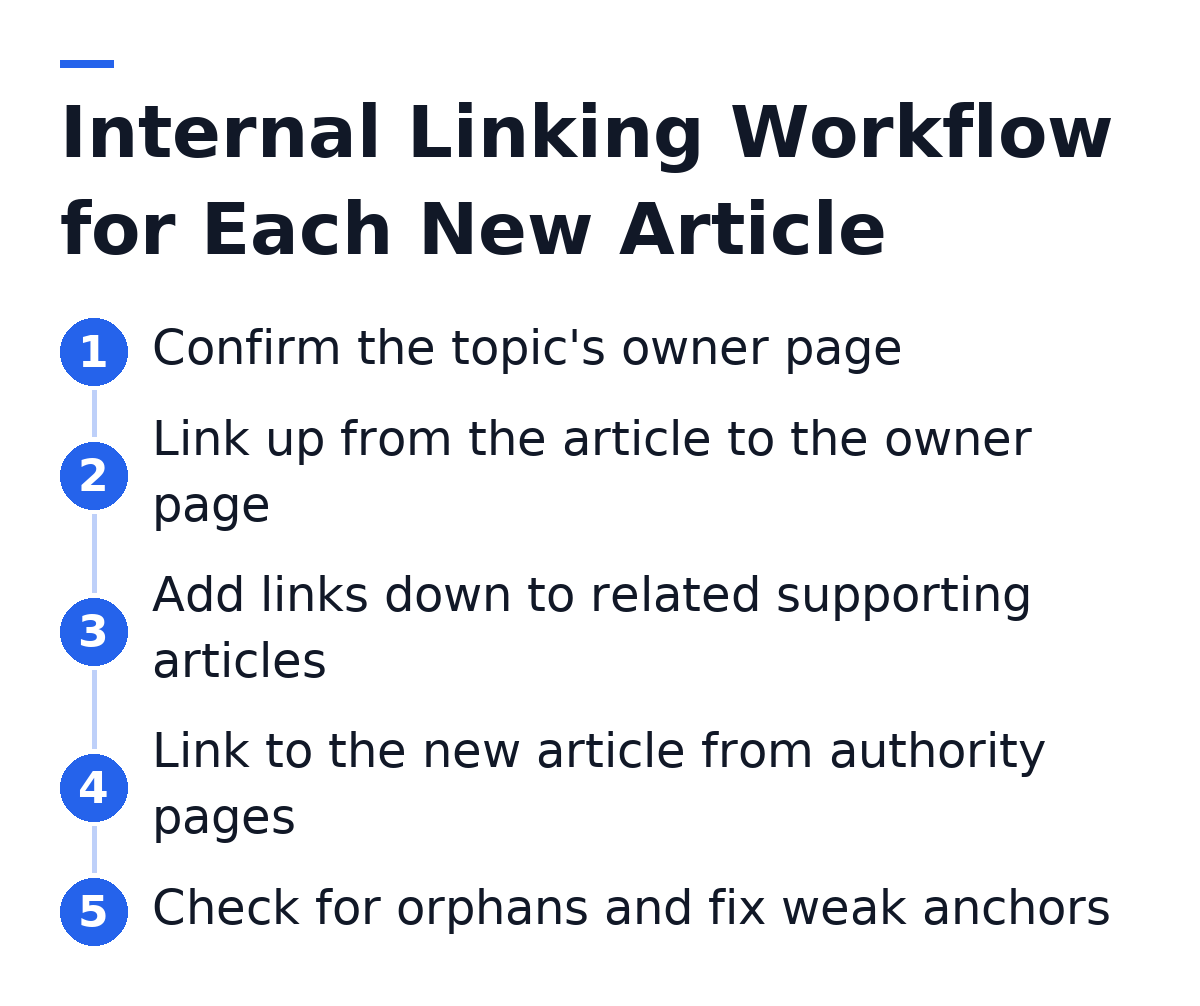
Topic groups only work when the links run both ways. Group articles by topic, with one broad page and several narrower pages under it. Each narrow article links up to the broad page, and the broad page links down to each narrow article. Narrow articles that cover adjacent questions should also link sideways to each other where it helps the reader.
Two-way links tell Google that the pages form a coherent body of coverage on one subject, which supports the broad page for competitive terms. For AI assistants, a dense set of related pages gives the model more of your own content to draw from when it assembles an answer, and makes your domain look like a source with depth on that subject instead of a single post.
How the Main Linking Approaches Compare
The comparison below shows why a structured topic model beats ad hoc linking on almost every point that matters to a small team.
| Approach | Effort to maintain | Signal to Google | Signal to AI assistants |
|---|---|---|---|
| Ad hoc links added while writing | Low at first, grows messy | Weak and scattered | Unclear which page owns a topic |
| Navigation and footer only | Low | Weak, treated as boilerplate | Often ignored in extracted passages |
| Topic groups with two-way links | Moderate, needs a map | Strong topical relevance | Clear owner page with depth behind it |
| Automated related-post widgets | Low | Moderate, relevance varies | Weak without descriptive context |
8. Connect Blog Content to Product and Integration Pages
Informational traffic needs a path to the product. A post about reducing churn should link to the churn analytics feature page. A tutorial on syncing data between two tools should link to the integration page for that pair. Place those links where the problem is described, so the product page reads as the next step instead of an ad.
This passes authority from content that earns links to pages that rarely earn them on their own. It also matters for AI answers: when an assistant reads a guide on your domain and finds a clear, relevant link to the feature that solves the problem, the connection between your brand and that use case is stated on the page. That makes it easier for the assistant to name your product when a buyer asks a related question.
9. Cap the Number of Links So Each One Means Something
More links dilute each link. There is no fixed limit, but a page with dozens of body links to loosely related posts signals nothing. Link where the reader would genuinely want to go next. If a paragraph has three links, ask which one the reader actually needs and cut the rest. Never link the same target twice from one article with different anchors.
Each link on a page shares the authority that page passes on, so restraint concentrates value on the links that remain. Readers click fewer links on cluttered pages, and AI systems reading a passage packed with links get a muddier picture of what the page is about.
10. Write the Sentence Around the Link for AI Readers
The surrounding sentence should make sense if it is quoted alone. AI assistants lift passages, not pages. A sentence like "We covered this before, see here" means nothing out of context. A sentence like "Usage-based pricing works best when your onboarding flow shows customers their consumption from day one" stands on its own and makes the link relevant to anyone reading it.
Self-contained sentences around links help Google read the anchor in context and help AI systems quote your passage accurately. The habit is the same one that makes content easy to cite in general: one idea per sentence, no pronouns that reach back across a heading. Writing tools vary a lot in how well they produce this, and that difference shows up in any comparison of the best AI writing tools for SEO and AI search.
11. Re-Link Every Time You Publish or Refresh
Internal linking is a recurring task, not a launch task. Every new article needs inbound links from older pages, or it starts life as a near-orphan. Every refresh is a chance to add links to newer content the original version could not reference. Build both steps into your publishing checklist so they happen every time, not when someone remembers.
Older pages usually hold more authority than new ones, so linking back into old content is how new articles get crawled and ranked quickly. For a small team this is the step that slips first, because it means editing pages nobody is assigned to. That is where tooling earns its place: a capable assistant (the trade-offs are compared in our ranking of the best AI writing assistant options) can suggest links, but someone still has to place them and keep the map current.
- After publishing, add links to the new article from two to five related older pages.
- During each refresh, scan for newer articles the page should now reference.
- Recheck anchors after any URL change and update redirects.
- Run an orphan check on a regular schedule.
Taken together, these eleven practices turn internal links from scattered references into a structure that tells Google which page owns each topic and gives AI assistants a clear, well-connected source to cite. The work is simple. Doing it consistently on every article, every month, is where small teams usually fall behind.
Related: SEO Content Creation in 2026: What Ranks and Gets Cited
Gofylo publishes 10 to 30 articles a month to your CMS with internal links, schema markup and FAQ blocks built in, refreshes pages that sit just off page one using your Search Console data, and tracks which businesses six AI assistants name for your buyers' searches. Plans start at $149 a month. Start the 7-day free trial, or run the free AI Visibility report to see which pages to write first.