A page can target the right keyword, sit on a fast site and still go nowhere. I see this constantly in B2B SaaS blogs: well-written articles that rank on page three, never appear in an AI answer, and slowly lose the little traffic they had. The writing is usually fine. What is missing is optimization: the work of shaping a page so that a search engine and an AI assistant can both understand it, trust it and pull from it.
This explainer breaks SEO content optimization into the signals that actually move a page. I cover what each signal is, why it matters to Google, why it matters to assistants like ChatGPT and Claude, and how the pieces fit together as a system instead of a checklist. If you run content at a startup with a small team, or no team at all, the goal is to give you a working model you can apply to every page you publish.
SEO content optimization is the process of improving a page's content, structure and supporting signals so it matches what the searcher needs, ranks in Google's results and is easy for AI assistants to quote and cite. It matters most to teams that depend on organic discovery for pipeline: SaaS founders, content and SEO managers, demand generation teams and solo builders without a writing staff.

Where Optimization Sits in the Life of a Page
Optimization happens at three points in a page's life: before writing, during writing and after publishing. Most teams only think about the middle one, the moment someone runs a draft through a grader and adds a few missing terms. That is the least valuable of the three.
Before writing, optimization is a set of decisions: which query the page answers, which reader it serves, what the page must contain to beat what already exists, and how it connects to the rest of the site. A good seo content brief captures those decisions so the writer, human or AI, does not have to guess. If the brief is wrong, no amount of later polishing fixes the page.
During writing, optimization is about form. The answer goes near the top. Sections follow the order a reader's questions arise. Claims carry evidence. Headings describe what is under them. This is where a page becomes easy to scan for a person and easy to parse for a machine.
After publishing, optimization becomes maintenance. Search Console shows which queries the page actually earns impressions for, which often differ from the ones you targeted. AI assistants start answering your buyers' questions, and you can see whether they name you or a competitor. Pages decay as competitors publish and facts age. The post-launch phase is where most of the compounding happens, and it is the phase small teams most often skip.
- Pre-writing: query choice, intent, scope, angle, internal link targets
- Writing: answer placement, section order, evidence, headings, formatting
- Post-publishing: query drift, AI mention tracking, decay, refresh and re-linking
Intent Match Is the Signal Everything Else Depends On
Intent match means the page delivers the type of answer the searcher expected when they typed the query. It is the first filter. A page that misreads intent cannot be rescued by better keywords, more words or more links, because Google measures satisfaction and AI assistants pick sources that answer the question asked.
In B2B SaaS, intent errors tend to follow a pattern. A team writes a long educational piece for a query where buyers want a comparison. Or they publish a product page for a query where readers want a definition first. Or they write a how-to for a query where the reader already knows how and wants to choose a tool. Each mismatch shows up the same way: impressions without clicks, or clicks followed by quick returns to the results page.
Intent has more layers than the usual informational, commercial and transactional labels suggest. For a SaaS buyer, I find it useful to check four things about any query before optimizing the page that targets it.
- Format: does the reader expect a definition, a walkthrough, a comparison, a template or a pricing breakdown?
- Depth: is this a person learning the category, or a technical buyer who already knows it and wants specifics?
- Stage: is the reader exploring a problem, shortlisting vendors or validating a decision they have mostly made?
- Angle: does the reader care about cost, speed, integration effort, risk or results?
AI search adds a twist. When someone asks ChatGPT or Claude a question, the phrasing is longer and more specific than a typed query. A buyer might ask which content platform publishes to Webflow and refreshes old posts, where they would have typed two or three words into Google. Optimizing for intent in 2026 means writing for both the short query and the long conversational version of the same need. In practice, that means stating the specific situations your page covers in plain language, so a long prompt has something precise to match.
Coverage and Information Gain
Coverage is how fully a page addresses the topic its reader expects. Information gain is what the page adds that other pages on the same topic do not. Google rewards both, and AI assistants depend on both: coverage gets a page retrieved, information gain gets it chosen over near-identical sources.
Topical completeness
A page is topically complete when a reader does not need to open a second tab to finish understanding the subject at the depth they came for. For an article about onboarding emails, completeness might mean covering timing, segmentation, the first email's job, activation metrics and common failure points. Missing one of those leaves a gap, and gaps send readers back to the results page.
Completeness is not the same as length. A tightly scoped page can be complete in a modest number of words. A sprawling page can be long and still miss the one subtopic the reader needed. The test is whether the subtopics a knowledgeable person would expect are present, in an order that makes sense.
This is also where most term-based optimization tools focus. They compare your draft against top-ranking pages and flag related terms you have not used. That comparison is useful as a gap check. Used as a target, it pushes every page toward the same average, which is the opposite of what makes a page worth citing.
Information gain
Information gain is the part of your page a reader could not get elsewhere. For SaaS teams, the best sources of it are usually sitting inside the company already.
- Product data: what your own usage or support logs show about how customers actually behave
- Implementation detail: the specific steps, settings or edge cases your team has seen in real deployments
- Opinion with reasons: a clear position on a trade-off, with the reasoning a practitioner would use
- Worked examples: a before-and-after of a real page, workflow or configuration
- Failure stories: what went wrong for a customer or for your own team, and what changed afterward
AI assistants make information gain more important, not less. When ten pages say the same thing, an assistant can summarize the consensus without naming any of them. When one page contains a specific, well-stated fact or method that others lack, that page is the one the assistant needs to cite to support the claim. Unique substance is what turns a page from background material into a named source.
Structure That Machines Can Lift
Structure is how the page is organized into headings, paragraphs, lists and tables. Good structure lets a reader scan, lets Google understand which part of the page answers which question, and lets an AI assistant extract a clean passage without dragging in unrelated text.
The most important structural habit is answer-first writing. When a heading poses a question, the paragraph directly under it answers that question in one to three sentences. Context, nuance and examples follow. This matches how Google selects featured snippets and how retrieval systems behind AI assistants score passages: the passage that contains the direct answer, close to the question, wins.
A second habit is self-contained paragraphs. A paragraph that begins with a pronoun pointing back across a heading, like "This is why it matters", makes sense on the page but breaks when lifted out of it. An assistant quoting that paragraph has no idea what "this" refers to. Naming the subject in each paragraph's first sentence costs a few words and makes every passage quotable on its own.
- Headings that describe their section precisely, so they work as labels out of context
- One idea per paragraph, with the subject named in the first sentence
- Lists when a section names several parallel items, such as components, signs or steps
- Tables when the reader compares options on the same points
- Definitions stated plainly near the top, in a single sentence that could stand alone
- Short declarative sentences for the core claims, with nuance in the sentences that follow
Structure also signals scope. A clear heading hierarchy tells both Google and an assistant which subtopics the page covers and how they relate. H2s mark the main concepts. H3s mark the parts of a concept. When a page uses headings for visual styling instead of meaning, that signal turns into noise.
How AI Assistants Decide What to Cite
AI assistants cite pages that they can retrieve for the question and that contain a passage clearly supporting the answer they want to give. Ranking well on Google helps with the first part, because several assistants draw on web search results. The second part depends on how your content is written.
Retrieval comes first
When an assistant searches the web to answer a question, it issues one or more queries, collects candidate pages and breaks them into passages. A page that never appears in those candidate sets cannot be cited, however good it is. This is the main reason traditional SEO still matters for AI visibility: indexation, crawlability, relevance to the query and the authority signals that help a page surface in search results all feed retrieval.
Assistants also tend to rewrite a buyer's question into several narrower searches. A question about the best way to scale SaaS blog output might become searches about content automation, publishing workflows and AI writing quality. Pages that cover those adjacent angles, and link between them, give the assistant more ways to find you.
Extractability decides the quote
Once a page is retrieved, the assistant looks for a passage it can use. Passages that state a fact or a definition directly, name their subject and stay on one idea are easy to use. Passages that hedge, wander or depend on surrounding context are harder, so the assistant moves to another source.
- A direct answer to a specific question, placed under a heading that asks it
- Named entities: product names, integrations, standards and categories stated explicitly
- Specific claims an assistant can attribute, such as how a feature behaves or what a plan includes
- Comparisons stated plainly, with the dimension of comparison named
- Consistency with other trusted sources on the facts, plus something those sources lack
There is a measurable gap between being mentioned and being cited. An assistant might name your brand in an answer without linking your page, or cite your page for a definition without recommending your product. For a SaaS team, the commercial question is narrower: when buyers ask an assistant which tools solve their problem, does your company appear, and which competitors appear instead? Optimizing for that question means publishing pages that clearly state what your product does, for whom, and how it compares, on the exact topics buyers ask about.
Entities, Evidence and Trust
Entities are the specific, identifiable things a page talks about: companies, products, people, standards, integrations and concepts. Search engines and language models both organize knowledge around entities, so a page that names them precisely is easier to place in context than a page that speaks in generalities.
For a SaaS company, the entity work starts with your own brand. Your product name, category and core capabilities should be stated the same way across your homepage, product pages, documentation and articles. When an assistant sees consistent descriptions of what your product is and does, it has more confidence repeating them. Inconsistent naming, or product pages that never say plainly what the product does, leave the assistant to guess or to describe a competitor instead.
Evidence is how a page supports its claims. A claim with a named source, a worked example or a specific product behavior behind it is more credible to a reader and more usable to an assistant. A claim with no support, especially a number with no source, is a liability. Readers distrust it, and assistants are increasingly cautious about repeating unsupported figures.
- Authorship: a named author or team with relevant experience, stated on the page
- Sourcing: claims linked to original sources, not to pages that summarize them
- Specificity: concrete product behavior, settings and outcomes instead of generic benefits
- Freshness: dates and facts that reflect the state of things in 2026, with older context labeled as history
- Consistency: the same facts about your product stated the same way across the site
Never publish a statistic you cannot trace to its original source. An unsupported number weakens the page for readers, and an AI assistant that cannot verify it has a reason to cite someone else.
The On-Page Elements That Still Do Work
Title tags, meta descriptions, URLs, headings, schema markup, image alt text and internal links are the classic on-page elements. They still matter in 2026, though their jobs have shifted. Each one is a label that helps a machine understand what the page is and where it fits.
Title tags and meta descriptions. The title is the strongest single relevance signal you control and the first thing a searcher reads. It should describe the page's actual angle in plain words. The meta description does not drive rankings directly, but it shapes clicks, and a click-through rate that stays low tells you the title and description are promising something the searcher did not want.
Headings. Headings carry the page's outline into search and AI systems. Descriptive headings that could work as standalone labels help passage-level understanding. Clever or vague headings waste that signal.
Schema markup. Structured data gives search engines an explicit statement of what the page contains: an article, an FAQ, a product, an organization. It does not guarantee rich results, but it removes ambiguity about the page type and its key facts.
Here is a minimal FAQ schema block of the kind an article can carry in its head. It states one question and one answer in a format search engines read directly.
<script type="application/ld+json">
{
  "@context": "https://schema.org",
  "@type": "FAQPage",
  "mainEntity": [{
    "@type": "Question",
    "name": "What is SEO content optimization?",
    "acceptedAnswer": {
      "@type": "Answer",
      "text": "The process of improving a page's content, structure and signals so it ranks and gets cited by AI assistants."
    }
  }]
}
</script>
The @context line tells the parser which vocabulary is in use. The @type of FAQPage declares the page type. The mainEntity array holds each question, with the question text in name and the answer under acceptedAnswer. The answer text should match what is visible on the page word for word or close to it, because markup that contradicts visible content is a trust problem.
Internal links. Links between your own pages tell search engines which pages are related and which matter most, and they give AI retrieval systems paths to adjacent content. Thoughtful internal linking also keeps readers on the site long enough to move from an educational page toward a product page. Anchor text should describe the destination, and every new article should both link out to and receive links from related pages.
Optimization as a Loop, Not a Launch Task
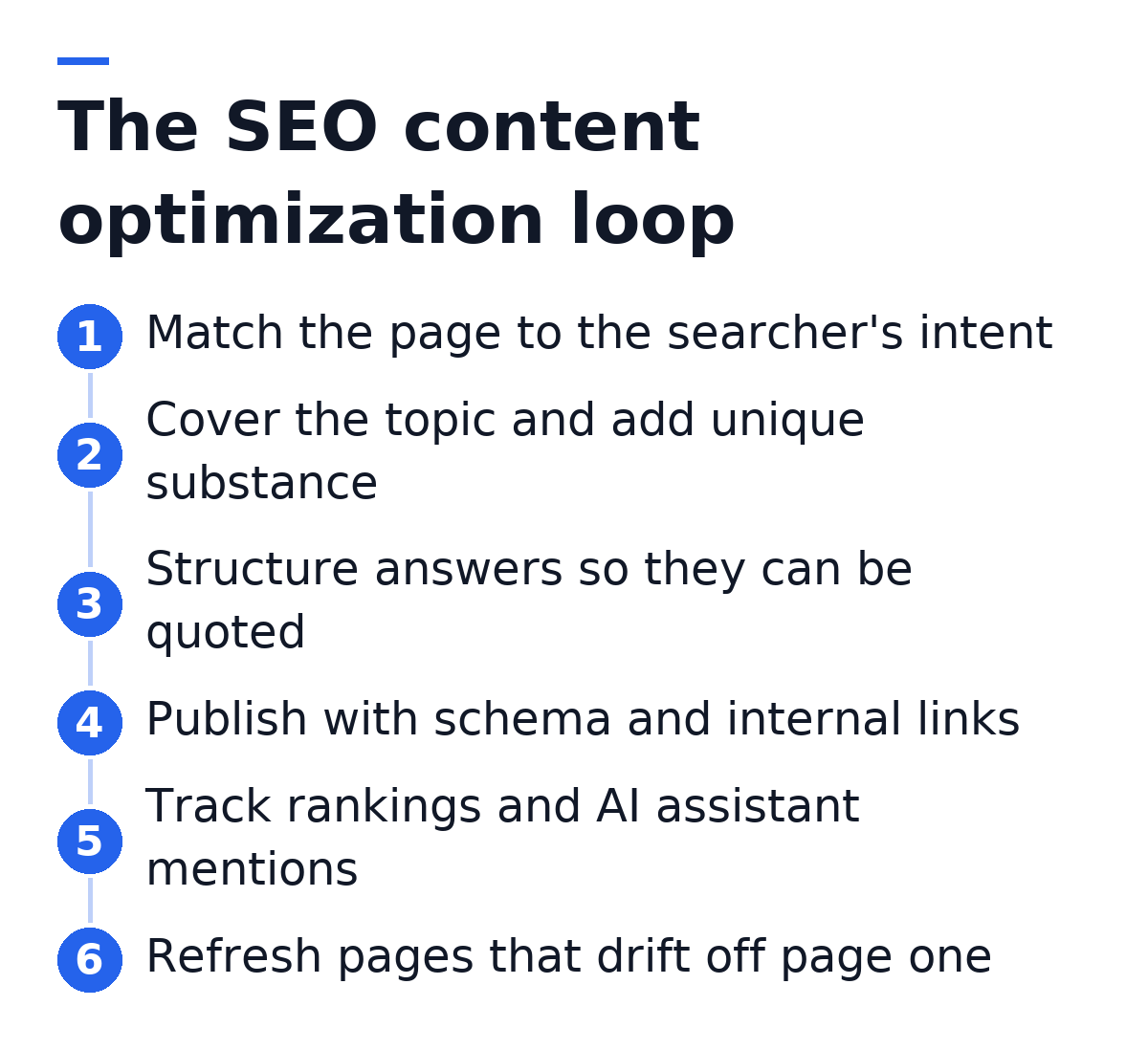
SEO content optimization works best as a continuous loop: publish, measure, diagnose and refresh. A page is never finished, because the search results around it, the questions buyers ask and the answers AI assistants give all change after it goes live.
The loop starts with data you already have. Google Search Console shows each page's impressions, clicks, average position and the queries driving them. The most useful pattern to look for is a page sitting just off page one, with steady impressions and few clicks. That page has proven relevance. It usually needs a sharper answer, a missing subtopic, a better title or stronger internal links, not a rewrite from scratch.
Query drift is the second pattern. A page targeting one phrase often ends up earning impressions for related phrases you never planned for. Those queries tell you what readers and Google think the page is about. Sometimes the right move is to add a section that serves them directly. Sometimes the drift shows that the queries deserve their own page.
Decay is the third. A page that ranked well can slide as competitors publish fresher, deeper pages, as product details change or as facts go out of date. Decay is slow, so it is easy to miss without a regular review. The fix is a refresh: update facts and examples to 2026, add what the newer competing pages cover, tighten the answer at the top and recheck links.
- Pages near page one with steady impressions and a low click-through rate
- Pages earning impressions for queries they do not directly answer
- Pages losing position or clicks over several months
- Pages whose product details, screenshots descriptions or pricing references are out of date
- Topics where AI assistants name competitors and never name you
The AI side of the loop needs its own measurement. Search Console tells you nothing about whether ChatGPT or Claude names your company when a buyer asks for a recommendation. Tracking that means running your buyers' real questions through the assistants on a schedule and recording who gets named and which sources get cited. The gaps, topics where competitors appear and you do not, are the clearest list of pages to write or strengthen next.
One more practical point: keep the previous version of any page you refresh. Refreshes usually help, but not always. If a revised page loses position, being able to restore the earlier version quickly turns a risky change into a safe experiment.
What Optimization Tools Measure, and What They Miss
Optimization tools measure proxies. Content graders compare a draft's terms and headings against top-ranking pages. Rank trackers report positions. Site auditors flag technical issues. Search Console reports impressions and clicks. AI visibility trackers record what assistants say. Each one sees a slice of the picture.
Term-based graders are the most common category and the easiest to over-trust. A high score means your draft uses vocabulary similar to pages that already rank. That is a useful sanity check for missing subtopics. It says nothing about whether the page answers the question better, contains anything original or is structured so an assistant can quote it. Chasing a score to the maximum tends to produce pages that read like averages of their competitors.
- Graders measure term and topic overlap, and miss originality and answer quality
- Rank trackers measure position, and miss clicks, intent fit and AI citations
- Search Console measures impressions, clicks and queries, and misses what assistants say
- AI visibility trackers measure mentions and citations, and miss on-page quality
- Technical auditors measure crawlability and errors, and miss content substance
The practical lesson for a small team is to treat tools as inputs to judgment. A grader can tell you that competing pages all cover integrations and you do not. Only someone who understands the buyer can decide whether integrations belong on this page or on a separate one, and what your page should say about them that the others do not.
What an Optimized SaaS Page Looks Like in Practice
Concrete examples make the signals easier to see. Here are three common SaaS page types, each described before and after optimization. None of them required a total rewrite.
A feature explainer that buried its answer. A project management startup had an article explaining resource allocation. The first four paragraphs discussed why planning is hard before the page defined the term. After optimization, a one-sentence definition sat under the first heading, followed by a short list of the components of resource allocation and a worked example using a fictional five-person team. The rambling introduction became two sentences. The page's substance barely changed. Its usefulness to a reader skimming for the answer, and to an assistant looking for a quotable definition, changed a lot.
A comparison page with no comparison. An analytics company published a page targeting an alternatives query. It described its own product at length and mentioned competitors only in passing. Readers wanted a side-by-side. The optimized version added a table comparing options on the same points (setup effort, data sources, pricing model, best-fit team size), stated plainly where each option was strongest and kept the product's own pitch to a clear section of its own. The honest framing made the page a credible source, which is exactly what an assistant needs before it repeats a recommendation.
An integration page that never named the integration's details. A billing tool's integration page said the product "connects seamlessly" with a popular CRM. It never said which objects synced, in which direction or how often. The optimized page listed the synced objects, the sync direction, the setup steps and the known limitations. Buyers asking an assistant whether the tool syncs invoices to that CRM now had a page that answered the question precisely.
In each case, the optimization came from asking what the reader needed at that moment and whether the page delivered it in a form that could be read quickly and quoted cleanly. The same question applies to every page on a SaaS site, and it is the core of good content optimization at any scale.
Manual Workflows Versus Autonomous Systems
The hardest part of SEO content optimization for a small team is keeping the loop running, not understanding it. Every signal above needs ongoing attention: briefs, drafts, structure, schema, links, Search Console reviews, AI mention tracking and refreshes. A founder or a two-person marketing team can do it for a handful of pages. Doing it across a growing library, month after month, is where manual workflows break.
I think about content operations in three models. A fully manual workflow puts every step on people. A tool-assisted workflow gives those people better data and drafting help, but they still prompt, review, format, link and publish each piece. An autonomous system has software agents research, write, structure, link, publish and refresh articles on their own, with people setting direction and reviewing output. The comparison below shows where each model holds up and where it strains.
| Model | Who does the work | Where it strains | AI visibility coverage |
|---|---|---|---|
| Fully manual | Writers, editors and an SEO lead | Output and refresh cadence limited by headcount | Usually untracked |
| Tool-assisted | People prompting and editing with software support | Every article still needs human prompting and publishing | Tracked separately, if at all |
| Autonomous system | AI agents, with people setting direction | Needs clear brand and content settings up front | Built into the same loop |
The structural difference is where the loop's attention comes from. In manual and tool-assisted models, every refresh and every new article waits for someone to have time. In an autonomous model, the system watches the data and acts on it, so the loop keeps running when the team is busy shipping product.
This is the model Gofylo is built on. Gofylo tracks how AI assistants, including ChatGPT and Claude, answer the searches your buyers make and shows where they name competitors instead of you. Its content engine then researches, writes and publishes articles aimed at those gaps, up to 30 articles a month on the Business plan, with each article taking a few minutes to produce. Articles ship with schema markup, internal links, FAQ blocks and verified source citations, in 18+ languages, straight to CMSs such as WordPress, Webflow, Shopify, Ghost and Framer. Published pages that sit just off page one are rewritten from your Search Console data, and the earlier version is kept so you can restore it.
Autonomy does not remove judgment. The output reflects the direction you give it: your audience, tone, product facts and topics to avoid. In Gofylo those choices live in Content Settings, and getting them right at the start matters more than any single article, because every article afterward inherits them.
Related: SEO Content Creation in 2026: What Ranks and Gets Cited
Frequently Asked Questions
What is SEO search engine optimization in digital marketing?
SEO is the practice of improving a website so it appears in unpaid search results for the queries its buyers use. In digital marketing, it is the channel that builds compounding, long-term traffic, alongside paid ads, email and social. In 2026 it also overlaps with optimizing for AI assistants, because many of those assistants retrieve and cite pages that search engines already index and rank.
Is SEO dead or evolving in 2026?
SEO is evolving in 2026, not dead. Buyers still search Google, and AI assistants still depend on crawlable, well-ranked web pages for much of what they cite. What has changed is the target: a page now needs to rank and also be written so an assistant can lift a clear answer from it. Teams that optimize for both get found in both places.
Can ChatGPT do SEO?
ChatGPT can help with parts of SEO, such as drafting, outlining, suggesting headings and rewriting passages. On its own it does not see your Search Console data, track your rankings, publish to your CMS, maintain internal links across your site or monitor how AI assistants describe your brand over time. Those jobs need a system connected to your site and data, with a person or an autonomous workflow running the loop.
Want to see where AI assistants recommend your competitors instead of you? Start with Gofylo's free AI Visibility report to find the gaps, then try any plan free for 7 days and let Gofylo research, write, publish and refresh the articles that close them.