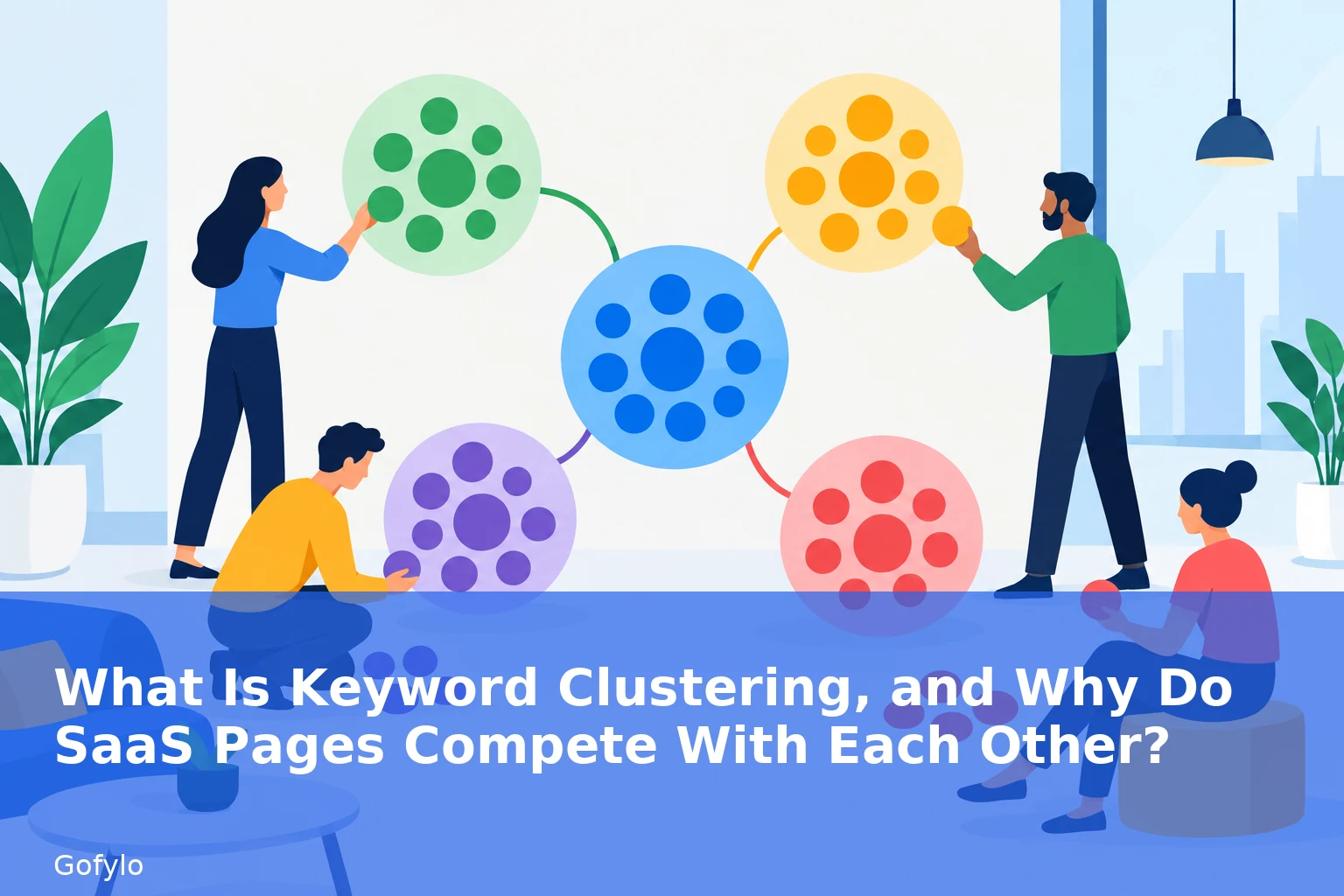
What is keyword clustering? It is the practice of grouping search terms that share the same intent so that one page answers all of them, instead of several pages splitting the work. If you run content for a SaaS product, you have probably felt the problem before you had a name for it. You published a page on "SOC 2 automation," then another on "automated SOC 2 compliance," then a third on "SOC 2 compliance software." Months later none of them sits on page one, the rankings swap places from week to week, and nobody can say which URL is supposed to win.
That confusion has a cost. Each duplicate page took writing time, each one splits the links and engagement a single page would have collected, and each one gives Google and AI assistants a muddier signal about what your site is the best answer for. I have seen small teams publish forty articles and end up with roughly a dozen real topics, competing with themselves for the other twenty-eight slots.
Keyword clustering is the step after keyword research where you sort your keyword list into small groups, each group mapped to one page, so every page owns one search intent. It matters most to lean SaaS teams who publish steadily and need each article to win a distinct query instead of competing with the last one.

Why SaaS Sites End Up Competing With Themselves
Most cannibalization starts with a reasonable habit: treating each keyword in a spreadsheet as its own article idea. Keyword tools export phrases one row at a time, and a content calendar built from that export inherits the same shape. The spreadsheet does not tell you that two rows are the same question asked in different words.
SaaS categories make this worse. Product language is unsettled, so buyers search for the same thing many ways. A team selling an onboarding tool sees "user onboarding software," "product tour tool," "in-app onboarding platform" and "customer onboarding app" in the same export. Some of those are one intent. Some are not. Without a deliberate grouping step, the calendar treats them all as separate.
- Keyword exports list phrases, not intents, so near-duplicates look like new opportunities.
- Different writers or freelancers pick up overlapping rows without seeing each other's drafts.
- Product marketing renames features, creating fresh phrasing for an existing topic.
- Old posts are never retired or merged, so new pages stack on top of them.
- Volume targets reward article count, which also rewards splitting one topic into several pages.
The Definition, Stated Precisely
The standard description is short. According to the Wikipedia entry on keyword clustering, after keyword research, search engine professionals cluster keywords into small groups which they spread across pages of the website to achieve higher rankings. Two details in that description are worth noticing. The groups are small, and they are spread across pages: the output is a page map, not a longer list.
In practice a cluster has three parts. There is a primary keyword that names the page, a set of secondary keywords that the same page should also rank for, and an intent label that explains why they belong together. If you cannot write the intent label in one sentence, the cluster is probably two clusters.
Intent Is the Unit, Not the Phrase
Two keywords belong in the same cluster when one page can fully satisfy both searchers. Word overlap is a weak guide. "Churn rate formula" and "how to calculate churn" share almost no words, yet they want the same page. "Churn software" and "churn rate formula" share a word and want completely different pages: one is a buyer comparing tools, the other is an analyst who needs a calculation.
This is why clustering sits inside a wider keyword seo strategy rather than replacing it. Research tells you which demand exists. Clustering decides how that demand maps to URLs. The questions I ask of any two candidate keywords are simple:
- Would the searcher be happy landing on the same page for both?
- Does the expected format match (a definition, a tutorial, a comparison, a pricing page)?
- Is the buyer at the same stage, learning the problem or choosing a vendor?
- Would one page answering both need to bury half of its content to stay coherent?
How Clusters Get Built: Two Methods
There are two main ways to decide which keywords belong together, and most mature workflows combine them. One trusts what Google already ranks. The other trusts the meaning of the words.
SERP-overlap clustering
SERP-overlap clustering groups keywords when their search results share URLs. If the top ten results for "product tour tool" and "in-app walkthrough software" contain many of the same pages, Google is treating the two queries as one intent, and one page of yours can compete for both. Teams usually set a threshold, such as a minimum number of shared URLs, and tune it by spot-checking groups by hand.
The strength of this method is that it reflects how Google actually behaves. The weakness is cost and drift: it needs live result data for every keyword, and the grouping changes when the results change.
Semantic and NLP clustering
Semantic clustering groups keywords by meaning, typically by turning each phrase into a vector embedding and grouping phrases that sit close together. It is fast and cheap on large lists, and it catches synonyms that share no words. Its weakness is the mirror image of SERP overlap: two phrases can mean nearly the same thing to a language model while Google serves them very different results, for example a "what is" query against a "best tools" query on the same subject.
The table below sets out where each method holds up.
| Method | What it groups on | Strength | Weakness |
|---|---|---|---|
| SERP overlap | Shared ranking URLs | Mirrors Google's intent reading | Needs live data, shifts over time |
| Semantic / NLP | Meaning of the phrase | Fast on large lists, catches synonyms | Can merge different intents |
| Hybrid | Meaning first, then SERP check | Balances cost and accuracy | More steps to maintain |
What a Finished Cluster Map Looks Like
A finished cluster map is a table with one row per page. Each row holds the primary keyword, its secondary keywords, the intent, the content format and either an existing URL or a note that the page still needs writing. Here is a small slice for a hypothetical churn analytics product:
cluster_id,primary_keyword,secondary_keywords,intent,format,url
C01,churn rate formula,how to calculate churn|churn calculation example,learn,explainer,/blog/churn-rate-formula
C02,churn analytics software,churn prediction tool|customer churn platform,choose vendor,comparison,new
C03,reduce saas churn,how to lower churn|churn reduction tactics,solve problem,guide,/blog/reduce-churn
C04,net revenue retention,nrr meaning|nrr benchmark,learn,explainer,new
The first line is the header. Each following line is one page. C01 merges two phrasings of a calculation question into one explainer. C02 holds buyer queries that need a comparison page, which is a different format from C01 even though both mention churn. C03 already has a URL, so any new keyword that fits it becomes an update to that page, not a new article. C04 is a gap: real demand with no page yet.

Keyword Clusters and Topic Clusters Are Different Layers
A keyword cluster is a set of queries that one page answers. A topic cluster is a set of pages that together cover a subject and link to each other. The first operates inside a page and the second operates across a site. People often use the terms interchangeably, and the confusion leads to plans with either one bloated page or twenty thin ones.
The layers depend on each other. You cannot design a sensible set of linked pages until you know how many distinct intents exist, and that count comes from keyword clustering. Once each page owns a clear intent, internal links between those pages tell search engines how your subjects relate. That relationship is also what entity work builds on: the same consistency that helps with Earning a Google Knowledge Panel helps a search engine see your site as a coherent source on one subject.
Why Clustering Matters for AI Assistants Too
AI assistants reward clustering for a reason that has little to do with classic rankings. When ChatGPT, Claude, Perplexity or Gemini answer a question, they often break it into several related sub-queries, retrieve pages for each and assemble an answer. A page that covers one intent completely, including its common phrasings and follow-up questions, matches more of those sub-queries than three partial pages do.
Google's own generative features work in a similar direction. Its guidance on AI features and your website says there are no special requirements beyond normal good SEO practice and helpful content, which means a clean, intent-focused page structure carries straight over. Anyone thinking about ai overviews seo is, in effect, thinking about whether each question has one strong page behind it.
- One complete page per intent gives an assistant a single, quotable source instead of fragments.
- Secondary keywords inside a cluster often mirror the follow-up questions an assistant asks itself.
- Consistent terminology across a cluster makes it easier for models to connect your brand to the subject.
- Fewer duplicate pages reduce the chance an assistant cites an outdated version of your answer.
Where Clustering Goes Wrong
Clustering fails in two opposite directions. Over-merging puts different intents on one page, so a definition, a vendor comparison and a tutorial fight for space and none of them is good. Under-merging keeps near-synonyms apart, which recreates the cannibalization the exercise was meant to fix.
Clustering once and never again. Results shift, products add features and new phrasings appear. A cluster map written at launch goes stale within a few quarters. New keywords should be checked against existing clusters before anyone opens a new draft.
Ignoring pages you already have. Many teams cluster a fresh keyword list and plan new articles, while the existing blog already covers half of those clusters badly. Mapping current URLs into the clusters first usually reveals merges and redirects that pay off faster than new writing.
Trusting one method blindly. Pure semantic grouping merges a "what is" query with a "best tools" query. Pure SERP overlap can split queries that Google simply has not settled on yet. Checking a semantic grouping against live results catches most of both errors.
Clustering is also only as good as the list it starts from. Solid keyword research and analysis upstream decides whether your clusters reflect what buyers search, or only what a single seed term suggested.
Related: Entity SEO: How Google's Knowledge Graph Drives Rankings
Frequently Asked Questions
What is a keyword in SEO with an example?
A keyword is the word or phrase a person types or speaks into a search engine or AI assistant, and the term a page is built to answer. For a billing platform, "usage-based billing software" is a keyword with buyer intent, while "what is usage-based pricing" is a keyword with learning intent. They would sit in different clusters on different pages.
What is clustering and its example?
Clustering is grouping items so that items in the same group are more alike than items in other groups. In SEO, an example is placing "how to calculate churn," "churn rate formula" and "churn calculation example" in one group because a single explainer page satisfies all three searchers.
How do you find your keywords?
You find keywords by combining your own Search Console queries, keyword tool data and the terms your competitors already rank for, then filtering for the ones that match what your product solves.
How many keywords per 1000 words?
There is no correct number. Google does not reward a target keyword density, and forcing repetitions makes a page read worse. A practical approach is to use the primary keyword in the title, the opening and a heading where it fits, then cover the secondary keywords of the cluster naturally where each one answers part of the question.
Clustering by hand works for a few dozen keywords. Past that, keeping the map current, mapping new demand to existing pages and refreshing the pages that slip is ongoing work that small teams rarely have time for. That maintenance is where autonomous content systems change the economics: agents that research, assign intent, write, internally link and publish without someone prompting each step, so the cluster map turns into published pages instead of a spreadsheet.
If you want to see which questions in your category have no strong page yet, start with Gofylo's free AI Visibility report: it shows which businesses AI assistants name for your buyers' searches and the pages worth writing. From there, Gofylo's Content Engine can research, write and publish up to 30 articles a month to your CMS in 18+ languages, each taking a few minutes. Every plan includes a 7-day free trial, so you can test it against your own cluster map this week.