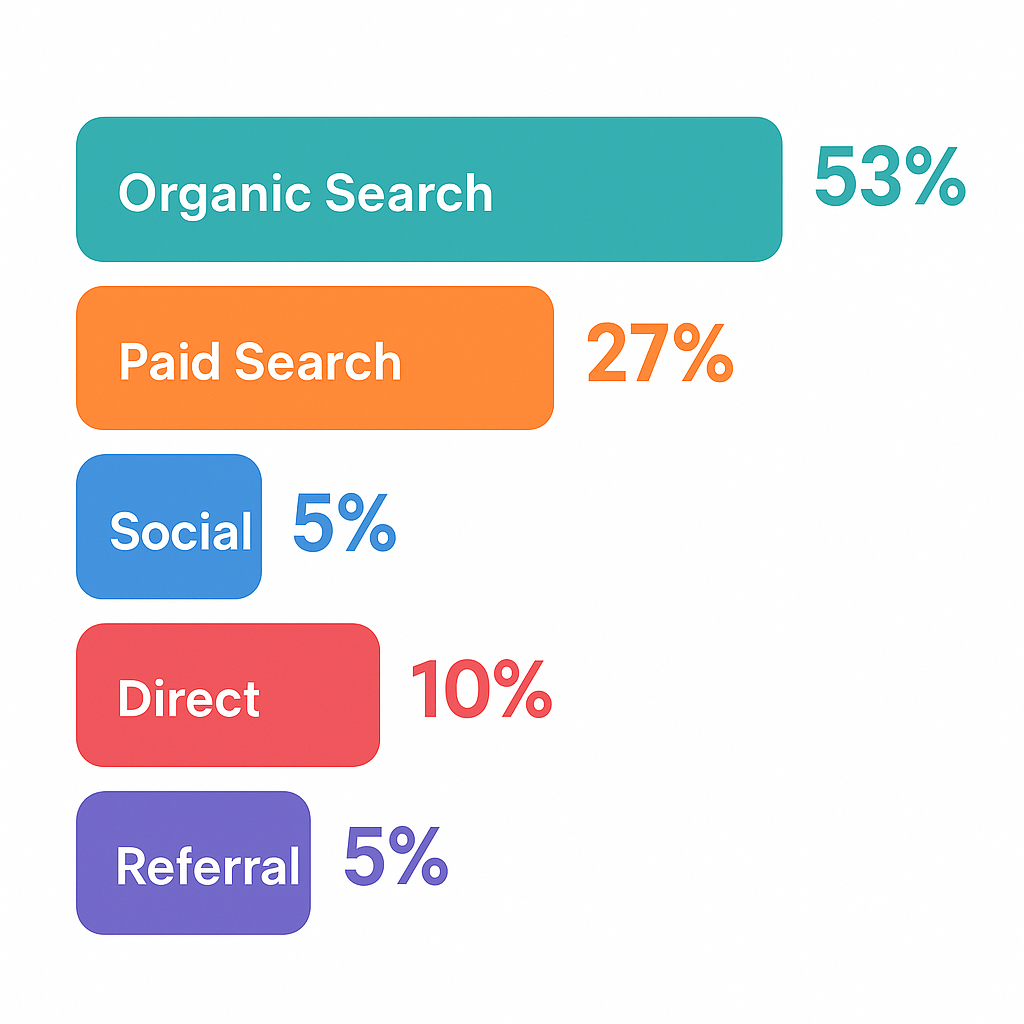
Organic traffic is the volume of visitors who arrive at your website by clicking an unpaid result in a search engine — no ad spend, no boosted post, no sponsored placement. As of 2026, this channel still dominates web acquisition: according to Sagapixel data cited by babylovegrowth.ai, organic search accounts for roughly 53% of all web traffic, nearly double the share held by paid search. For founders and marketing leads running lean teams, that ratio matters enormously — it means the majority of potential buyers are reachable without a media budget, provided you earn the ranking.
But what is organic traffic, exactly, and why does it behave so differently from every other acquisition channel? The short answer: it's the only channel where a single well-ranked page can compound returns for months or years without additional spend. In 2026, that compounding dynamic extends beyond Google to AI-powered engines — ChatGPT, Claude, Perplexity, and Gemini now surface and cite content in conversational answers, creating a second layer of organic reach that most teams aren't yet measuring.
Thesis: Organic traffic isn't just free clicks — it's a compounding asset. Once a page earns authority, it generates returns that scale independently of your marketing budget. Understanding the mechanics behind it is the prerequisite for building a strategy that actually holds.
The Precise Definition of Organic Traffic
Organic traffic refers specifically to sessions initiated by a user clicking a non-paid search result — a listing that appeared because a search engine's algorithm determined it was relevant, not because a company paid to place it there. The session begins the moment the user lands on your site from that unpaid result, and your analytics platform (Google Analytics, Search Console, or any third-party tool) logs it under the 'organic search' channel. What separates organic traffic from other unpaid channels like direct traffic (typing your URL) or referral traffic (a link on another site) is the intent signal attached to it: the user typed a query, which tells you something concrete about what they were looking for. That intent alignment is why organic search traffic tends to convert at higher rates than display or social traffic.
How Search Engines Decide Who Gets Organic Clicks
Search engines rank pages using algorithmic signals that assess relevance, authority, and experience — commonly bundled under Google's E-E-A-T framework (Experience, Expertise, Authoritativeness, Trustworthiness). When a user submits a query, the engine scores hundreds of candidate pages against those signals in milliseconds and returns a ranked list. The pages at the top of that list capture the overwhelming majority of clicks. Google's search documentation describes this process as indexing, ranking, and serving — each stage acting as a filter that determines which content earns visibility and which remains buried. For B2B SaaS companies, the practical implication is that ranking on page one requires satisfying both technical requirements (crawlability, page speed, schema markup) and content requirements (topical depth, internal linking, query-to-content alignment).
The Click Distribution Reality
Click distribution across organic results is steep and unforgiving. According to babylovegrowth.ai, 70% of search clicks concentrate in the top five organic results, leaving the bottom half of page one fighting over a fraction of available traffic. The gap between organic and paid is equally striking: the top organic result attracts 18 times more clicks than the leading paid advertisement, according to data cited by marketveep.com. These numbers explain why 'ranking on page one' is not a sufficient goal — position one and position five have meaningfully different yield, and anything below page one is effectively invisible for most queries.
- Position 1–3: captures the majority of clicks for high-volume informational and commercial queries
- Position 4–5: still valuable, but click-through rate drops sharply after position three
- Position 6–10: marginal traffic contribution; often useful only for long-tail, low-competition queries
- Page 2 and beyond: negligible click volume for most query types
- Featured snippets and AI Overviews: can capture clicks above position one, but also create zero-click results
Organic Traffic vs. Paid Traffic: The Structural Difference
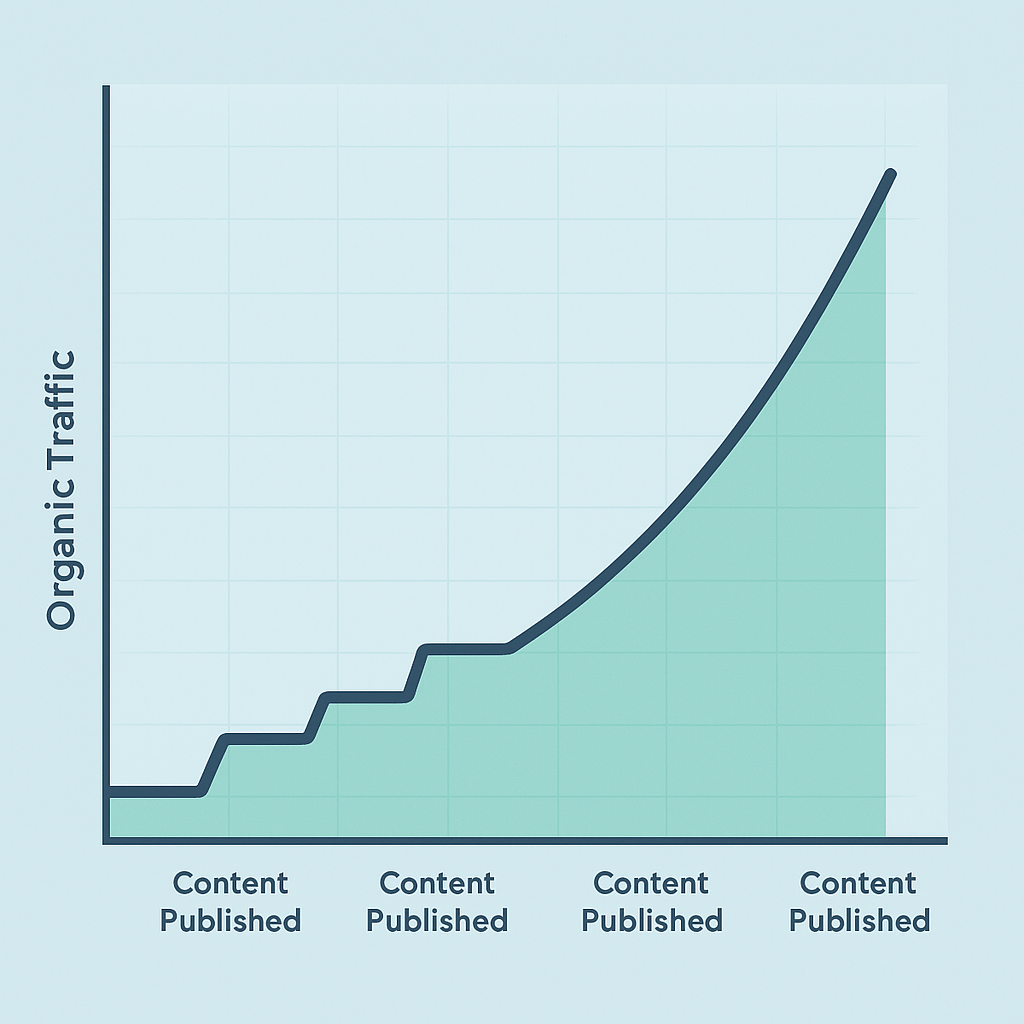
The fundamental difference between organic and paid traffic is ownership versus rental. Paid traffic — search ads, display, social promotion — delivers visitors precisely as long as you're spending. Pause the budget, and the traffic stops immediately. Organic traffic works the opposite way: you invest upfront in content and technical SEO, earn a ranking, and that ranking continues generating sessions without recurring cost. The economics look unfavorable early (content takes time to rank) and increasingly favorable over time (a ranked page amortizes its creation cost across years of traffic). This is why 49% of marketers report organic search as their most profitable channel — the ROI calculation changes once you account for the full lifetime of a ranked asset, not just the quarter it was published.
Why Organic Traffic Compounds While Paid Traffic Doesn't
Authority accumulates. Each new piece of content you publish and rank adds to your domain's topical authority. Search engines interpret a consistent body of content on a subject as a signal of expertise, which makes subsequent articles in the same cluster easier to rank. A paid campaign doesn't carry this effect — running ads for six months gives you no structural advantage in month seven.
Internal links multiply value. When you publish related articles and link them together, you distribute ranking signals across your entire content library. A new article benefits from the authority of older, established pages in the same cluster. This is the mechanical reason why topical authority SEO produces compounding returns — the system builds on itself rather than starting from zero each cycle.
Backlinks are permanent equity. When an external site links to your content, that signal persists indefinitely and continues to influence rankings. A quality backlink earned in year one still contributes to domain authority in year three. Compare this to a paid impression that evaporates the moment the campaign ends.
Indexed pages grow the surface area. Every new page you publish is a potential entry point for a different query. A site with 500 indexed articles can rank for hundreds of distinct keyword clusters simultaneously. A paid account targets only the keywords you're actively bidding on, with no carryover effect when the budget runs out.
Organic Traffic in the Age of AI Search
In 2026, organic traffic is no longer a concept confined to Google's blue links. AI-powered search engines — ChatGPT, Claude, Perplexity, and Gemini — now answer queries by surfacing and citing content from across the web. When one of these engines cites your article in a response, the user clicking through to your site is, by definition, organic traffic: no ad spend, no sponsored placement, just earned visibility based on content quality. This second layer of organic reach is what the field now calls GEO (Generative Engine Optimization), and it operates on different signals than traditional SEO. AI engines weight structured content, direct answers, FAQ blocks, schema markup, and E-E-A-T signals heavily — which means the same content investments that drive Google rankings also improve AI search visibility, provided the content is structured for citation rather than just keyword density.
Key distinction: Traditional SEO organic traffic comes from a user clicking a ranked URL. AI search organic traffic comes from an LLM citing your content in a generated answer. Both are unpaid. Both compound. Most analytics stacks only measure the first.
What Counts as an Organic Traffic Source?
The term 'organic traffic' in its strict technical sense refers to search-engine-driven sessions, but practitioners increasingly use it to describe any unpaid, earned traffic — as opposed to paid or directly acquired traffic. Understanding the boundaries matters because different analytics platforms categorize sessions differently, and misclassification can distort your channel attribution. Google Analytics 4, for example, uses UTM parameters and referrer data to assign sessions to channels. A session from a search engine without a paid campaign tag will land in the organic search bucket. A session from a social media post without a UTM tag may land in direct or organic social, depending on the platform version.
- Organic search: clicks from unpaid Google, Bing, Yahoo, or DuckDuckGo results
- AI search referrals: click-throughs from ChatGPT, Perplexity, Claude, or Gemini citations
- Organic social: unpaid post clicks on LinkedIn, Twitter/X, or other platforms
- Direct traffic: users typing your URL or arriving via untagged links — often misattributed organic
- Referral traffic: clicks from third-party websites linking to your content
- Email (organic): clicks from email campaigns are typically tracked separately and not counted as organic
How Much Organic Traffic Is Enough?
There's no universal benchmark for 'good' organic traffic because the number means nothing without context: your conversion rate, your average contract value, your competitive landscape, and your growth stage all determine what a healthy organic traffic number looks like for your business. For B2B SaaS companies, a more useful frame is whether your organic traffic is growing month-over-month and whether the sessions being generated are from queries with commercial or informational intent that maps to your product. A hundred highly qualified organic sessions from a niche B2B query can generate more pipeline than ten thousand sessions from an unrelated informational search. That said, scale matters — search visibility is a numbers game at the top of the funnel, and broader keyword coverage increases the probability of capturing buyers at multiple stages of the decision process.
The Role of Content Volume and Topical Authority
Content volume is one of the strongest levers for expanding organic reach. Each article you publish targets a distinct set of queries, and the more queries you cover in a coherent topical cluster, the more authority your domain accumulates in that space. According to Ahrefs' organic traffic methodology, the volume of ranking keywords is a primary driver of estimated organic traffic — more indexed, ranking pages means more traffic surface area. For context, consider that the average eCommerce brand ranks for approximately 1,783 keywords, driving an estimated 9,625 organic monthly visits, according to data from opensend.com. B2B SaaS sites with deep topical content libraries regularly exceed those baselines by an order of magnitude. The constraint for most teams isn't strategy — it's the operational capacity to produce content at the volume and consistency that compounding requires.
How Autonomous Platforms Change the Organic Growth Equation
The traditional objection to organic traffic as a primary growth channel is resource intensity: consistent content production at scale requires writers, editors, SEO specialists, and publishing workflows that most early-stage teams can't sustain. This is where the shift to autonomous content platforms changes the equation structurally. Rather than a manual workflow that scales linearly with headcount, an autonomous platform runs agents that handle keyword research, article generation, internal linking, schema markup, image creation, and CMS publishing without human prompts for each task. The output isn't just faster — it's systematically optimized for both traditional SEO signals and AI search citation patterns simultaneously.
Gofylo is built specifically for this use case. Its Content Engine has generated over 48,000 articles, each produced in under four minutes with E-E-A-T-compliant structure, schema markup, internal links, FAQ blocks, and AI-generated images — at a rate of 30 articles per month on the standard plan. Critically, Gofylo also tracks AI search visibility across ChatGPT, Claude, Perplexity, and Gemini through its AI Visibility Tracker, giving teams an AI Visibility Score (averaging 94 across active accounts) as a benchmark for GEO performance alongside traditional rank tracking. For a B2B SaaS team that wants organic traffic to compound without building a content department, this is the structural difference between renting traffic through paid channels and owning it through autonomous, continuously-published content.
Tools like SEMrush and Ahrefs give you excellent visibility into what's ranking and where gaps exist. What they don't do is close those gaps autonomously — publishing, optimizing, and tracking AI citations requires a separate operational layer. That's the gap autonomous platforms like Gofylo are designed to fill.
FAQ
What does the term organic traffic mean?
Organic traffic refers to visitors who arrive at a website by clicking an unpaid result in a search engine such as Google, Bing, or Yahoo — as opposed to clicking a paid advertisement. The word 'organic' signals that the visit was earned through search relevance and authority, not purchased. In 2026, the definition has expanded to include click-throughs from AI engines like Perplexity and ChatGPT that cite your content in generated answers.
How much organic traffic is good?
There's no single threshold because 'good' depends on your industry, conversion rate, and growth stage. For B2B SaaS, the more useful metric is whether organic sessions are growing consistently and whether they come from queries with commercial or informational intent that aligns with your product. A site targeting niche enterprise buyers may generate strong pipeline from a few hundred monthly organic sessions, while a broader SaaS product might need tens of thousands to move pipeline meaningfully.
What is an example of organic traffic?
A concrete example: a VP of Marketing at a SaaS startup types 'what is organic traffic in SEO' into Google, clicks the third non-sponsored result, and lands on your blog post. That session is organic traffic. A second example from AI search: a founder asks Perplexity 'what is paid traffic vs organic traffic,' and Perplexity cites and links to your explainer article in its answer — the click-through is also organic traffic, now arriving via an AI engine rather than a traditional search results page.
How do I increase my organic traffic?
The highest-leverage moves are: fix technical issues that prevent crawling or indexing; build a keyword strategy around queries your target buyers actually use; publish content with genuine topical depth and clear structure; earn backlinks from authoritative external sources; and optimize for AI search by including FAQ blocks, schema markup, and direct answers. Consistency matters as much as quality — search engines reward sites that publish regularly within a coherent topical cluster, which is why autonomous content platforms have become a practical alternative to manual workflows for teams without dedicated content staff.
What is the difference between organic traffic and direct traffic?
Organic traffic originates from a user clicking a search engine result — there's a query and a ranking involved. Direct traffic occurs when someone navigates to your site by typing the URL directly, using a bookmark, or arriving via an untagged link that analytics can't attribute to a known source. Direct traffic is often a proxy for brand awareness and repeat visitors. Organic traffic is more strongly correlated with new user acquisition from search queries.
Does organic traffic include traffic from AI search engines like Perplexity?
Technically, click-throughs from AI engines like Perplexity, ChatGPT, or Gemini show up in most analytics platforms as referral traffic (with the engine's domain as the referrer) rather than the organic search channel. However, in practice they represent earned, unpaid visibility — the same compounding dynamic as traditional organic search. In 2026, treating AI search referrals as a distinct organic channel alongside traditional search is the more accurate and strategically useful framing.
If you want to see where your brand actually stands in AI search right now — across ChatGPT, Claude, Perplexity, and Gemini — Gofylo's free AI Search Grader gives you a concrete score in minutes. And if you're ready to start compounding organic traffic without building a content team, the full platform is $79/month with a 3-day free trial, no credit card required. Start your trial at gofylo.com.