As of 2026, the phrase 'SEO AI agent' has gone from niche engineering jargon to a term appearing in board decks and quarterly OKRs. But most explanations conflate two very different things: an AI assistant that helps with SEO tasks, and an AI agent that autonomously executes an entire SEO workflow without waiting for a human prompt. Those are not the same thing, and the distinction has real consequences for how teams build organic growth engines. According to data from quickseo.ai, the agentic AI market is on track to grow from $7.6 billion in 2026 to $236 billion by 2034 — a 31x expansion — which tells you something about the structural shift underway.
If you're a founder or marketing lead at a B2B SaaS company, you're likely already using some form of AI in your content workflow. DemandSage's 2026 data shows that over 56% of marketers already use generative AI in their SEO workflows. But using AI to draft a brief is categorically different from deploying an agent that conducts keyword research, writes a fully optimized article, publishes it to your CMS, builds internal links, and then tracks whether that article gets cited in ChatGPT or Perplexity — all without a single human touchpoint. This guide unpacks the architecture, the mechanics, and the implications of SEO AI agents for teams that care about both traditional Google rankings and AI search visibility.
Core thesis: An SEO AI agent is not a smarter writing tool. It is a persistent, goal-directed system that plans, executes, and improves across the full content lifecycle — including both Google and AI search surfaces — without human orchestration at each step.
What an SEO AI Agent Actually Is
An SEO AI agent is a software system that uses a large language model (LLM) as its reasoning core and connects that core to external tools — search APIs, CMS integrations, analytics platforms, link databases — so it can plan and execute multi-step SEO workflows autonomously. Unlike a chatbot or an AI writing assistant, an agent doesn't wait for you to issue each instruction. It receives a high-level goal ('rank for these 30 target keywords this month'), decomposes that goal into subtasks, selects and calls the right tools for each subtask, evaluates the output, and iterates until the goal is met. The human sets the objective; the agent figures out the path. This goal-directed, tool-using, self-correcting loop is what separates an agent from a feature. A keyword suggestion dropdown inside your CMS is not an agent. A system that researches keyword opportunity, drafts a full article with proper schema, publishes it, and then monitors whether it earns an AI citation in Perplexity — running on its own, at 4 a.m., while you sleep — is an agent. The distinction matters because it changes what's operationally possible for small teams. You stop being the bottleneck in your own content pipeline.
The Architecture Underneath: How Agents Reason and Act
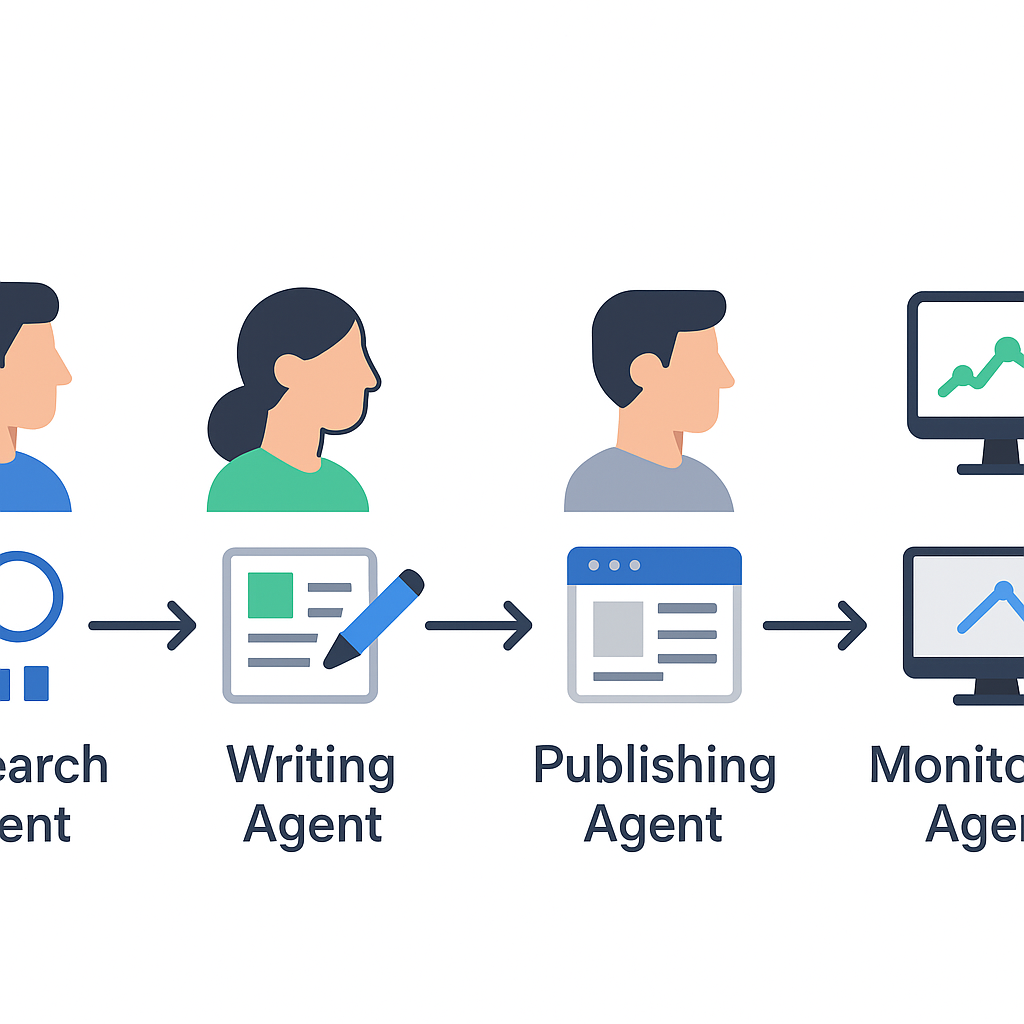
Most SEO AI agents in 2026 follow one of two architectural patterns: a single-agent loop or a multi-agent pipeline. In a single-agent loop, one LLM orchestrates all tasks sequentially — it researches, writes, optimizes, and publishes within a single reasoning chain. In a multi-agent pipeline, specialized sub-agents handle distinct phases: a research agent handles keyword clustering and competitor gap analysis; a writing agent handles content generation; a publishing agent handles CMS integration; a monitoring agent handles performance tracking and AI visibility scoring. The multi-agent approach tends to produce higher-quality outputs because each sub-agent is prompted and constrained for its specific function, rather than a generalist model trying to do everything at once. Google's own documentation on information retrieval systems has long emphasized the importance of structured, semantically coherent content — something that specialized writing agents, tuned specifically for E-E-A-T compliance, handle more reliably than a monolithic prompt chain.
The connective tissue between these agents is tool access — commonly implemented via APIs, model context protocol (MCP) layers, or orchestration frameworks. Tool access is what makes an agent genuinely useful for SEO: without the ability to call a real keyword API, read a live SERP, push content to WordPress, or query an AI visibility tracker, the agent is just a very elaborate text generator. Real SEO AI agents have tool calls embedded in their reasoning loops. When the research agent identifies a keyword cluster with strong commercial intent and low AI search coverage, it doesn't just note the opportunity — it queues the writing agent to produce the article, specifies the target entity structure, and flags the cluster for the monitoring agent to track post-publication. That handoff happens programmatically, without a human project manager in the loop.
How SEO AI Agents Differ From AI Writing Tools
The market is crowded with AI writing tools that get labeled as 'agents' for marketing reasons, so it's worth being precise. An AI writing tool — Writesonic's SEO AI Agent, Jasper, Frase, and similar products — takes a human-provided brief and generates a draft. The human still defines the topic, sets the target keyword, reviews the output, edits it, and publishes it. The AI reduces writing time but doesn't eliminate human orchestration. A true SEO AI agent starts earlier in the chain — it identifies what should be written before a human asks, generates the content, optimizes it for both structured schema and semantic entity coverage, pushes it live to the CMS, builds internal links to contextually related articles, and then monitors whether the content is getting cited by Google and by AI search engines like ChatGPT and Perplexity. The workflow isn't shortened; it's removed from the human's plate entirely. This is not a marginal productivity improvement — it's a structural change in how content pipelines operate. According to Energent.ai's 2026 industry report, teams deploying advanced AI data agents report saving an average of 3 hours per day, and that figure likely understates the effect on content-heavy teams where research, writing, and publishing account for the bulk of working hours.
- AI writing tools: require human briefs, human review, human publishing decisions
- SEO AI agents: self-initiate tasks based on keyword gaps, performance data, or competitor moves
- AI writing tools: operate on a per-document basis, one article at a time
- SEO AI agents: operate across topical clusters, managing content calendars autonomously
- AI writing tools: have no visibility into post-publication performance
- SEO AI agents: monitor rankings, AI citations, and backlink signals and adjust strategy accordingly
- AI writing tools: optimize for readability and keyword density at the document level
- SEO AI agents: optimize for topical authority, internal link architecture, and AI search citation patterns across an entire site
The meaningful comparison isn't 'AI tool vs. no AI tool.' It's 'AI tool that amplifies a human workflow vs. AI agent that replaces the workflow's orchestration layer.' For a team of two trying to compete with a company that has eight content writers, only the second option changes the structural equation.
The Seven Core Workflows SEO AI Agents Handle
The workflows that a mature SEO AI agent system handles in 2026 span the entire content lifecycle, from pre-publication strategy through post-publication performance optimization. Understanding which workflows are genuinely automatable — and which still benefit from human judgment — helps teams deploy agents where they produce the highest leverage rather than treating automation as an all-or-nothing proposition. The workflows below represent the current capability ceiling for production-grade SEO AI agents, based on what's running in real deployments rather than what's theoretically possible. Each workflow carries different ROI characteristics, and the most sophisticated agents prioritize workflows in order of their compounding effect on organic authority rather than executing them uniformly.
Keyword Research and Intent Clustering
Keyword research is the workflow where SEO AI agents deliver the most immediate, measurable advantage over manual processes. A human researcher working with Ahrefs or SEMrush can process perhaps a few hundred keywords in a focused session, identify intent patterns, and map them to a content calendar over several hours. An agent with API access to the same data sources can ingest tens of thousands of keyword variants, cluster them by semantic similarity and search intent, score each cluster by difficulty, volume, and current AI search coverage gap, and output a prioritized content roadmap in minutes. More importantly, the agent can continuously monitor keyword drift — as search behavior shifts, it identifies new opportunities and flags declining clusters without waiting for a scheduled quarterly audit. Intent clustering is particularly valuable for B2B SaaS companies because commercial-intent keywords often have lower search volumes but higher conversion relevance, and manual analysts frequently under-prioritize them in favor of high-volume informational terms that don't convert.
Content Generation and On-Page Optimization
Content generation is the most visible capability, but the sophistication varies enormously across implementations. Commodity AI writing tools generate text that passes a surface readability check but lacks the structured semantic signals that both Google's quality raters and AI search engines use to evaluate authority. Production-grade SEO AI agents generate content with proper entity coverage — named entities, their relationships, and their attributes — because that's what makes content citable by both traditional search indexes and LLM-based answer engines. They automatically incorporate FAQ schema, HowTo schema where appropriate, heading hierarchies that match topical depth expectations for the keyword cluster, and internal linking anchors that reinforce the site's topical authority graph. Gofylo's Content Engine, for example, produces fully E-E-A-T-compliant articles in under 4 minutes per piece, with schema markup, internal links, AI-generated images, and embedded YouTube videos included — not as post-processing steps but as integral outputs of the generation pipeline. That's a meaningfully different capability than 'generate a 1,500-word draft.'
CMS Publishing and Internal Linking
Publishing sounds like a trivial step, but it's where many content workflows break down at scale. An SEO AI agent that can research and write but can't push content to your CMS without a human in the loop is still creating a bottleneck. Production agents integrate directly with CMS platforms — WordPress, Webflow, Shopify, Ghost, Framer, Wix, and others — and publish structured content with correct metadata, canonical tags, and image alt text without manual intervention. The internal linking component is especially important for AI search visibility: LLMs trained on your indexed content learn your site's conceptual structure partly through its link graph. Agents that automatically build contextually relevant internal links as new content is published are continuously reinforcing your site's topical authority signals in ways that manual internal linking audits — run quarterly, if you're disciplined — simply cannot replicate at the required cadence.
AI Search Visibility and GEO Tracking
This is the workflow that most SEO tools built before 2025 don't handle at all, and it's increasingly the one that matters most. As of 2026, a growing share of informational queries that previously drove organic search traffic are being answered directly inside ChatGPT, Claude, Perplexity, and Gemini — without the user clicking through to a website. If your content isn't being cited as a source in those AI-generated answers, you're invisible to a substantial and growing portion of your potential audience. SEO AI agents with GEO (Generative Engine Optimization) tracking capabilities monitor which queries surface your brand, which articles are being cited, and what AI visibility score your domain holds across the major AI engines. Conceptually related to the ai visibility tracking tools and llm visibility tools covered elsewhere in our library, this tracking layer closes the feedback loop: the agent knows which content is being cited and can adjust generation priorities accordingly, producing more of what the AI engines are rewarding and less of what's being ignored.
Why Traditional SEO Workflows Break at Scale
Manual SEO workflows have a fundamental scaling problem that AI agents solve structurally rather than incrementally. A content team of three people can produce roughly 12 to 20 articles per month at quality levels sufficient to rank in competitive B2B SaaS categories — and that's if they're disciplined, experienced, and not pulled into other priorities. The moment a category becomes competitive, that volume is insufficient to build topical authority fast enough to outrank incumbents with larger teams and established domain authority. The standard response is to hire more writers or engage an SEO agency, both of which introduce coordination overhead, quality variability, and cost structures that don't compound. AI agents break this constraint by decoupling output volume from headcount. The AI-powered SEO Software Market is expected to reach $32.6 billion by 2035 at a CAGR of 23.4%, according to market.us — a growth rate that reflects how broadly teams are recognizing this scaling advantage.
The deeper problem with traditional workflows is latency. A human-managed content pipeline has review cycles, editorial calendars, Slack threads, and revision loops built into it by necessity. By the time a topic identified in a quarterly keyword audit becomes a published, indexed article, weeks or months may have passed — and the SERP landscape has shifted. An SEO AI agent operating continuously identifies the opportunity and publishes the content in the same session. This latency reduction is particularly valuable in fast-moving B2B SaaS categories where competitor content strategies shift frequently, new product categories emerge, and AI-generated answers displace traditional rankings on short cycles. Audit agents alone — not full SEO AI agents but the simpler subset that identifies and surfaces technical issues — return a median 11.4x over the manual baseline, according to quickseo.ai's 2026 data. That figure reflects how much latent value exists in SEO workflows that are currently blocked by human throughput constraints.
Coordination cost compounds. Every article that requires a brief, a writer assignment, an editorial review, and a publishing step has three to five human touchpoints that introduce delay and quality variance. At 10 articles per month, that's manageable. At 100, it's a project management problem that consumes more management bandwidth than it saves in writing time. Agents eliminate most of these touchpoints by design.
Quality variance is underestimated. Human content teams produce uneven quality — some articles are exceptional, some are mediocre, and the distribution is hard to predict. Production-grade SEO AI agents apply the same optimization criteria to every piece: entity coverage, schema markup, heading hierarchy, internal linking, and E-E-A-T signals. The floor is higher and more consistent, even if the ceiling is occasionally lower than a great human writer's best work.
AI search changes the calculus. Traditional content team ROI was measured in organic traffic and keyword rankings. In 2026, a piece of content that ranks #3 on Google but is never cited in an AI-generated answer has a meaningfully different yield than one that is. Traditional workflows have no mechanism to optimize for AI citation patterns — there's no human-driven process that reliably improves your AI visibility score across ChatGPT, Claude, and Perplexity simultaneously. Agents with GEO tracking capabilities do.
Volume thresholds for topical authority. Google's Helpful Content system and the entity models inside major AI engines both reward topical depth — not just one good article on a subject, but comprehensive coverage of a topic cluster from multiple angles. Building that depth manually takes quarters. Agents can build it in weeks, publishing 30 or more interlinked, internally consistent articles per month that reinforce each other's authority signals.
SEO AI Agents and AI Search: The GEO Layer
The most important thing most SEO guides in 2026 still underweight is that there are now two distinct search surfaces that matter for organic visibility: traditional search engines (Google, Bing) and AI answer engines (ChatGPT, Claude, Perplexity, Gemini). These surfaces have different ranking mechanisms, different content quality signals, and different citation behaviors. An SEO AI agent that optimizes only for traditional search rankings is solving half the problem. The teams that are compounding organic reach fastest in 2026 are the ones running agents that optimize for both simultaneously — producing content that ranks in Google's index and gets cited in AI-generated answers.
How Answers Are Surfaced in ChatGPT, Claude, and Perplexity
AI answer engines use a combination of their pre-training data (the content their models were trained on), retrieval-augmented generation (RAG) over live web indexes, and proprietary ranking signals to decide which sources to cite when answering a query. Perplexity, for example, operates a real-time web search layer that retrieves candidate documents and then surfaces citations based on relevance, freshness, and authority signals. ChatGPT's browsing mode and Claude's search integrations work similarly. What this means practically is that content needs to be structured for both kinds of retrieval: semantically dense for LLM pre-training relevance, and freshly indexed with strong structured data signals for RAG-based retrieval. FAQ schema is particularly important — Google's structured data guidelines document how FAQPage schema improves answer-box eligibility, and the same structured signals that feed Google's answer features also improve discoverability in AI RAG systems. An SEO AI agent that generates FAQ blocks natively — rather than as an afterthought — is building AI citation potential into every piece of content it publishes.
What 'AI Visibility Score' Measures and Why It Matters
An AI Visibility Score is a composite benchmark that measures how frequently and prominently a brand or domain appears in AI-generated answers across the major engine set. It typically incorporates citation frequency (how often your content is cited), citation position (whether you're the primary source or a secondary reference), query coverage (what percentage of relevant queries in your category surface your brand), and sentiment signal (whether the citation context is positive, neutral, or negative). This is a distinct measurement from traditional SEO rank tracking — a domain can rank #1 on Google for a keyword while being completely absent from the AI-generated answer for the same query, because the AI's RAG layer may prefer a different source's structured content. Tools that track AI visibility — including Gofylo's AI visibility score and related platforms like Profound AI and other llm tracker implementations — give teams a single number to benchmark against over time. Gofylo's AI visibility score is based on asking ChatGPT and Claude about a brand, giving teams a single benchmark for how those two engines see them.
Building vs. Buying: The SEO AI Agent Landscape
The question of whether to build a custom SEO AI agent or deploy a purpose-built platform is a real architectural decision for technical teams, and it deserves a candid answer rather than a vendor-driven one. As of 2026, both approaches are viable depending on your team's engineering capacity and time-to-value requirements. The build path gives you maximum control over agent behavior and tool integrations; the buy path gives you a production-grade system without the engineering overhead of building and maintaining the agent infrastructure yourself. The right answer depends on whether your competitive advantage comes from the SEO workflow itself or from the product and market insights that a great SEO workflow helps you surface.
Open-Source and DIY Approaches
A meaningful developer community has formed around building custom SEO AI agents using open frameworks. GitHub repositories under the 'SEO AI agent' and related tags include implementations built on LangChain, AutoGen, CrewAI, and custom tool-calling patterns. n8n — a workflow automation platform — has become a popular orchestration layer for teams that want to wire together LLM calls, search APIs, and CMS webhooks without writing a full agent framework from scratch. An SEO AI agent built on n8n typically chains nodes for keyword research (pulling from a search API), content generation (calling an LLM), and CMS publishing (pushing to WordPress or a headless CMS via API). SEO AI agent training in this context means iteratively refining the prompts and tool configurations that govern each node's behavior — it's less about training a model and more about tuning an orchestration pipeline. The tradeoff is real: you get full control and no vendor lock-in, but you also own the maintenance burden, the reliability engineering, and the ongoing prompt engineering as LLM APIs evolve. For most non-engineering founders and marketing leads, the build path consumes engineering resources that have higher-leverage uses elsewhere in the product.
Purpose-Built Autonomous Platforms
Purpose-built SEO AI agent platforms handle the infrastructure complexity so teams can focus on strategy rather than maintenance. Gofylo is built specifically for B2B SaaS companies and content-driven businesses that want autonomous content generation, publishing, and AI visibility tracking without building any of it themselves. It handles keyword research from competitors and live search results, topic clustering, article writing in the customer's brand voice, CMS publishing, and AI visibility tracking. Each article is produced in a few minutes and includes schema markup, internal links, FAQ blocks, AI-generated images in five styles, and verified source citations. Content is published across 18+ languages, which matters for SaaS companies with international GTM motions. Other tools in the category approach pieces of this problem: Writesonic's SEO AI Agent focuses on the content generation layer, Nightwatch focuses on keyword tracking and performance monitoring, and Frase focuses on content briefs and on-page optimization. None of them close the full loop from keyword research through AI visibility tracking without human intervention at multiple stages. The SEO agency model — engaging a human team to run SEO strategy — is a third path, but it carries the same throughput and latency constraints as in-house manual workflows, at higher cost and lower institutional knowledge retention.
The build-vs-buy decision simplifies to one question: Is maintaining an AI agent infrastructure a core competency your team needs to develop, or is it overhead that distracts from your actual product? For most B2B SaaS founders, it's overhead. Purpose-built platforms like Gofylo exist precisely to remove that overhead.
The Compounding Mechanism: Why Autonomous Agents Outperform Manual Workflows
The most important characteristic of a well-deployed SEO AI agent system isn't speed or volume — it's compounding. Manual content workflows produce linear results: publish 10 articles, get 10 articles' worth of traffic. Autonomous agent systems produce compounding results because each article reinforces the authority of the articles around it, the internal link graph deepens with each publication, and the AI visibility score improves as the density of cited content on a domain increases. The compounding effect accelerates over time in ways that are difficult to replicate with periodic manual campaigns. According to DemandSage's 2026 data, AI SEO saw a 45% boost in organic traffic and a 38% rise in eCommerce conversions in 2025 — figures that reflect the compounding behavior of AI-assisted content strategies operating at volume rather than one-off optimizations.
The compounding mechanism works through three reinforcing loops. The first is topical authority compounding: as a domain publishes more interlinked content on a topic cluster, both Google and AI search engines weight that domain more heavily as an authoritative source on the topic, which improves ranking and citation probability for each new piece published in that cluster. The second is internal linking compounding: each new article creates new internal linking opportunities, strengthening the site's semantic structure and improving crawlability and link equity distribution. The third is AI visibility compounding: as a domain accumulates more citations in AI-generated answers, it becomes part of the 'known authoritative sources' set that LLM RAG systems preferentially retrieve from, creating a positive feedback loop where being cited increases the probability of future citations. None of these loops operate at meaningful velocity in a manual content workflow running at 8 to 12 articles per month. They operate at meaningful velocity when an agent is publishing 30 interlinked, schema-optimized articles per month across targeted topic clusters.
This compounding behavior is why the adoption numbers are so striking despite the deployment backlog. According to quickseo.ai's 2026 data, 79% of enterprises have adopted AI agents in some form, but only 11% run them in production — a 68-percentage-point deployment backlog. The teams in that 11% are building compounding advantages that will be structurally difficult to close for competitors who are still running manual workflows or using AI tools that require human orchestration. The gap between early adopters and late movers in autonomous SEO isn't widening linearly — it's widening at the same rate as the compounding loops they've started. In B2B SaaS categories where organic search is a primary acquisition channel, that compounding advantage translates directly into pipeline and revenue.
- Topical authority compounding: each published piece increases ranking probability for the next piece in the cluster
- Internal link compounding: denser link graphs improve crawlability, equity distribution, and entity relationship signals
- AI citation compounding: being cited in AI answers increases the probability of future citations by improving domain authority in RAG retrieval
- Keyword coverage compounding: broader coverage of a topic cluster surfaces long-tail queries that individually are low-volume but collectively drive substantial traffic
- Competitor displacement compounding: as your domain's authority grows, lower-authority competitors are progressively displaced from the queries they share with you
Compounding organic growth requires sustained volume. A single well-optimized article doesn't trigger the compounding loops — a consistent cadence of interlinked, schema-optimized content published to a strengthening topic cluster does. That cadence is only sustainable at scale with autonomous agents.
Frequently Asked Questions
What is an SEO AI agent, in plain terms?
An SEO AI agent is a software system that uses an LLM as its reasoning core and connects it to external tools — search APIs, CMS platforms, analytics systems — to plan and execute SEO workflows without human prompting at each step. It receives a high-level goal, decomposes it into tasks, calls the right tools, and iterates until the goal is met. The key word is 'autonomous' — it runs without a human managing each action in the sequence.
How is an SEO AI agent different from tools like Writesonic's SEO AI Agent?
Writesonic's SEO AI Agent and similar tools are primarily AI-assisted writing environments — they help a human write better and faster, but the human still defines the topic, reviews the output, and publishes the result. A full SEO AI agent system initiates tasks based on keyword gap analysis, writes and optimizes content, publishes it autonomously to your CMS, builds internal links, and then monitors AI search visibility without requiring a human at each handoff. The workflow is removed from the human's plate, not just accelerated.
Can an SEO AI agent help with AI search (ChatGPT, Perplexity) as well as Google?
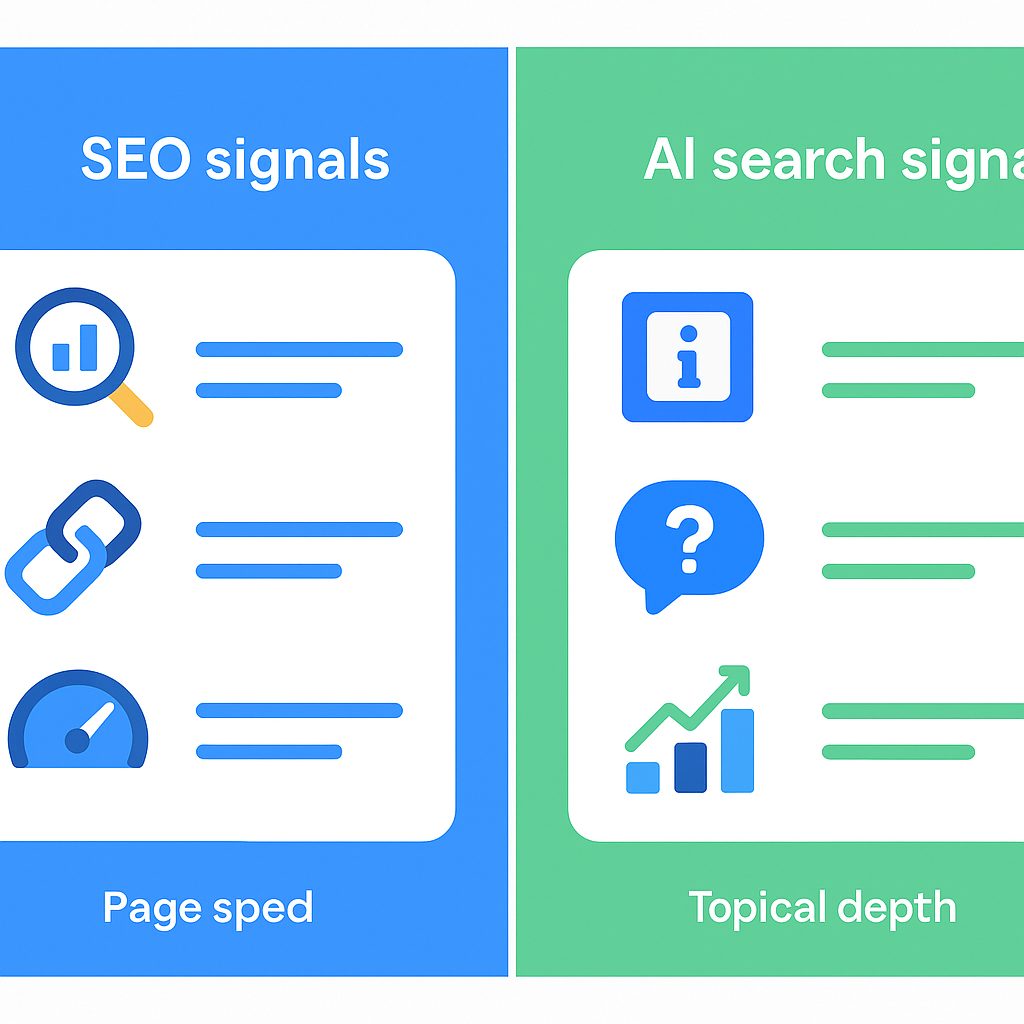
Yes — and the best agents are specifically designed to optimize for both surfaces simultaneously. Traditional SEO signals (backlinks, keyword density, page speed) determine Google rankings, while AI search visibility depends on entity coverage, FAQ schema, topical depth, and citation frequency in AI-generated answers. Agents that generate structured content with embedded FAQ blocks and proper schema markup are building AI citation potential into every piece they produce, not as an add-on but as a native output of the generation pipeline.
What does SEO AI agent training involve?
In the context of custom-built agents, 'training' typically refers to prompt engineering and configuration rather than model fine-tuning — you're tuning the instructions that govern each agent's behavior, not training a new model from scratch. For teams using purpose-built platforms, training is largely configuration: setting target keywords, content tone, CMS integrations, and publication frequency. The underlying LLM models handle the language generation; your 'training' is specifying the strategic parameters.
Is it better to build an SEO AI agent on n8n or GitHub, or buy a platform?
Building on n8n or open-source frameworks like LangChain gives you full control and no vendor dependency, but you own the infrastructure, maintenance, and ongoing prompt engineering as LLM APIs evolve. Buying a purpose-built platform trades control for speed and reliability — you get a production-grade system without the engineering overhead. For most B2B SaaS founders and marketing leads without dedicated AI engineering resources, the buy path produces value faster and lets engineering focus on product rather than internal tooling.
What results should I realistically expect from deploying an SEO AI agent?
Results depend heavily on domain age, current authority, and category competitiveness, but the directional benchmarks from 2026 deployments are meaningful. DemandSage data shows AI SEO implementations producing 45% boosts in organic traffic. The compounding effect typically accelerates after 60 to 90 days as topical authority builds and internal link graphs densify. AI search visibility improvements — tracked via AI Visibility Score — tend to appear earlier, because AI citation signals respond faster to structured content quality than traditional ranking algorithms do.
If your content pipeline still depends on human orchestration at every step, you're competing with one hand tied. Gofylo handles keyword research, content generation, CMS publishing, and internal linking — 30 articles per month, each written in a few minutes, and gives an AI visibility score for how ChatGPT and Claude see a brand. Start a 3-day free trial at gofylo.io.