
As of 2026, keyword SEO strategy has split into two parallel disciplines. You still need to win Google's ranked results, but you also need your content to be the source AI assistants like ChatGPT, Claude, and Perplexity pull when users ask conversational questions instead of typing search terms. This guide walks you through a concrete, sequential process for building a keyword SEO strategy that targets both surfaces — one that compounds over time rather than requiring constant manual effort.
By the end of this guide, you will have a working keyword list organized by intent, a mapping of those keywords to content assets, and a publishing cadence that feeds both traditional rankings and AI citation. 2026 data shows that "tell me about" searches jumped 70% from 2024 to 2025, which means the conversational, intent-rich keywords this guide prioritizes are becoming more valuable month over month. What you need:
- Access to Google Search Console (free — connected to your domain)
- A keyword research tool such as Google Keyword Planner (free) or Ahrefs
- A working list of 5–10 competitor domains in your niche
- A defined ICP (ideal customer profile) with at least one primary pain point articulated
- A CMS or publishing destination where you can create and update pages
- Basic familiarity with your site's existing content (a quick audit helps — see the concept of seo content audits)
- A target topic cluster or category you want to own
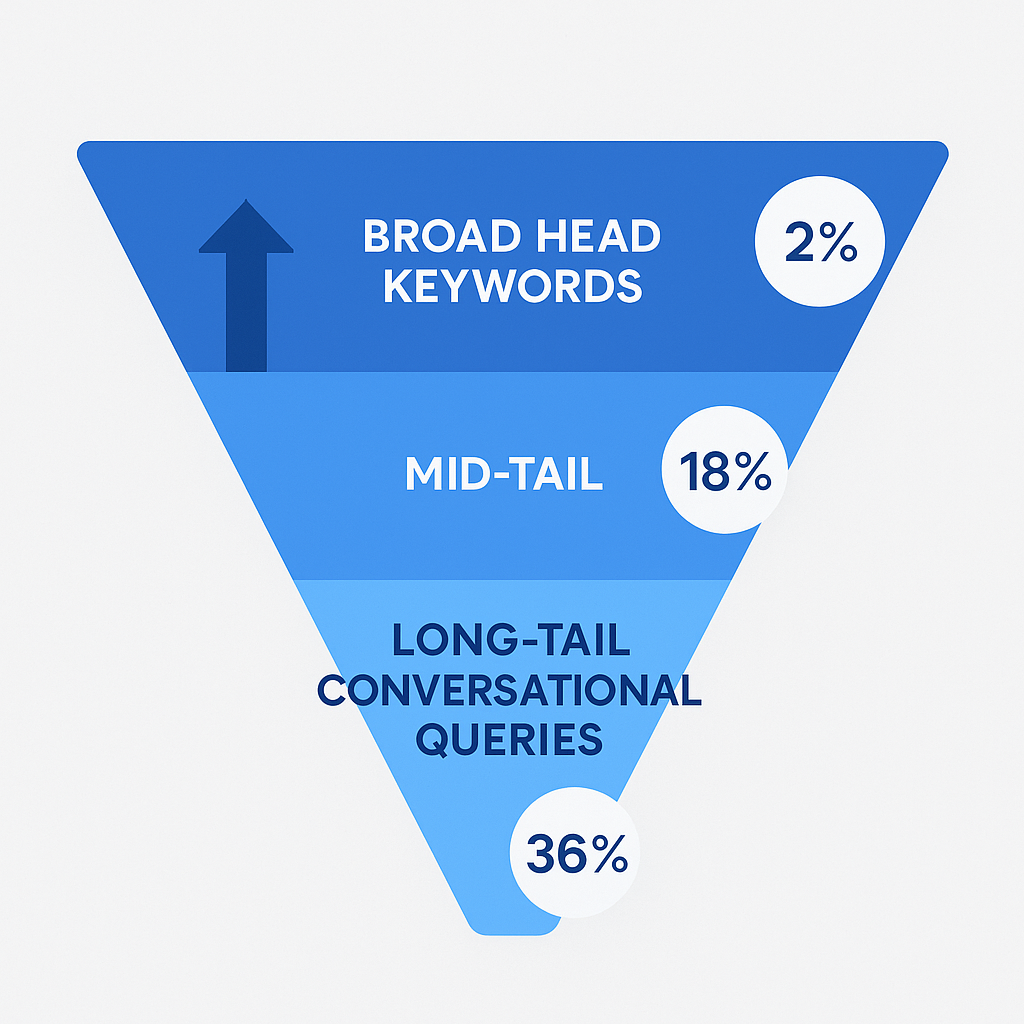
Step 1: Anchor on Search Intent Before You Touch a Keyword Tool
Search intent is the reason a query exists — the job the searcher is hiring Google or an AI assistant to do. Before you generate a single keyword, you need to decide which intent categories matter most to your business. For B2B SaaS companies, intent typically falls into four buckets: informational (learning about a problem), navigational (finding a specific brand or tool), commercial (comparing options before buying), and transactional (ready to sign up or demo). Each bucket requires a different content type and a different keyword shape. A keyword strategy built on head terms alone almost always skews toward informational traffic that never converts. A strategy anchored in intent maps keywords to specific stages of the buyer journey, which lets every article earn both rankings and revenue-relevant attention. Intent also determines how AI assistants respond — ChatGPT and Claude are far more likely to cite a page that directly and completely answers a specific question than one that broadly covers a topic. Start here, not with volume numbers.
- Write down the 3–5 core problems your ICP is actively trying to solve
- Assign each problem an intent type: informational, commercial, or transactional
- Note the specific language your customers use — pull from support tickets, sales calls, and community forums
- Identify which stage of the funnel each problem belongs to
- Flag which problems are most likely to surface in AI assistant queries (conversational phrasing, 'how to', 'what is', 'best way to')
Step 2: Generate a Raw Keyword List Using Multiple Input Sources
Keyword generation works best when you pull from multiple independent sources simultaneously. A single tool gives you one data perspective; combining sources surfaces the full shape of what your audience actually searches. Start with your own Google Search Console data — it shows you queries you already have some impression share for, which means you have a structural advantage. Then layer in competitor research, seed keyword expansion, and conversational query mining to fill the gaps your existing content hasn't reached.
Map Competitor Gap Keywords
Competitor gap analysis is one of the fastest ways to build a high-relevance keyword list. Pull the top 5–10 competitor domains into a tool like Ahrefs and filter for keywords they rank for in positions 1–10 that you do not rank for at all. These are validated keywords — the SERP has already confirmed searcher demand — and your competitors have already done the hard work of proving the content type that works. Prioritize gaps where multiple competitors rank, which signals consistent demand rather than a one-off ranking.
Mine Long-Tail and Conversational Variants
Long-tail keywords are where the real leverage sits in a keyword SEO strategy. According to data cited by Ranktracker, long-tail keywords (3+ words) account for 70–92% of all search traffic and convert at 36% average rates — nearly 2.5x higher than short-tail keywords. At the same time, 94% of keywords get an average of 10 monthly searches or less, according to WebFX's 2026 SEO statistics report — which means most of the long-tail universe is thin individually, but collectively enormous. Mine variants using Google's 'People Also Ask' boxes, autocomplete suggestions, and the 'Related searches' section at the bottom of SERPs. These are real user phrases, not tool-generated approximations.
Tip: Don't confuse low search volume with low value. A keyword that drives 50 searches per month from your exact ICP can be worth more than a 5,000-volume term that attracts students and researchers. Qualify by intent, not just volume.
Step 3: Apply the 80/20 Filter to Prioritize Your Keyword List
The 80/20 rule in SEO holds that roughly 20% of your targeted keywords will generate 80% of your meaningful organic traffic and conversions. Applying this filter to a raw keyword list means you stop treating all keywords as equally worth pursuing. The practical way to implement it: score every keyword on three dimensions — estimated traffic potential, keyword difficulty (how hard it is to rank given current SERP competition), and commercial value (how closely the query maps to a buying decision). Then rank the list by the product of those three scores and cut everything below the median. What remains is your working priority list. This is the difference between a content calendar that looks productive and one that actually moves revenue.
- Assign a traffic potential score (1–5) based on monthly search volume relative to your category
- Assign a difficulty score (1–5, inverted — low difficulty = high score) using SERP analysis
- Assign a commercial intent score (1–5) based on how close the query is to a buying decision
- Multiply the three scores to get a composite priority number
- Cut keywords below the 50th percentile of composite scores
- Flag the top 20% for immediate content creation; schedule the rest in a rolling calendar
Warning: Keyword difficulty scores from tools are trailing indicators — they reflect how hard it was to rank six months ago, not today. Always verify by manually reviewing the current SERP. If the top results are all thin, templated pages, even a 'high difficulty' keyword may be winnable with depth and structure.
Step 4: Map Keywords to Content Assets and Cluster Them
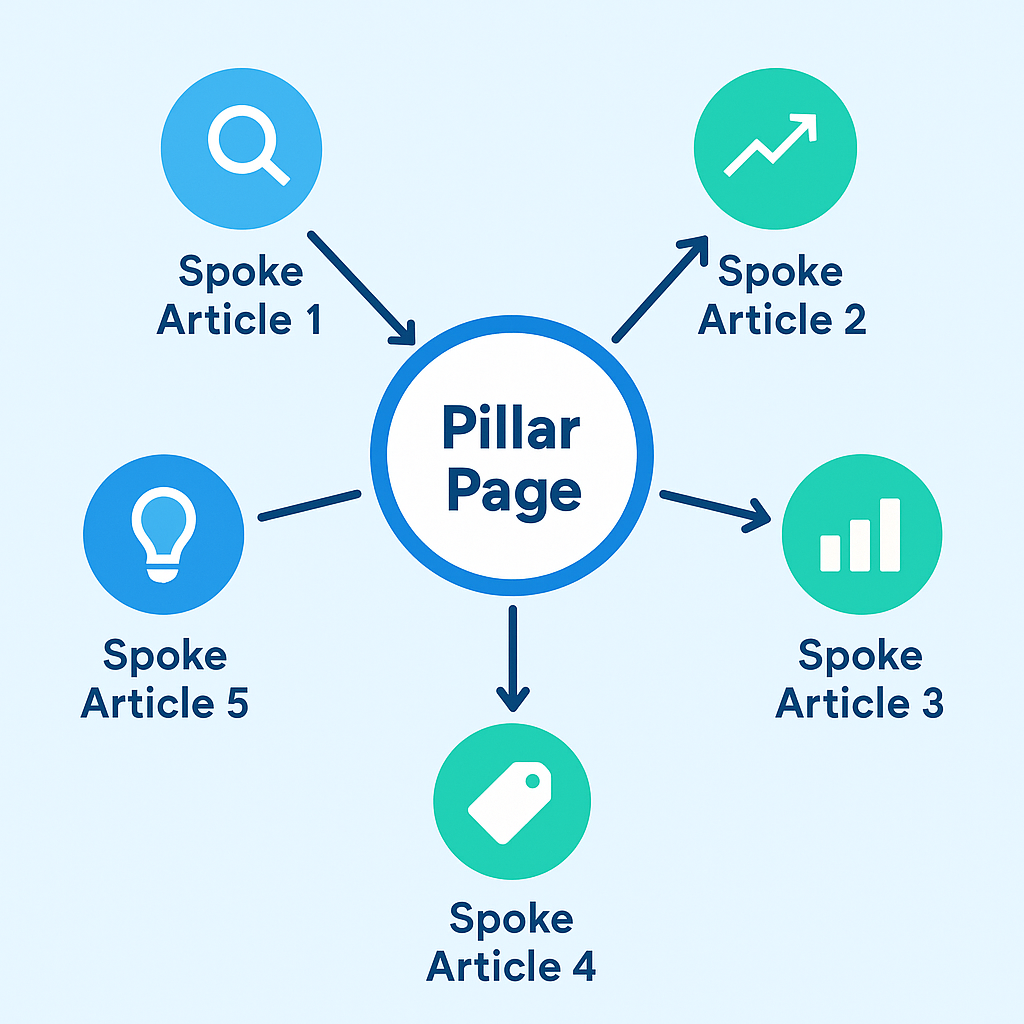
A keyword list without a content structure is just a spreadsheet. The next step is mapping each prioritized keyword to a specific content asset — either an existing page you will optimize or a new page you will create — and then grouping those assets into topic clusters. Topic clustering is the structural mechanism behind topical authority seo: a hub page covers the broad topic, while spoke pages go deep on individual subtopics, all internally linked together. This architecture signals to Google that your site has genuine depth on a subject, and it gives AI assistants a coherent body of content to draw from when composing answers. Each spoke should target one primary keyword and two to four secondary keywords that share the same search intent.
One URL, one primary keyword. Every page in your cluster should own one primary keyword. When two pages target the same term, they split authority and neither ranks well — a problem called keyword cannibalization. Audit your existing content before assigning any keyword to a new page. If a published article already targets the same intent, update and consolidate rather than creating a new asset.
Internal linking is load-bearing. Once your cluster map exists, the internal link architecture between hub and spokes is what activates it. According to our guide on internal linking, every spoke page should link back to the hub, and the hub should link forward to each spoke. This passes PageRank efficiently within the cluster and tells crawlers the relational hierarchy of your content. Without deliberate internal linking, even well-written spoke pages can sit in crawl dead zones and never accumulate authority.
Step 5: Optimize On-Page and URL Structure for Each Target Keyword
Once your keyword-to-content map exists, on-page optimization is the execution layer. Each page needs the primary keyword placed in five critical locations: the title tag, the H1, the meta description, the first paragraph of body copy, and the URL slug. The URL placement is particularly high-leverage: according to SE Ranking's 2026 SEO statistics, URLs that include words related to a target keyword earn a 45% higher click-through rate than those that don't include target keyword terms. For B2B SaaS pages competing in dense SERPs, a 45% CTR lift is a meaningful edge that requires no additional content work — just deliberate URL structure from the start.
- Place the primary keyword in the URL slug — keep it short and descriptive, no stop words
- Open the title tag with the primary keyword or a close variant, stay under 60 characters
- Write the meta description to answer the searcher's core question in 150–160 characters
- Use the primary keyword naturally in the first 100 words of body copy
- Use secondary and semantic keywords in H2 and H3 subheadings throughout
- Add schema markup (Article, FAQ, HowTo) to make structured data readable by both Google and AI engines
High quality content is the ceiling. On-page optimization improves the ranking ceiling set by your content quality, but it cannot raise that ceiling. If the underlying article is thin, repetitive, or fails to satisfy the searcher's intent, no amount of keyword placement will sustain a top-three position. The resource on high quality content covers the substance side of this equation in depth — treat on-page optimization as the container, and content quality as what fills it.
Step 6: Optimize for AI Search Citation, Not Just Google Ranking
A keyword SEO strategy that ignores AI search is structurally incomplete in 2026. According to SparkToro's research cited by Search Atlas, 58.5% of Google searches in the U.S. result in zero clicks — meaning more than half of all queries are answered by an AI Overview or featured snippet before any organic result is clicked. That number will increase. Winning the AI citation layer requires a different optimization approach than winning position one in the traditional blue-link results. The good news is that the two are more aligned than they appear: both reward clarity, specificity, and content that directly and completely answers a stated question.
- Structure every article with clear H2 and H3 headings that mirror natural question phrasing
- Open each section with a 2–3 sentence direct answer before expanding into detail
- Include FAQ blocks using proper FAQPage schema — AI assistants parse structured Q&A reliably
- Add verified citations and named sources inline, not just in a bibliography — LLMs weight inline attribution heavily
- Avoid pronoun-heavy writing where 'it' or 'they' point to entities named paragraphs earlier — AI models read page sections in isolation
- Refresh published articles regularly using Search Console data to catch ranking drift before it compounds
Tip: Platforms like Gofylo score how ChatGPT and Claude see your brand — the AI Visibility Score shows whether your keyword and content investments are translating into AI citation, not just traditional rankings. It's the metric that closes the loop between keyword strategy and AI search presence.
What Separates Good Content Quality from content that AI assistants cite The structural difference is specificity. An article that says 'there are many factors to consider' will never be cited by an AI. An article that says 'keyword difficulty scores from tools are trailing indicators — verify manually by reviewing the current SERP' gives the model something it can lift and attribute. According to Google's Search Central documentation on creating helpful content, people-first content that demonstrates first-hand expertise is the standard for both ranking and citation. The What Separates Good Content Quality angle is a useful frame: specificity, original insight, and clear structure over length and keyword density.
Troubleshooting
Even a well-constructed keyword SEO strategy runs into execution problems. The issues below are the most common failure modes for B2B SaaS teams, and each has a specific structural fix rather than a 'publish more content' non-answer.
Your content ranks but doesn't convert. This is almost always an intent mismatch. The keyword you targeted was informational but the page pushes a demo CTA immediately. Fix it by reviewing what the SERP actually surfaces for the keyword — if all ranking pages are educational, your page needs to be primarily educational too. Move commercial CTAs lower, and add a 'next step' section that bridges the reader from information to consideration without forcing a conversion before they're ready.
You're stuck on page two for high-priority terms. Page two rankings are often a topical authority problem, not a keyword density problem. The solution is building out the topic cluster around that page — add supporting spoke articles that link to the stuck page, strengthen the internal linking structure, and ensure the hub page is comprehensive. Topical authority accumulates across a cluster, not within a single URL. Adding five related spoke articles often unlocks a page-one move for the hub without touching the hub itself.
Your AI citation rate is zero despite good rankings. AI assistants prioritize content that is structured for extraction: short declarative sentences, clear section headings that are self-contained questions, inline citations, and FAQ blocks with proper schema. If your articles read as long-form editorial with narrative flow, they rank fine in Google but are structurally invisible to LLM extractors. Audit your top-ranked pages and add FAQ sections, tighten the opening paragraph of each H2 section to 2–3 direct sentences, and add FAQPage schema markup.
Your keyword list keeps growing with no publishing output. This is a production bottleneck, not a strategy problem. The keyword list is a research artifact — it has no value until it becomes published content. If your team cannot sustain a publishing cadence manually, autonomous platforms that research keywords, write articles, and publish them directly to your CMS close the gap structurally. Gofylo, for example, publishes 30 articles per month per plan, writing each in a few minutes and distributing across 18+ languages — which converts a 200-keyword backlog into a manageable execution timeline without headcount.
FAQ
How to generate keywords for SEO?
Start with your ICP's stated problems, then expand using Google Search Console data, competitor gap analysis in a tool like Ahrefs, and Google's own autocomplete and 'People Also Ask' features. Layer in conversational query variants — 'how to', 'what is', 'best way to' — since these surface in both traditional search and AI assistant responses. Cross-reference your seed list against real SERP data to confirm demand before prioritizing any keyword for content creation.
What is the 80/20 rule in SEO?
The 80/20 rule in SEO means that roughly 20% of targeted keywords will drive approximately 80% of your meaningful organic traffic and conversions. It is applied as a prioritization filter: score keywords by traffic potential, difficulty, and commercial intent, then concentrate content production on the top quintile. This prevents teams from spreading publishing capacity across hundreds of low-value keywords instead of compounding authority in the most commercially relevant areas.
Is Google Keyword Planner free?
Yes — Google Keyword Planner is a free tool available inside Google Ads. You need a Google Ads account to access it, but you do not need to run any paid campaigns. It provides search volume ranges, competition levels, and keyword suggestions based on seed terms or a competitor URL. Volume data is shown in ranges rather than exact numbers at the free tier, which is adequate for directional research and initial keyword list generation.
What are the top 5 SEO strategies?
The five highest-leverage SEO strategies in 2026 are: (1) keyword intent mapping — aligning content to the specific job a searcher is hiring a result to do; (2) topic clustering and topical authority building — owning a subject area across a hub-and-spoke architecture; (3) on-page technical optimization — title tags, URL structure, schema markup, and internal linking; (4) high-quality, experience-led content creation that demonstrates first-hand expertise; and (5) AI search optimization — structuring content for extraction and citation by LLM-based assistants. According to WebFX's 2026 SEO statistics, 46% of SEO experts rate keyword management as the single most effective SEO tactic, which anchors the list at the keyword strategy layer.
Ready to execute this keyword SEO strategy without a content team? Gofylo autonomously researches competitor keywords, writes articles in your brand voice, and publishes 30 per month to your CMS — with schema markup, internal links, FAQ blocks, and an AI Visibility Score that tracks how ChatGPT and Claude cite your brand. Start your 3-day free trial at gofylo.com.