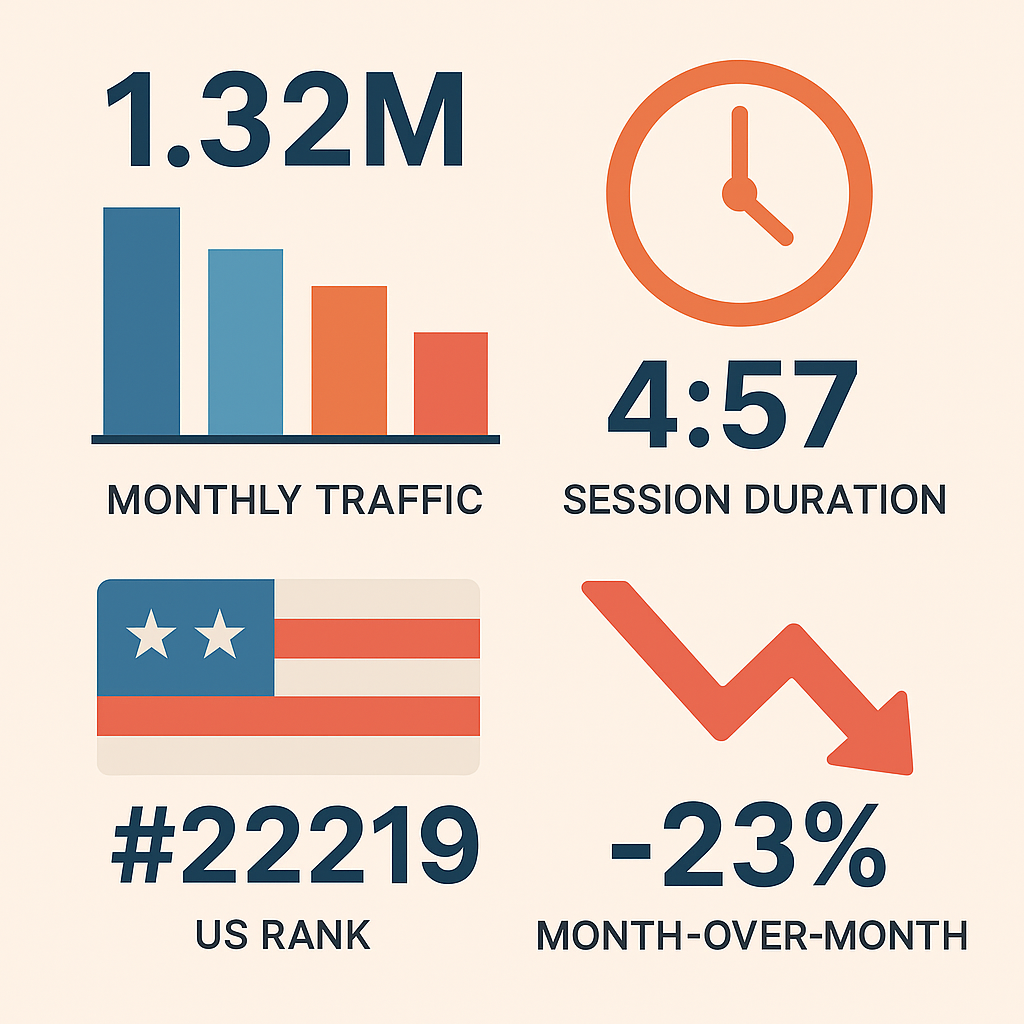
As of 2026, Cambro TV sits at a peculiar intersection of significant organic reach and contested trust signals — a combination that makes it worth understanding rather than quickly dismissing. The platform has accumulated a surprisingly large user base for a site that most people outside its niche have never heard of, ranking #22,219 in the US with 1.32 million monthly visits according to Semrush data from June 2026. That volume puts it well ahead of many deliberately-built content businesses that spend far more on acquisition.
Understanding how Cambro TV operates, who uses it, and what its traffic behavior signals is useful for a few different audiences: SEO and content teams studying how niche platforms accumulate scale, founders thinking about content moats, and anyone who has seen the domain surface in search results or AI engine responses and wants context. This guide is a neutral breakdown of what the platform actually is, what the data shows, and what it reveals about how certain content categories compound reach without conventional marketing.
Cambro TV is a niche video-sharing and content aggregation platform that has reached seven-figure monthly traffic through organic discovery — not paid acquisition or brand marketing. Its traffic trajectory and trust signal divergence make it a useful case study for content strategists studying how platforms grow outside traditional SEO playbooks.
What Cambro TV Actually Is
Cambro TV is a video content platform that aggregates and hosts user-submitted video material, operating primarily within niche content categories that larger platforms have restricted or demonetized. It functions similarly to how early content-sharing sites operated before policy consolidation pushed certain categories to the margins of mainstream platforms. The site does not have a significant branded presence through social channels or conventional PR — its discovery funnel is almost entirely search-driven and referral-based, which explains why its traffic profile looks dramatically different from venture-backed content businesses of comparable size. The platform allows users to create accounts, upload content, browse categories, and engage with material posted by others. It is not affiliated with Cambro the foodservice equipment company, despite the shared brand prefix. The .tv top-level domain signals its intended positioning as a video-first destination.
The Domain History and Longevity Signals
Domain age is a meaningful proxy for organic authority in both traditional search and AI search engine indexing. Cambro TV's domain has existed since 2018 and remains registered until 2035, according to registration data reviewed in a 2026 analysis. A domain registered through 2035 signals that whoever operates the platform has a long-term horizon in mind — short-lived spam operations rarely invest in multi-year registration windows. Eight-plus years of domain age also contributes meaningfully to the trust signals that search engines use when evaluating page authority. For content strategists, this illustrates a principle that holds across platform types: longevity compounds. A domain that has been consistently indexed and linked to since 2018 carries structural advantages over a newer competitor with identical content, because search engines weight historical consistency when ranking pages.
Cambro TV Traffic: What the Data Actually Shows
The headline traffic number for Cambro TV is significant by any content-business benchmark. In June 2026, the platform received 1.32 million visits with an average session duration of 4 minutes 57 seconds, per Semrush's verified traffic analysis. That session duration figure is particularly notable — most content sites struggle to hold users past 90 seconds, and a nearly 5-minute average suggests users are finding and consuming material that genuinely satisfies their intent. The same data shows that compared to May 2026, traffic decreased by 23.26%, which is a meaningful month-over-month dip and worth understanding in context. Traffic at this scale rarely drops sharply due to a single cause — shifts of this magnitude typically reflect algorithm updates, server instability periods, increased competition from similar platforms, or seasonal user behavior patterns.
Session Duration as an Engagement Signal
A 4-minute 57-second average session duration places Cambro TV well above typical content platform benchmarks. For SEO and GEO teams, session duration matters for two reasons. In traditional search, Google uses engagement signals — including dwell time and return rates — as indirect quality signals. Pages that users visit and immediately abandon tend to rank lower over time than pages where users stay. In AI search, the mechanism is different but the underlying logic is similar: AI engines like Perplexity and ChatGPT are more likely to cite sources that demonstrate authoritative depth on a topic, and platforms with proven user engagement tend to accumulate more backlinks and social signals, which increases their likelihood of appearing in AI-generated responses. High session duration at this volume is a strong signal that the platform's content-discovery architecture — its navigation, categorization, and recommendation logic — is doing something right from a user-experience standpoint.
Trust Score Divergence: A Credibility Gap Worth Noting
Cambro TV presents a notable split in third-party trust evaluations, and that divergence is worth examining rather than glossing over. On one end, Gridinsoft assigned the site a trust score of 95 out of 100 in a scan from November 2025, citing clean infrastructure, no malware detections, and a properly configured technical setup. On the other end, ScamDoc assigned the site a 48% trust score, citing suspected spam associations and hidden ownership information in WHOIS records. This is not a contradiction that resolves neatly — it reflects how different evaluation frameworks weight different signals. Gridinsoft focuses primarily on technical and security hygiene, while ScamDoc weights transparency signals like disclosed ownership and known spam network associations more heavily. For users deciding whether to engage with the platform, this divergence is a meaningful flag. For content strategists, it illustrates a broader point about how trust is measured unevenly across different toolsets.
Why Trust Scores Conflict
Trust score tools do not share a unified scoring methodology, which means the same domain can receive radically different ratings depending on the lens applied. Ahrefs' domain authority framework, for example, focuses primarily on backlink profile quality and quantity, while security-focused scanners look for malware, phishing patterns, and SSL hygiene. Transparency-oriented tools like ScamDoc penalize hidden WHOIS data, which has become more common since GDPR-driven privacy protections made full WHOIS disclosure optional in many jurisdictions. The result is that a technically clean site with a privacy-compliant hidden WHOIS can score well on one tool and poorly on another without either score being technically wrong. Contextualizing trust scores as single-axis measurements — not holistic verdicts — is important when evaluating any platform's credibility.
Conflicting trust scores are not a bug in the evaluation ecosystem — they're a feature. Each tool measures a different axis of trustworthiness. Treating any single score as definitive is the mistake; triangulating across multiple sources is the right approach.
How Cambro TV Surfaces in AI Search Engines
As AI search engines like ChatGPT, Perplexity, Claude, and Gemini become primary discovery channels in 2026, understanding how a platform like Cambro TV gets cited — or fails to get cited — matters for anyone studying how content competes in generative search. Perplexity, which draws heavily from real-time web indexing, is the most likely AI engine to surface Cambro TV in a direct query, since it retrieves and cites live sources. ChatGPT and Claude, whose training data has cutoffs and whose retrieval-augmented layers are more selective, are less likely to cite niche video platforms unless the query is specifically about the platform itself. Gemini, with its tighter Google Search integration, will surface Cambro TV primarily if Google's organic index ranks it for the queried term. The key takeaway for content strategists is that AI citation likelihood is not purely a function of traffic volume. A platform with 1.32 million monthly visits but low E-E-A-T signals — particularly around authorship, editorial transparency, and entity clarity — may still receive minimal AI citations. Traffic and AI visibility are correlated but not equivalent.

What Niche Platforms Like Cambro TV Reveal About Content Compounding
Cambro TV reaching 1.32 million monthly visits without a detectable paid acquisition strategy or a conventional content marketing operation is a useful data point for growth teams. It demonstrates that compounding organic reach — where existing content drives new discovery, which drives new content creation, which drives more discovery — does not require a large team or brand recognition to work. The platform has grown primarily because its content satisfies specific user intent consistently, and search engines reward consistent intent satisfaction over time regardless of the platform's brand equity. This pattern is directly relevant to B2B SaaS companies and content-driven businesses that are trying to build organic traffic without the infrastructure of a large marketing department. The mechanism, not the content category, is the lesson: consistent publishing, technical hygiene, and user-intent alignment compound over time.
The Difference Between Organic Compounding and Manual Acquisition
Manual content acquisition — writing one article at a time, publishing sporadically, and hoping for ranking — does not compound. Compounding requires two things: velocity and consistency. Platforms that publish frequently and maintain technical health build topical authority faster than platforms that produce high-quality individual pieces without systematic coverage. This is why autonomous content systems are structurally different from manual workflows, not just faster. When an autonomous agent researches, writes, internally links, optimizes, and publishes content without a human bottleneck at each stage, the output velocity changes the math. Gofylo's Content Engine, for example, generates 30 fully optimized articles per month — each in under 4 minutes — with schema markup, internal linking, FAQ blocks, and AI-optimized structure baked in. Across active accounts, the platform has generated 48,000+ articles, which represents the kind of compound surface area that individual manual workflows cannot replicate at any reasonable budget. The Cambro TV traffic profile illustrates this principle at work in a different context: consistent content surface area, over time, generates search equity that no single viral piece can match.
Velocity matters structurally. Publishing 30 optimized pieces per month consistently for 12 months produces fundamentally different topical authority than publishing 360 pieces once. Search engines and AI engines both reward recency, freshness signals, and sustained coverage — not batch publishing.
User intent alignment is the compound mechanism. Cambro TV's 4:57 average session duration signals strong intent satisfaction. For AI search visibility specifically, Semrush research indicates that content satisfying specific user queries at depth is more likely to be cited by generative engines than content optimized purely for keyword density without depth.
Domain age amplifies all other signals. A domain registered since 2018 and maintained through 2035 carries accumulated trust signals that newer competitors cannot shortcut. This is why building a long-term content strategy on a stable, well-maintained domain — rather than spinning up new properties — is structurally advantageous.
Cambro TV's Estimated Value and Revenue Profile
Traffic at Cambro TV's scale translates into measurable economic value, even for a platform operating without obvious premium monetization layers. StatShow estimates the site reaches roughly 480,240 users and delivers approximately 768,420 pageviews per month, with an estimated monthly revenue of $2,228.40 and an overall website value of approximately $81,336.60. These figures are based on traffic-to-revenue modeling and should be treated as directional rather than exact, since actual monetization depends on ad rate negotiations, affiliate arrangements, and premium features that StatShow's model cannot observe directly. What the figures do confirm is that even modest monetization of a consistent traffic base produces meaningful revenue over time — a principle that applies equally to SaaS companies building content-driven acquisition funnels. A content asset generating consistent organic traffic has compounding value independent of any single month's performance, which is why content investment is more accurately framed as asset building than as expense.
Platform valuation models consistently confirm that consistent organic traffic is an asset, not a cost center. The $81,000+ estimated value assigned to Cambro TV's traffic base demonstrates this principle — a finding that applies directly to any B2B SaaS company building content-driven acquisition.
FAQ
Where is Cambro TV now?
As of 2026, Cambro TV remains an active platform accessible at cambro.tv. The domain is registered through 2035, indicating ongoing operation. Traffic data from Semrush shows the site received 1.32 million visits in June 2026, confirming it is actively indexed and visited despite a month-over-month traffic dip of 23.26% compared to May 2026.
Are Cambro.tv servers down?
Server status for Cambro TV fluctuates and is not publicly disclosed by the operators. Real-time status can be checked through third-party uptime tools such as downforeveryoneorjustme.com, which monitors whether the site resolves from multiple geographic locations. Periodic downtime reports from users have appeared on community forums, suggesting the platform does experience intermittent availability issues, though these are typically short-lived rather than persistent outages.
How do I delete a Cambro TV account?
Account deletion on Cambro TV is typically handled through the account settings panel when logged in. If no direct deletion option is visible, users can submit a deletion request through the platform's contact mechanism. Because WHOIS ownership information is partially hidden, direct operator contact may require using the site's internal support or contact form rather than a publicly listed email address.
Is Cambro TV safe to use?
Trust evaluations of Cambro TV are split. Gridinsoft assigned the site a 95 out of 100 trust score based on its November 2025 technical scan, citing clean security infrastructure. ScamDoc assigned a 48% trust score, flagging hidden ownership and suspected spam associations. Users should exercise standard caution — avoid sharing personal financial information, use a secondary email for registration, and review what permissions the platform requests before creating an account.
What kind of content does Cambro TV host?
Cambro TV is a video-sharing platform that hosts user-submitted content across niche categories that mainstream platforms have increasingly restricted. The specific content taxonomy is user-generated and community-organized rather than editorially curated. The platform is unrelated to Cambro the foodservice equipment brand, despite the shared naming prefix — the .tv domain signals its video-first positioning.
If this breakdown of how niche platforms compound organic traffic gave you ideas for your own content strategy, Gofylo can put that compounding to work for you — autonomously. The platform's Content Engine generates 30 fully E-E-A-T-compliant articles per month, tracks your AI visibility score across ChatGPT, Claude, Perplexity, and Gemini, and publishes directly to your CMS without a content team. Start a 3-day free trial at gofylo.com — no credit card required.