As of 2026, the signals that determine whether a buyer trusts your company before ever visiting your website have multiplied dramatically. A prospect might encounter your brand in a Reddit thread, a Perplexity answer, a G2 review, a competitor's comparison page, or a LinkedIn comment — often before a single Google search. Brand monitoring is the practice of systematically tracking every place your company name, product, executives, and key terms appear across the web, social platforms, review sites, and increasingly, inside AI-generated answers. Without it, you're navigating blind.
The market for brand monitoring tools reflects how seriously teams are taking this problem. According to Verified Market Reports, the brand monitoring tools market was estimated at USD 3.5 billion in 2024 and is projected to reach USD 7.5 billion by 2033, growing at a CAGR of 8.5%. That trajectory is not a coincidence — it mirrors the fragmentation of attention across channels and the emergence of AI search engines as a new, high-stakes distribution layer that most monitoring stacks weren't built to handle.
Brand monitoring in 2026 is not just a PR function. It's a data layer that feeds SEO strategy, competitive intelligence, product feedback loops, and AI search visibility — all at once. Teams that treat it as a single-channel activity consistently underestimate what they're missing.
What Brand Monitoring Actually Covers
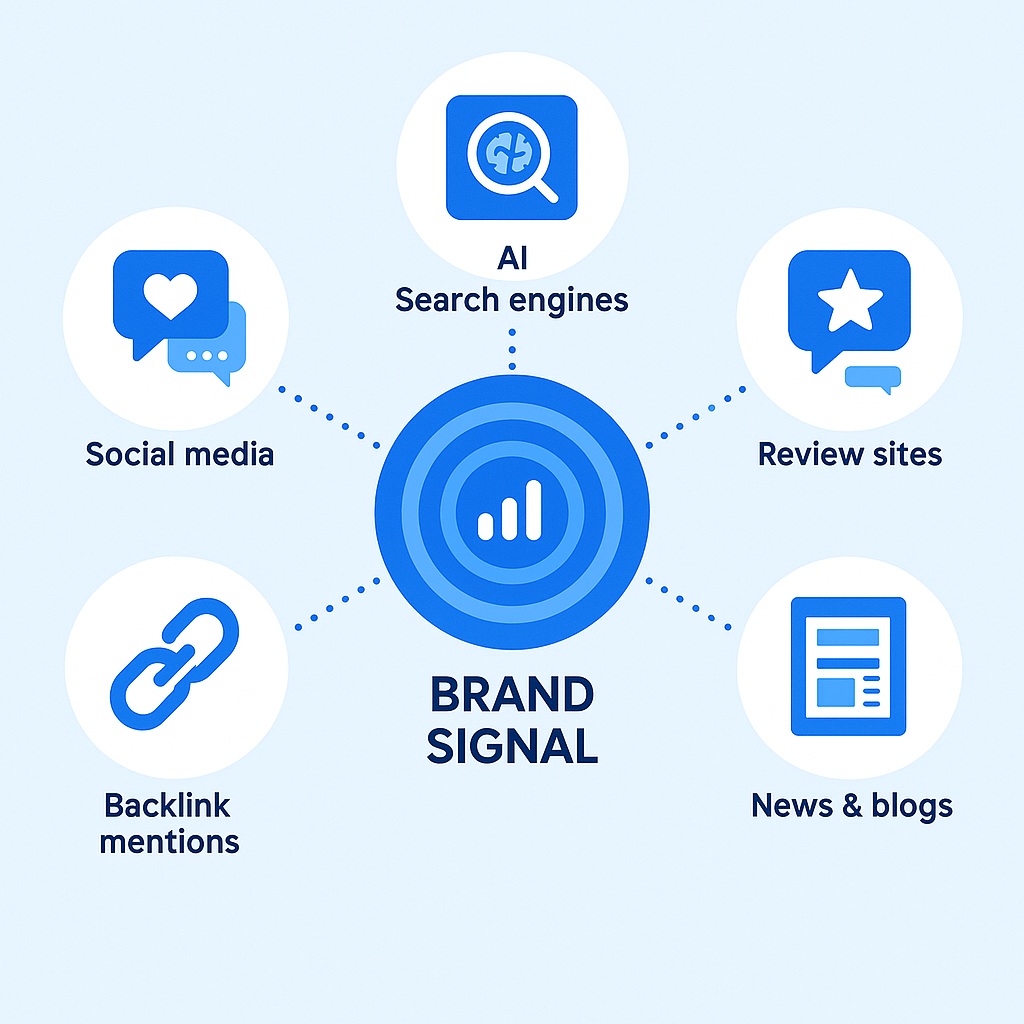
Brand monitoring is the continuous process of detecting and analyzing every instance where your brand — including your company name, product names, executive names, branded hashtags, and close variants — is mentioned across digital channels. It is not a single tool or a single channel. It is a discipline that spans social media, search engine results pages, news outlets, review platforms, forums, podcasts, and now the outputs of AI language models like ChatGPT, Claude, Perplexity, and Gemini. The goal is to give your team a real-time, consolidated view of how your brand is perceived, where it appears, how often, and in what context — so you can act on that signal rather than react to it weeks later when a narrative has already hardened.
The Traditional Channels: Search, Social, and Review Sites
For most of the last decade, brand monitoring software focused on three core channel types: social media mentions, news and blog references, and review site activity. Social monitoring captures what people say about your brand on platforms like LinkedIn, X (formerly Twitter), Reddit, and industry Slack communities. News and blog tracking picks up editorial coverage, press mentions, and third-party articles that reference your company. Review site monitoring covers platforms like G2, Capterra, Trustpilot, and Product Hunt, where structured opinion data — star ratings, written reviews, comparison threads — accumulates over time and directly shapes buyer decisions. According to WiseGuyReports, the social media monitoring application segment alone was valued at 1.5 USD billion in 2024, making it the largest single application category within the brand monitoring tools market. That concentration of value tells you something important: social signals are still the primary surface where brand perception forms and shifts fastest.
The Emerging Layer: AI Search and LLM Citations
What changed fundamentally in 2025 and has now become the baseline in 2026 is the addition of AI-generated answers as a monitoring surface. When a prospect asks Perplexity 'What's the best project management tool for a 10-person SaaS team?' or asks Claude to compare your product against a competitor, the answer that surfaces — and whether your brand appears in it at all — is now as commercially significant as a first-page Google ranking. AI brand monitoring means tracking whether your brand is cited, recommended, or described accurately inside LLM-generated answers across the major AI search engines. Most legacy brand monitoring tools do not cover this surface. Teams that rely only on traditional brand monitoring software are therefore missing a growing share of the discovery journey.
Why Brand Monitoring Matters Beyond Reputation
The most common framing of brand monitoring is defensive: catch a bad review before it spreads, spot a PR crisis before it peaks, respond to a negative tweet before it goes viral. That framing is accurate but incomplete. In practice, a well-instrumented brand monitoring program generates intelligence that is directly useful to product, sales, content, and SEO teams — not just communications. The value compounds the more channels you cover and the faster you close the loop between signal detection and action. Teams that treat brand monitoring purely as a reputation defense function consistently leave strategic insight on the table.
Crisis Detection and Response Windows
A negative mention on a niche forum can be irrelevant at hour one and widely cited by journalists at hour forty-eight. The response window is not days — it's hours, and in some categories it's minutes. Brand monitoring software that delivers real-time alerts with sentiment classification lets teams triage incoming signals by severity before they escalate. The operative question is not whether something negative will be said about your brand — it will — but how quickly you can contextualize it and decide whether to respond, escalate, or let it pass. That decision requires data, not instinct.
Competitive Intelligence as a Byproduct
Brand monitoring tools that track mentions of your competitors' names, products, and executive teams generate competitive intelligence as an organic byproduct of the monitoring workflow. When a competitor launches a new feature and the response on LinkedIn skews negative, that's a signal. When a competitor is consistently cited in AI search answers for a category you compete in but your brand is absent, that's a positioning gap with a measurable content solution. Effective brand monitoring turns ambient market conversation into structured competitive data without requiring a separate research process.
How Brand Monitoring Connects to Rank Tracking
Brand monitoring and rank tracking are distinct practices, but in 2026 they are increasingly unified under a single performance lens. Traditional rank tracking tells you where your URLs appear in Google's search results for specific keyword queries. Brand monitoring tells you where your company name and products appear in editorial content, social conversations, review platforms, and AI-generated answers. The overlap becomes clear when you consider that AI search engines like Perplexity and ChatGPT cite sources — meaning your content's ability to get referenced in an LLM answer is simultaneously a brand monitoring question and a rank tracking question. We've covered the mechanics of LLM rank tracking and AEO tracking in related guides; the key point here is that brand monitoring now feeds directly into the same performance loop. A brand mention in a high-authority article improves your probability of being cited by AI search. A citation inside a Perplexity answer increases branded search volume in Google. The two signals reinforce each other, which is why monitoring them in isolation misses the compounding effect.
Brand mentions and AI citations are now mutually reinforcing signals. A strong presence in editorial content increases LLM citation probability; LLM citations drive branded search queries back to Google. Teams that monitor only one of these loops are measuring half the picture.
The Five Dimensions of a Complete Monitoring Stack
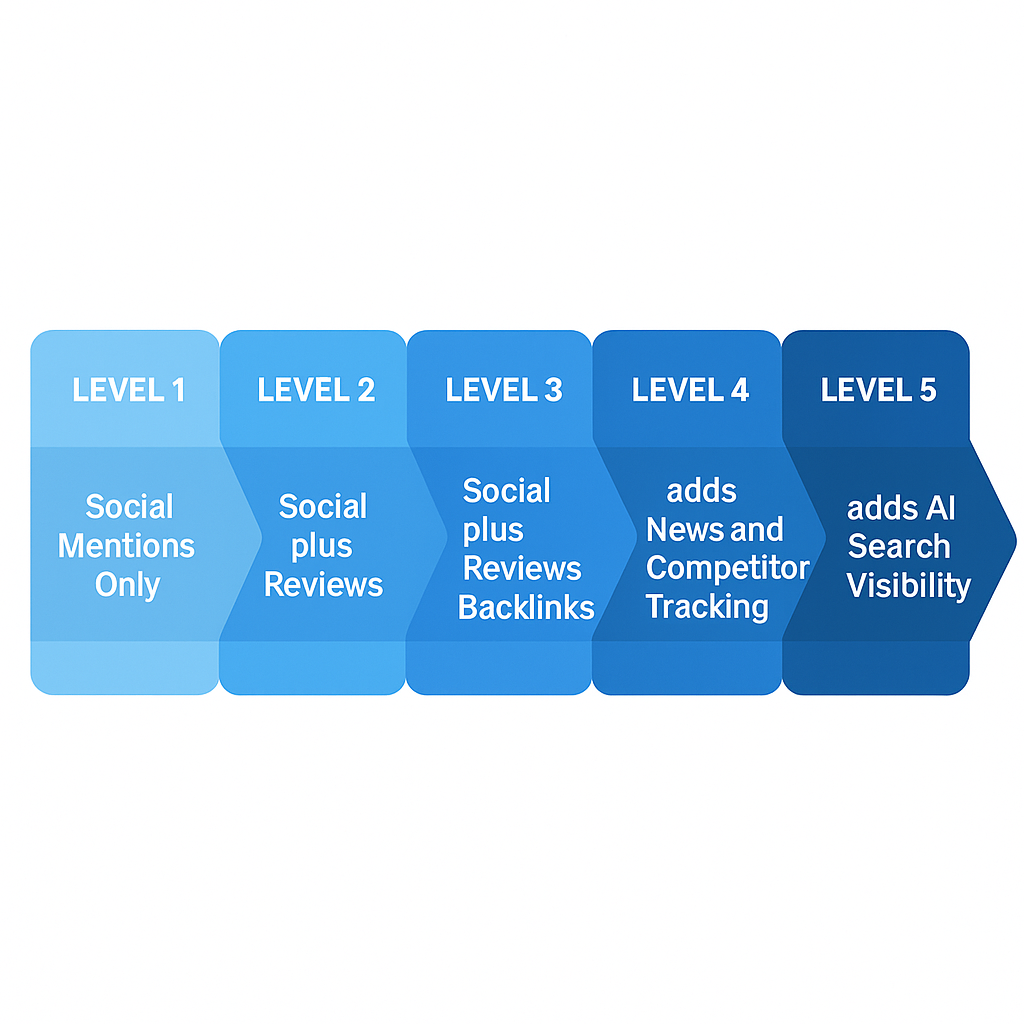
A genuinely complete brand monitoring program in 2026 is not a single tool — it is a stack of five distinct monitoring functions, each covering a different signal type and serving a different downstream use case. Many teams collapse these into one or two tools and then wonder why their data has blind spots. Understanding the five dimensions helps you evaluate whether your current setup is actually comprehensive or whether it only feels that way because the missing channels are invisible by definition.
Social Monitoring
Social monitoring tracks real-time mentions of your brand across platforms like LinkedIn, X, Reddit, Facebook, Instagram, and TikTok. It should capture both direct mentions (tagged posts, explicit name references) and untagged references (someone discussing your product by name without using the @ symbol). The most valuable social monitoring setups go beyond mention counts to classify sentiment, track reach and engagement metrics per mention, and surface emerging themes in the conversation around your brand. For B2B SaaS companies, LinkedIn and Reddit are typically the highest-signal platforms because that's where practitioners talk about tooling decisions honestly.
AI Search Visibility
AI search visibility monitoring tracks whether and how your brand appears in AI-generated answers across ChatGPT, Claude, Perplexity, and Gemini. This is the newest and most differentiated dimension of brand monitoring, and it requires purpose-built tooling — generic social listening platforms do not index LLM outputs. The key metrics are: citation frequency (how often your brand appears in answers for relevant queries), citation sentiment (is the reference positive, neutral, or negative), and citation accuracy (is the AI describing your product correctly). An AI Visibility Score that aggregates these signals into a single benchmark — like the one Gofylo provides, which scores a brand based on how ChatGPT and Claude respond when asked about it — gives teams a single number to track week over week rather than manually sampling individual queries.
Review and Sentiment Monitoring
Review monitoring covers G2, Capterra, Trustpilot, App Store, Google Business Profile, and any industry-specific review aggregator relevant to your category. Reviews are unique in that they are structured, persistent, and increasingly used as source material by AI search engines when answering product comparison queries. A cluster of negative reviews citing the same complaint — poor onboarding, slow support response, missing integration — is both a reputation signal and a product signal. Teams that route review data into product feedback loops close the loop between market perception and actual product improvement.
Backlink and Domain Mention Tracking
Backlink monitoring tracks which external domains link to your website and in what context. A brand mention without a link is also worth tracking — unlinked mentions represent outreach opportunities where a simple email might convert a reference into a domain authority signal. Tools like Ahrefs and Semrush both provide backlink tracking alongside mention monitoring, making them useful baseline tools even if they don't cover AI search surfaces. From an SEO perspective, backlink monitoring feeds directly into understanding your link acquisition velocity and the editorial context in which other sites are referencing your brand.
Competitor Brand Monitoring
Monitoring competitor brand mentions follows the same mechanics as self-monitoring but serves a different strategic purpose. When you track how often your competitors are mentioned, which platforms drive the most engagement, what sentiment surrounds their brand, and whether they appear in AI search answers for queries where you're absent, you build a picture of competitive share of voice that is far more granular than what keyword rank data alone reveals. Competitor brand monitoring is what turns a reactive monitoring program into a proactive content and positioning strategy.
What AI Brand Monitoring Actually Means
AI brand monitoring is not a metaphor for using AI tools to help you monitor — it specifically refers to tracking your brand's presence and representation inside AI-generated search results and conversational AI outputs. As of 2026, a meaningful and growing share of product discovery queries that used to route through Google are now being answered by language models that synthesize sources and return a direct response. When a buyer asks ChatGPT to recommend a CRM for a 50-person B2B team, the answer they get — and whether your product appears in it, how it's described, and what sources are cited — is now a brand monitoring question. The challenge is that LLM outputs are probabilistic and dynamic: the same query asked twice can return different answers, citations can appear and disappear, and sentiment framing can shift without any change in your own content. This makes AI brand monitoring categorically different from monitoring a static SERP.
The practical implication is that improving your AI search visibility requires the same inputs that improve traditional SEO — high-quality, authoritative, well-structured content with clear entity signals — but also requires a monitoring layer that specifically queries AI search engines with relevant prompts and records whether your brand is present. Google's own guidance on creating helpful, reliable, people-first content emphasizes E-E-A-T signals (Experience, Expertise, Authoritativeness, Trustworthiness) that LLMs weight heavily when selecting citation sources. Teams that build content against these standards and monitor their AI search presence systematically are the ones compounding brand visibility across both channels simultaneously.
AI brand monitoring requires querying language models directly with category-relevant prompts and recording whether your brand is cited. No social listening tool does this natively. It requires purpose-built infrastructure — or a platform like Gofylo that gives an AI visibility score based on how ChatGPT and Claude see your brand.
Brand Recognition and the Levels Beneath It
Brand monitoring data is most meaningful when interpreted against a framework of where your brand sits in terms of awareness and recognition. The traditional five-level model of brand recognition provides that interpretive scaffolding. Brand rejection sits at the bottom: a potential buyer has heard of you and actively avoids you, usually due to a past negative experience or strong negative associations from social proof. Brand non-recognition is the zero-awareness state: your brand simply doesn't register. Brand recognition — the middle tier — means a buyer can identify your brand when prompted but doesn't think of it unprompted. Brand recall is the step above: the buyer can retrieve your brand name without a prompt when asked to name options in your category. Brand insistence is the top of the pyramid: a buyer will specifically seek out your product and resist substitutes. Understanding which level your brand occupies in your target audience's mind helps you interpret what your monitoring data actually means — a surge in mentions might push you from recognition to recall, while a pattern of negative sentiment might indicate movement in the wrong direction, toward rejection rather than preference.
Rejection is measurable. When brand monitoring surfaces a pattern of negative mentions — consistent complaints about onboarding, pricing, or support — that is early-stage rejection data. Addressed quickly through product changes or proactive communication, rejection patterns can be reversed before they solidify into permanent buyer avoidance.
Non-recognition has a content solution. When your brand is simply absent from conversations about your category — not mentioned positively or negatively, just not present — that's a content and distribution problem. Increasing publication frequency, targeting the right long-tail queries, and building AI search presence through E-E-A-T-compliant content directly addresses non-recognition at scale.
Recall requires consistent, authoritative presence. Moving from recognition to recall means your brand needs to appear repeatedly in trusted contexts — cited by AI search engines, referenced in editorial content, present in category conversations on LinkedIn and Reddit. Brand monitoring tells you where you currently appear and, by inference, where you need to build presence to close the recall gap.
Insistence compounds over time. Brand insistence — where buyers seek you out specifically — is the organic growth equivalent of a compounding interest rate. It builds slowly, accelerates as your share of voice grows, and becomes self-reinforcing as satisfied customers generate the mentions that attract the next cohort. Monitoring lets you see this flywheel forming before your revenue data confirms it.
How to Evaluate Brand Monitoring Software
The brand monitoring software landscape has fragmented considerably, and no single platform covers all five monitoring dimensions equally well. Evaluating your options requires clarity on which dimensions matter most for your current stage and what tradeoffs you're willing to accept. The most important evaluation criteria for a B2B SaaS team in 2026 are channel coverage, AI search tracking capability, alert latency, sentiment accuracy, and integration depth with your existing workflow tools.
- Channel coverage: Does the tool cover social, news, reviews, forums, and AI search — or only a subset of those surfaces?
- AI search tracking: Can the platform query ChatGPT, Claude, Perplexity, and Gemini for brand mentions, or does it stop at traditional web crawling?
- Alert latency: How quickly does the tool surface a new mention? Real-time or near-real-time alerting is essential for crisis response; daily digests are insufficient.
- Sentiment classification accuracy: Does the sentiment model correctly distinguish between 'I loved their product' and 'I love how they managed to break my workflow'? Sarcasm and nuance are common failure points.
- Integration depth: Does the tool push alerts to Slack, connect to your CRM, or export to your BI stack? Monitoring data that lives in a separate dashboard rarely gets acted on.
- Competitor tracking: Can you monitor competitor brand mentions with the same tooling, or does that require a separate product?
- Pricing model: Per-mention pricing can become unexpectedly expensive for brands with high volume. Flat-rate plans are more predictable for growth-stage teams.
One dimension that is increasingly differentiating is the Competitor Intelligence layer. According to Semrush's brand monitoring capabilities, tracking unlinked brand mentions and competitor positioning has become a baseline expectation in the category — but coverage of AI search surfaces is where most legacy tools have a gap that remains largely unfilled as of 2026. When evaluating any brand monitoring software, ask specifically: 'Show me how you track whether my brand appears in a Perplexity answer.' If the answer is manual query sampling or a separate product, you're looking at a workflow with a significant hole.
Brand Monitoring at Scale Without a Dedicated Team
The fundamental tension in brand monitoring for growth-stage companies is that the activity generates enormous value but also demands consistent attention. Most startups and bootstrapped product builders do not have a dedicated brand manager, a PR team, or a social listening analyst. The monitoring function tends to fall on the marketing lead or the founder, who realistically has capacity for a weekly review at best — not the real-time loop that crisis response and competitive intelligence require. This is where autonomous agents and integrated platforms change the economics of the problem.
The business research data illustrates why the market is moving toward automation: according to Business Research Insights, the global brand monitoring tools market, valued at $0.81 billion in 2026, will grow to $1.79 billion by 2035 at a CAGR of 9.1%. That growth is not driven by large enterprises adopting tools they didn't have before — it's driven by smaller teams adopting monitoring infrastructure that was previously too expensive or too operationally demanding to run without dedicated headcount. The availability of platforms that connect monitoring alerts directly to workflow tools like Slack, that automatically classify sentiment, and that track AI search visibility without manual query sampling means a one-person marketing team can operate a monitoring stack that would have required a three-person function in 2022.
Gofylo researches keywords from competitors and live search results, groups them into topic clusters, and publishes articles to a customer's CMS — 30 a month on the standard plan — so that content gaps can be addressed directly through its publishing workflow. The same platform gives an AI visibility score by asking ChatGPT and Claude about the brand and returning the results as a score. For a team that also needs to generate the content that improves that score, having both the monitoring layer and the content production layer in a single platform — at $79/month — eliminates the coordination overhead that kills most distributed tool stacks. This connects directly to the broader rank tracking picture we've covered in guides on monitoring SEO performance and rank tracking tools: the most effective setups in 2026 are the ones where the monitoring data and the content response mechanism live in the same system.
- Connect brand monitoring alerts directly to Slack so the right person sees them without checking a dashboard
- Classify incoming mentions by severity and sentiment automatically rather than reading every alert manually
- Route product feedback signals from review monitoring into a tagged backlog rather than a shared inbox
- Use competitor brand mention data to identify content gaps and commission articles or landing pages that address the positioning opportunity
- Track AI search visibility on a weekly cadence with a scored benchmark rather than sampling queries manually
- Close the loop between monitoring signals and content production in a single platform to eliminate handoff lag
If you're running brand monitoring and content production in separate systems with a manual handoff between them, you're losing the compounding value of acting on signals fast. Gofylo researches keywords, writes articles in your brand voice and publishes them to your CMS, and gives an AI visibility score based on how ChatGPT and Claude see your brand — start a 3-day free trial at gofylo.io.
Frequently Asked Questions
What is brand monitoring?
Brand monitoring is the systematic practice of tracking every mention of your company name, products, executives, and branded terms across digital channels including social media, news outlets, review platforms, forums, and AI-generated search answers. The goal is to give marketing and communications teams a real-time view of how their brand is perceived, where it appears, and in what context — so they can respond to reputation signals, extract competitive intelligence, and measure share of voice before the data is weeks stale. In 2026, a complete brand monitoring program also includes tracking whether and how the brand is cited inside AI search engine outputs from ChatGPT, Claude, Perplexity, and Gemini.
What are the 5 levels of brand recognition?
The five levels of brand recognition, from lowest to highest, are: brand rejection (awareness with active avoidance), brand non-recognition (zero awareness), brand recognition (can identify the brand when prompted), brand recall (can retrieve the brand name unprompted within a category), and brand insistence (actively seeks out the brand and resists substitutes). Brand monitoring data maps directly onto this ladder — sentiment patterns and mention frequency indicate which level you occupy with different audience segments, and changes in those metrics signal movement up or down the recognition hierarchy.
What is AI brand monitoring?
AI brand monitoring specifically refers to tracking whether and how your brand is represented inside AI-generated answers produced by language models like ChatGPT, Claude, Perplexity, and Gemini. Unlike traditional brand monitoring that crawls published web content, AI brand monitoring requires actively querying these AI search engines with relevant category prompts and analyzing whether your brand appears in the response, how it is described, and what sources are cited alongside it. This is a distinct technical capability that most legacy brand monitoring software does not offer natively, making it one of the most significant gaps in standard monitoring stacks as of 2026.
What are the 7 pillars of branding?
The seven pillars of branding most commonly referenced are: purpose (why the brand exists beyond profit), positioning (how it occupies a distinct space in the market), personality (the human traits associated with the brand), perception (how audiences actually experience and describe it), promotion (how the brand communicates its message), people (the team and culture that embody the brand), and performance (the measurable outcomes the brand delivers). Brand monitoring connects most directly to the perception and performance pillars — it provides the external data that tells you whether your intended positioning is landing as intended and whether your brand is generating the measurable share of voice that supports growth.
Is brand monitoring the same as social listening?
Social listening is a subset of brand monitoring, not a synonym. Social listening focuses specifically on tracking and analyzing conversations on social media platforms to understand sentiment, emerging themes, and audience behavior. Brand monitoring is the broader category that includes social listening but also covers news and editorial mentions, review site activity, backlink and unlinked domain references, and — in 2026 — AI search engine citations. A team that only runs social listening is missing several high-signal monitoring channels, particularly the AI search layer that has become commercially significant for buyer discovery.
Can brand monitoring improve SEO performance?
Yes, directly and in multiple ways. Unlinked brand mentions discovered through monitoring represent link acquisition opportunities — outreach to the referring site can convert a mention into a backlink that improves domain authority. Review and forum conversations that surface recurring questions signal content gaps that, when filled with well-optimized articles, drive organic traffic. And tracking whether your brand appears in AI search answers for category-relevant queries — a form of GEO-layer monitoring — feeds directly into the content and E-E-A-T signals that improve both AI citation probability and traditional Google search ranking quality. Monitoring SEO performance and brand monitoring increasingly share the same data inputs in a mature organic growth stack.
Ready to improve your brand monitoring strategy? Gofylo can help you get started. Visit gofylo.io to learn more.