A small business can buy SEO in three ways: a retainer with an agency or freelancer, a software subscription the team runs itself, or an autonomous platform that does the writing and publishing on its own. The cost gap between these routes is wide. I wrote this list for founders, marketing leads and solo operators who already know SEO matters and want resources they can switch on this week, without signing a long agency contract first.
The price benchmarks set the context. Backlinko's 2025 panel of 1,200 business owners found the average US small business spends $497 a month on SEO. On the provider side, the Ahrefs 2024 SEO Pricing survey of 439 providers put the industry-wide average monthly retainer at $2,917. Many small businesses therefore spend far less than a typical agency charges. That leaves them two options: find a cheaper provider, or replace part of the service with software.
Cheaper providers are easy to find. SE Ranking's 2025 survey of 260 agencies, 94% of which serve small or local clients, found that 64% charge less than $1,000 a month. Low prices carry risk, though. Backlinko (2025) found businesses spending under $500 a month were 75% more likely to be dissatisfied. A cheap retainer often buys a monthly report and very little published work. The resources below were picked because each one produces something you can see: a diagnosis, an optimized page, a published article, or a record of where AI assistants mention you.
I judged every resource on four points. First, does it work for both Google rankings and AI search, the answers ChatGPT, Claude, Perplexity, Gemini and Google's AI features give your buyers? Second, is the price public, or at least predictable? Third, how much of your own time does it need each week? Fourth, does the output keep its value after you stop paying? The list starts with free Google tools, moves through software suites and content tools, and ends with done-for-you and autonomous options. The table names every resource, what it is for and who it suits.
| Resource | What it is for | Who it suits |
|---|---|---|
| Google Search Console | Free performance and indexing data from Google | Every site owner, from day one |
| Google Business Profile | Free local listing on Google Search and Maps | Businesses with a physical or service-area presence |
| Semrush | All-in-one keyword, audit, competitor and AI visibility suite | Teams with someone who will run the data |
| Clearscope | Content optimization and grading for writers | Teams that already write in-house |
| Writesonic | AI writing plus AI search visibility features | Marketers who want drafts and GEO data in one tool |
| Outrank | Automated SEO article generation and publishing | Solo operators who want daily blog output |
| Rankai | AI-driven SEO service with content and page work handled for you | Founders who want a managed, agency-style result |
| Babylovegrowth | Automated articles, backlink exchange and AI search work | Small sites building authority from scratch |
| Gushwork | AI agents plus human marketers running inbound SEO | SMBs that want a done-for-you team |
| Gofylo | AI visibility tracking plus autonomous article publishing and refresh | Lean B2B teams that want Google and AI coverage without a content team |
If you pick only one resource, start with Google Search Console. It is free, it shows the exact queries that already bring people to your site, and every paid tool on this list is easier to judge once you have a few weeks of its data. If no paid option clearly improves on the numbers in Search Console, keep your money.
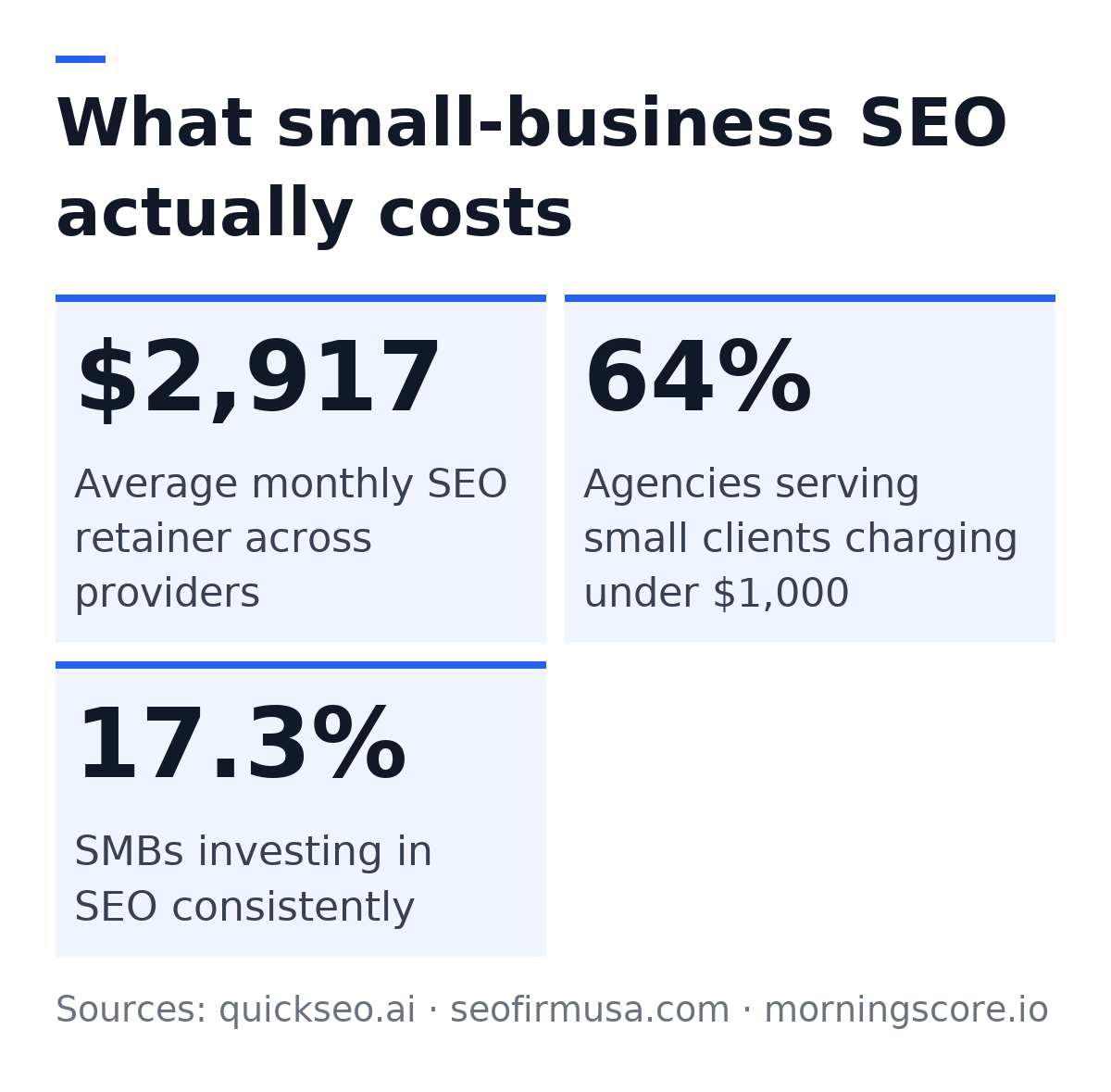
That last figure is the one I would remember. A 2026 survey by the Small Business Expo Research Desk (n=365) found only 17.3% of SMBs invest in SEO consistently, and 55.6% don't invest at all. For a small business, being consistent matters more than the size of the budget. The best low-cost resources are the ones you will keep running month after month.
Google Search Console
Google Search Console is Google's free tool for site owners. It reports the queries your pages appear for, along with impressions, clicks, average position and click-through rate. It also flags pages that cannot be indexed, problems with structured data, and Core Web Vitals issues. No paid tool can give you this data first-hand. Third-party suites estimate traffic, while Search Console reports what Google actually recorded.
For a small business, the most useful report is the list of queries where you rank between roughly positions 8 and 20. These are pages Google already considers relevant that sit just off the top results. Rewriting them is usually the cheapest SEO work available, because the page and the link equity already exist. The data also helps with AI search. AI assistants that draw on web search tend to cite pages that already rank and answer a question clearly, so a page that climbs in Google is more likely to be picked up.
- Performance report with queries, pages, countries and devices
- URL Inspection to check whether a specific page is indexed and why
- Sitemaps submission and indexing coverage reports
- Enhancements reports for structured data such as FAQ and product markup
- Core Web Vitals report based on real-user data
- API access, so other tools can read your data with permission
Best for Every small business with a website, without exception. Set it up before you spend anything on SEO. Then use its data as the baseline for judging any agency, freelancer or tool you try later. Solo founders can run it in half an hour a week.
Google Business Profile
Google Business Profile is the free listing that controls how a business appears in Google's local results and on Google Maps. You can add categories, hours, service areas, photos, products and posts, and you can reply to reviews. For businesses that serve customers in a defined area, it is often the highest-return free SEO asset there is. Small business marketers seem to agree: 91% of those actively optimizing their local business listing say they are likely or very likely to devote additional resources to it in the next 12 months.
B2B SaaS companies with no storefront still benefit from a verified profile. A profile confirms that the brand is a real entity, and Google and AI assistants use entity data when they decide which businesses to name. A complete profile with an accurate category, a description that matches your website, and genuine reviews makes your company easier to recognise as a distinct business. It takes one afternoon and costs nothing.
- Business categories and service-area settings
- Review collection and public replies
- Posts for offers, updates and events
- Insights on how people found the listing
- Products and services sections with descriptions
Best for Service businesses, clinics, agencies, shops and any company with customers in specific areas. SaaS founders should still claim and complete a profile so their brand is a recognised entity. They should not expect it to drive pipeline by itself.
Semrush
Semrush is an all-in-one SEO and marketing suite. It covers keyword research, competitor traffic analysis, backlink data, site audits, position tracking, local listing management and content tools. Its AI toolkit adds tracking of how a brand appears in AI assistant answers, so one subscription covers both Google and AI search monitoring. Pricing is public and tiered. Its add-ons, including the local and AI features, are billed separately from the core plan.
Semrush is a research and monitoring platform. It shows you what to fix and what to write, but your team still has to do the writing and the fixing. For a small business, the subscription pays off when someone in-house spends several hours a week acting on the data. If nobody has that time, the audits pile up unread. Semrush also suits teams that are hiring a freelancer and need an independent way to check that the freelancer's work moves rankings.
- Keyword Magic Tool for large keyword lists with intent labels
- Domain and competitor traffic analysis
- Site Audit with prioritized technical issues
- Position Tracking, including local and device-level views
- Backlink analytics and gap reports against competitors
- AI visibility features that show brand mentions in AI answers
Best for Small marketing teams or SEO managers who will run the research themselves and want one dashboard for keywords, audits, competitors and AI mentions. It also works as an independent check on an outside provider. It is less suited to solo operators who need articles written for them.
Clearscope
Clearscope is a content optimization platform. You enter a target keyword, and it builds a report of the terms, questions and topics that top-ranking pages cover. It then grades your draft against that report as you write in Google Docs, WordPress or its own editor. It can also monitor published content and flag pages that are losing traffic. Clearscope has added features for checking how content appears in AI search, which fits teams that now plan for both channels.
Clearscope improves writing that already happens. It does not decide your topics for you or publish anything. A small business with one capable writer, or a founder who enjoys writing, can raise the quality of every page with it. Teams looking for on page seo services often use a grader like this as the in-house version of the work. The writer does the optimization and the tool keeps it honest. Without anyone writing, though, the subscription has nothing to grade.
- Keyword-level content reports with term and question suggestions
- Real-time content grade inside Google Docs and WordPress
- Content inventory monitoring for traffic decay
- Readability and coverage guidance for writers
- Unlimited users on its plans, which helps with freelance writers
Best for Content and SEO managers at growth-stage companies who already produce articles in-house or with freelancers and want each page to be more complete. It is a quality layer that sits on top of an existing writing process. It does not replace that process.
Writesonic
Writesonic started as an AI writing tool and has grown into a platform that combines article generation with generative engine optimization features. It can draft SEO articles from a keyword, and its GEO features track how a brand is mentioned and cited across AI assistants. That puts writing and AI visibility monitoring in one subscription, which is the combination many small teams want in 2026.
In practice, Writesonic still expects a person to drive it. You pick the topics, run the drafts, edit them and publish them. That suits a marketer who wants to stay hands-on and likes having visibility data next to the editor. Teams comparing seo copywriting services against software often land on a tool like this. It costs far less than paying per article, and the trade-off is the hours spent editing and publishing.
- AI article writer with SEO-oriented templates
- AI search visibility tracking across major assistants
- Brand mention and citation monitoring
- Content suggestions tied to visibility gaps
- Integrations for publishing to common CMS platforms
Best for Demand generation and digital marketing teams who want to write with AI and track AI search mentions in the same place, and who have someone to edit and publish each week.
Outrank
Outrank is an automated SEO content platform. After you connect a site, it plans a content calendar, generates articles and publishes them to your CMS on a schedule, so a blog grows without the owner writing anything. It also includes a backlink exchange that connects participating sites. The pitch is simple: daily content on autopilot at a flat monthly price, which appeals to small sites that have never had a steady publishing rhythm.
Platforms like Outrank change what a small business pays for. The subscription covers output, not access to a tool. When you evaluate one, read a sample of what it publishes for a site like yours. Check whether the articles cite real sources, use structured data and link to your existing pages. Then decide whether its focus matches yours. Daily publishing suits a site that needs volume. A site that also needs to know where AI assistants recommend competitors may want visibility data alongside it.
- Automated content planning from your site and niche
- Scheduled article generation and publishing
- CMS integrations for common blogging platforms
- Backlink exchange among participating sites
- Multi-language article support
Best for Solo operators and bootstrapped builders who want a blog that fills itself on a predictable flat fee, and who care most about steady publishing volume.

Rankai
Rankai sells SEO as a managed, AI-driven service, closer to an agency than to a tool. It researches the topics, writes and publishes content and improves existing pages, with human SEO oversight on the AI's output. The client sees the result, more published and optimized pages, without operating any software. Its pricing is presented as a flat monthly fee, a different model from agency retainers billed by the hour.
This model suits founders who wanted to hire an agency and could not justify the price. Ahrefs' survey found agencies averaged $3,209 a month, consultancies $3,250 and freelancers about $1,348. AI-assisted services sit below those figures because software does much of the production. As with any service, ask for examples from sites in your category and agree on what counts as a deliverable before the first month.
Best for Founders and small teams who want an agency-style, hands-off arrangement with people involved, at a lower and more predictable cost than a traditional retainer.
Babylovegrowth
Babylovegrowth is an automated growth platform for small sites. It generates and publishes SEO articles on a regular cadence and runs a backlink exchange among member sites, and it covers AI search with content shaped to be cited by assistants. Content and link building come in one package, so it can take a new domain from no authority to a site with regular posts and some referring domains.
Link exchanges deserve a careful look whatever the provider. Google's spam policies treat excessive link schemes as a risk. Check how the network chooses partner sites and whether those links are relevant to your topic. For a brand-new small business site with nothing published, combining content and authority building in one product is the main attraction.
- Automated article generation and publishing
- Backlink exchange network between member sites
- Content shaped for AI assistant citations
- CMS publishing integrations
Best for New or very small sites that need published content and early backlinks at the same time, run by an owner who wants one subscription instead of separate content and outreach vendors.
Gushwork
Gushwork combines AI agents with human marketers to run inbound marketing for small and mid-sized businesses. SEO content is the core of the work. The service plans, writes, publishes and reports, and people stay involved in strategy and quality review. That makes it a done-for-you team built around AI, which is a different buying decision from licensing software.
Gushwork's hybrid model suits businesses that want a named person to talk to and some say in strategy, but cannot fund a full agency. Higher spending tends to bring higher satisfaction: those investing over $500/month were 53.3% more likely to be "extremely satisfied". Services in this tier are designed to reach that level of investment and output without the overhead of a traditional agency.
Best for SMBs and growth-stage companies that want human-reviewed SEO delivered as a service, with a person accountable for strategy and AI handling most of the production.
Gofylo
Gofylo publishes this article. It tracks how six AI assistants (ChatGPT, Google AI Overviews, Google AI Mode, Gemini, Perplexity and Claude) answer the searches your buyers make. It shows where those answers name competitors instead of you and which sites they cite. It then researches, writes and publishes articles aimed at those gaps directly to your CMS: WordPress, WordPress.com, Webflow, Shopify, Wix, Notion, Ghost, Framer, Feather or GitHub, plus a webhook. Each article includes schema markup, internal links, FAQ blocks, verified source citations and AI-generated images, in 18+ languages.
Once an article is live, Gofylo uses your Google Search Console data to rewrite pages that sit just off page one, and keeps the earlier version so you can restore it. Plans are Starter at $149/month (10 articles, 50 tracked searches), Pro at $299/month (20 articles, 150 searches) and Business at $599/month (30 articles, 350 searches). Yearly billing costs 10 months' price, and every plan has a 7-day free trial with a card. A free AI Visibility report shows any site which businesses AI assistants name for its buyers' searches, before you pay anything. For founders working through Startup SEO in 2026, it covers Google and AI search in one subscription, without a content team.
- AI visibility tracking across six assistants, with the competitors they name
- 10, 20 or 30 published articles a month depending on plan
- Direct publishing to ten CMS platforms plus a webhook
- Search Console-based refresh of pages just off page one, with restore
- Free AI Visibility report for any site
Best for Lean B2B SaaS startups, solo operators and small marketing teams who want Google rankings and AI assistant mentions covered by one autonomous subscription. It pairs well with free Google tools and with seo monitoring tools you may already use.
Whichever resources you choose, run them for at least a full quarter before judging. Keep Search Console as your source of truth for Google results. Track AI assistant mentions separately, because a page can be cited by Perplexity long before it reaches the top of Google, and a page can rank well in Google without being cited at all. A small budget can produce real results when it is spent on a consistent supply of published, refreshed pages and measured in both channels.
See which businesses AI assistants name for your buyers' searches before you spend anything. Run the free AI Visibility report from Gofylo, then start a 7-day free trial on the Starter plan ($149/month, 10 articles) to have articles aimed at those gaps published to your CMS this week.
Sources
- How Much Does SEO Cost in 2026? US Pricing Data - seofirmusa.com
- SMB SEO Statistics 2026: 75+ Benchmarks on Budgets, ROI, Time-to-Result, Churn & GEO - quickseo.ai
- How Much Does SEO Cost for a Small Business? 2025 Pricing Tiers - growth-rocket.com
- The SEO Services Report - Increv - increv.co
- Does SEO Work for Small Business? Yes. Here's the Data 2026 - morningscore.io
- Small Business Search Marketing Statistics - servicedirect.com
Related: Which Parts of SEO Can You Automate, and Which Still Need a Human?