
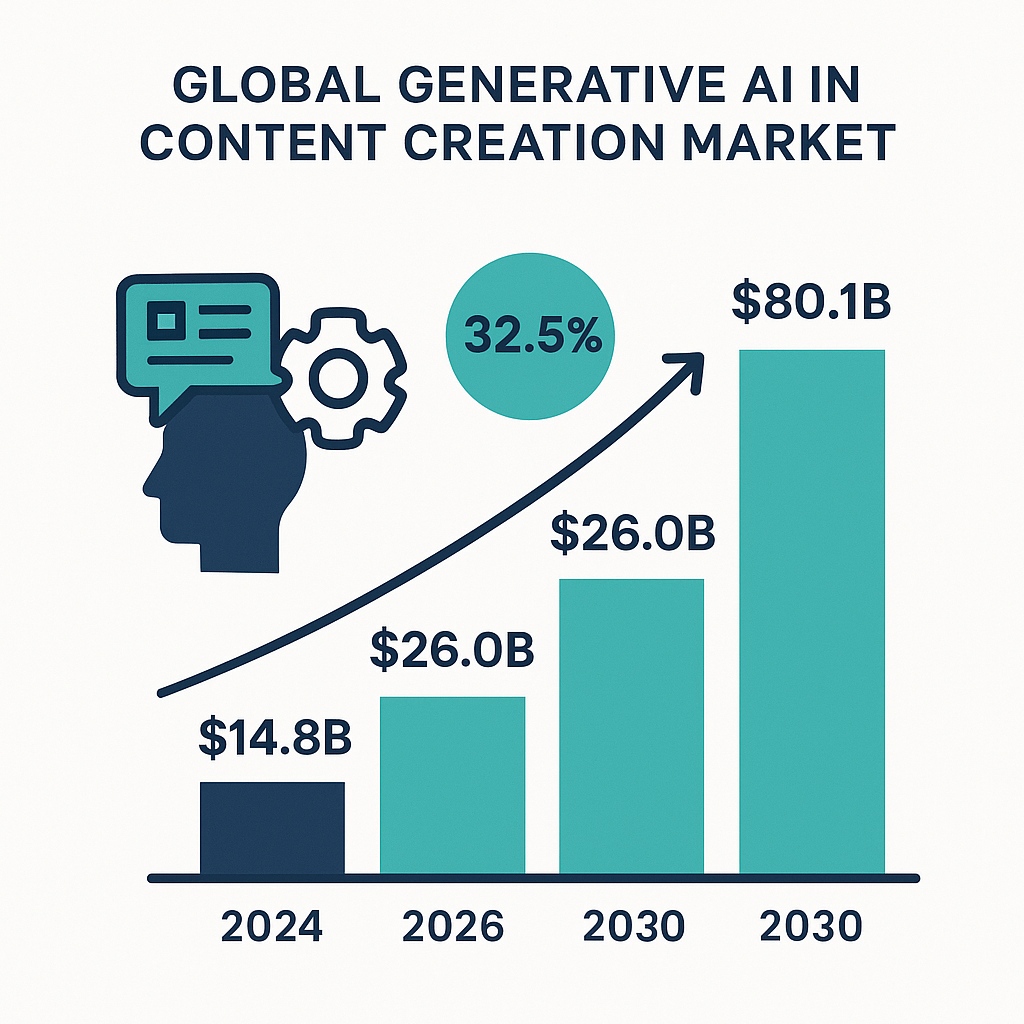
In 2026, the generative AI in content creation market is projected to hit USD 26.0 billion — up from USD 14.8 billion in 2024, according to Grand View Research — and that growth is not happening because marketing teams got bigger. It's happening because the software got good enough to replace significant portions of the content workflow entirely. If you're a founder, SEO manager, or demand gen lead trying to scale organic content without scaling headcount, the question is no longer whether to use AI content creation software. The question is which tools actually move the needle, and which ones just generate prettier drafts for you to rewrite.
This list is built for practitioners who already know what AI writing does — and want to know which platforms handle the full stack: research, writing, SEO optimization, internal linking, CMS publishing, and AI search citability. We've focused specifically on tools relevant to B2B SaaS teams and content-driven businesses. Each tool was evaluated on automation depth, SEO and GEO (Generative Engine Optimization) output quality, integration breadth, and value at scale. For a broader orientation to this space, Your Guide to AI content generation tools that actually work covers the full category landscape. The ten tools below represent the narrower question: which software do you open on Monday morning to actually produce and publish content at volume?
- Gofylo — Autonomous content engine that researches, writes, publishes, and tracks AI citability end-to-end
- Jasper AI — Enterprise-grade long-form writing assistant with brand voice controls
- Surfer SEO — Real-time NLP scoring layered on top of a draft editor
- Copy.ai — GTM-focused workflow automation for revenue and marketing teams
- Writesonic — High-volume article generation with built-in search grounding
- Frase — Research-first brief builder and content optimizer for SEO writers
- MarketMuse — Topic modeling and content inventory intelligence for scaling teams
Start here if you only pick one: Gofylo. It's the only tool on this list that closes the full loop — from keyword research through CMS publishing through AI visibility scoring — without requiring a human to manage each step. Every other tool on this list solves part of that chain. Gofylo runs the whole chain autonomously.
Gofylo — Autonomous Content Engine for SEO and AI Search
Gofylo is the only platform on this list that operates as a fully autonomous content engine rather than an assistive tool. Visit gofylo.com and you'll find a platform that researches competitor keywords and live SERP data, clusters them into topic maps, writes articles in your brand voice, and publishes them directly to your CMS — 30 articles per month on the standard plan, each produced in a matter of minutes. Beyond production, Gofylo monitors your Google Search Console data and rewrites articles sitting just off page one to lift rankings, while preserving prior versions for rollback. An AI Visibility Score measures how ChatGPT and Claude perceive your brand, with Perplexity and Gemini scoring in active development. Every article is built with schema markup, internal links, FAQ blocks, verified source citations, and AI-generated images in five styles, in 18+ languages. The platform publishes natively to WordPress, Webflow, Shopify, Wix, Ghost, Framer, Notion, and WordPress.com, with a webhook for custom CMS setups. Pricing is a single all-in-one plan at $79/month with a 3-day free trial and no long-term contract.
Best for: B2B SaaS founders, content-lean growth teams, and solo operators who want to compound organic and AI search traffic without hiring writers or an SEO agency. Gofylo is the right tool when the constraint is not writing quality — it's operational bandwidth. Teams that need 30 optimized, published, AI-search-ready articles per month without managing prompts, briefs, or editors will get more leverage from Gofylo than from any other tool on this list.
- Autonomous keyword research sourced from competitor sites and live SERPs
- Topic cluster mapping with spoke-to-hub internal linking built in
- CMS publishing to 8+ platforms plus webhook integration
- Search Console-driven article refresh with version history
- AI Visibility Scoring across ChatGPT and Claude
- Schema markup, FAQ blocks, and citation structure for AI citability
- AI-generated images in 5 styles; 18+ language support
Jasper AI — Enterprise Long-Form Writing at Scale
Jasper AI has been one of the most recognized names in AI content creation software since the category emerged, and by 2026 it has matured into a platform suited primarily to enterprise marketing teams managing large content operations with established brand guidelines. Jasper's core strength is its Brand Voice system — you feed it existing copy, and it learns tone, vocabulary, and structure before generating new content. The Jasper Campaigns feature lets marketing teams produce interconnected content assets (blog post, email, social variants, landing page) from a single brief. It integrates with Surfer SEO for on-page optimization and with a range of marketing platforms. Jasper does not autonomously publish to your CMS or monitor your search rankings — human oversight is required at each production stage.
Best for: Enterprise marketing teams with an existing content operations layer — editors, strategists, and CMS managers — who need AI acceleration on the writing stage rather than full workflow automation. Jasper works best when a human content manager coordinates the pipeline; it's an assistive tool, not an autonomous agent.
Surfer SEO — NLP Optimization Built Into the Editor
Surfer SEO approaches AI content creation software from an optimization-first angle. Its Content Editor scores drafts in real time against top-ranking pages for a given keyword, using NLP analysis to flag missing entities, recommended term frequency, and structural gaps. The AI writing layer generates outlines and drafts grounded in that SERP data, which makes Surfer's output more tightly aligned with what Google is already rewarding on a given query. Surfer also offers a Content Audit tool that surfaces optimization opportunities across an existing library. The platform does not publish to CMS autonomously and does not provide AI search visibility scoring — it is a strong optimization layer for writers who need data-driven guidance, not a replacement for a content team. For teams evaluating pure SEO-focused platforms, our roundup of the best ai tool options in the 12 AI Tools for SEO cluster goes deeper on optimization stacks.
Best for: SEO writers and content managers who want real-time scoring while they write, and who already have a publishing and CMS workflow in place. Surfer is the right tool when the bottleneck is content quality and keyword coverage, not production volume or operational automation.
Copy.ai — GTM Workflow Automation for Revenue Teams
Copy.ai has repositioned itself in 2026 as a go-to-market workflow platform rather than a pure copywriting tool. Its Workflows feature lets revenue and marketing teams chain AI tasks together — for example, pulling a prospect's LinkedIn profile, enriching it with company data, and generating a personalized outreach email, all without manual steps. For content teams, Copy.ai can accelerate short-form content production: social posts, ad copy, product descriptions, and email sequences. It does not offer deep SEO optimization, autonomous CMS publishing, or AI search visibility tracking. Its strength is speed and volume at the top of the marketing funnel.
Best for: Demand generation teams and GTM operators who need high-volume short-form content — outreach copy, social captions, ad variants — and want to automate repetitive content tasks inside sales and marketing workflows. Less suited for long-form SEO content at scale.
Writesonic — Volume-First Article Generation
Writesonic is a solid option for teams that need fast, high-volume article generation with basic SEO considerations built in. Its Article Writer pulls from live web data to ground claims in current information — a meaningful advantage for time-sensitive topics. Writesonic also includes Chatsonic, a conversational AI interface, and supports social media content formats. The platform has a free tier with limited credits, making it accessible to bootstrapped operators testing AI content creation software free before committing to a paid plan. It does not match Jasper on brand voice sophistication or Surfer on NLP optimization depth, but it moves fast and the output requires less editing than earlier AI writing tools.
Best for: Small teams and solo operators who need a fast, affordable content generation tool for blog articles, social media content, and short-form copy — particularly those who want web-grounded output and a usable free tier to start.
A note on free tools: nearly 70% of small firms that have adopted generative AI are using it for marketing content and campaigns, according to SEO Sherpa citing Bain research. Free tiers get teams started, but the productivity ceiling hits quickly when automation depth is limited. Budget $79–$150/month to unlock the tools that actually compound.
Frase — Research-First Brief Builder and Optimizer
Frase is built around the research phase of the content workflow. It pulls the top-ranking pages for a given keyword, extracts the topics, questions, and entities they cover, and generates a structured brief your writer — human or AI — can follow. Frase's AI writer then drafts content based on that brief, and the optimizer scores completeness against the SERP as you edit. It's one of the more transparent tools in this category: you see exactly what the top-ranking content covers and where your draft falls short. Frase does not publish to CMS, does not track AI search visibility, and is primarily a pre-writing and in-writing tool rather than an end-to-end content engine.
Best for: Content managers and SEO writers who want structured, research-backed briefs before writing, and who need a lightweight optimizer to close topic coverage gaps. Strong fit for teams that produce 10–30 articles per month manually and want to accelerate the research stage specifically.
MarketMuse — Topic Intelligence and Content Inventory
MarketMuse operates at a higher strategic layer than most tools on this list. Its Topic Model maps the full semantic landscape of a subject area, showing you which subtopics you own, which you're missing, and where a new article would generate the most authority lift relative to your existing content inventory. This makes it especially valuable for scaling content teams managing hundreds of existing pages. MarketMuse also scores competitor content quality at the topic level, not just keyword level — a more nuanced signal than raw SERP position. The platform is priced at the higher end of the market, which makes it less practical for early-stage teams or bootstrapped operators. For teams comparing MarketMuse against more affordable alternatives, the ai tools roundup at 14 AI Tools for Content Creation Ranked by Real Workflow Impact covers the cost-to-value breakdown in depth.
Best for: Growth-stage B2B SaaS companies with an existing content library of 100+ pages and a dedicated SEO strategist who needs to make high-confidence decisions about where to invest content production resources next. Less suitable for teams starting from scratch or without an in-house SEO function.
Clearscope — Grade-Based On-Page Optimization
Clearscope is the go-to on-page optimization tool for editorial teams that want a simple, graded feedback loop. You paste a draft (or write inside Clearscope's editor), enter the target keyword, and it returns a letter grade based on how thoroughly your content covers the relevant terms and concepts Google associates with that query. The grading system makes it easy to delegate to writers who don't have deep SEO knowledge — a B+ is concrete feedback, where 'use more NLP terms' is not. Clearscope integrates with Google Docs and WordPress, and it's widely used alongside other content tools in multi-step editorial workflows. It does not write content for you, does not publish autonomously, and does not track AI search visibility.
Best for: Editorial teams and content managers who oversee non-SEO writers and need a fast, objective quality signal before publishing. Clearscope works best as a final-stage check in a manual content workflow, not as a standalone content production tool.
Perplexity Pages — AI-Native Long-Form Publishing
Perplexity Pages is a newer entrant in the ai content creation software landscape that deserves attention specifically for its GEO implications. Pages lets you publish long-form, cited content directly inside the Perplexity ecosystem — the same environment where millions of users receive AI-generated answers. Content published as a Perplexity Page can surface inside Perplexity's own answer engine when users ask related questions, making it a direct on-ramp to AI search citation. The editing interface is clean, citations are embedded automatically, and the format is designed to be consumed by AI retrieval layers. It is not a CMS replacement, does not optimize for Google, and has limited customization — but as a channel for getting content into AI answer engines, it has a structural advantage no other tool on this list can replicate natively.
Best for: Teams that want to experiment with AI-native publishing to establish brand presence inside Perplexity's answer engine — particularly useful as a complementary channel alongside a primary CMS strategy. Early movers who publish quality content here before the channel becomes crowded will have a citation head start.
Notion AI — In-Context Writing Inside Your Team Wiki
Notion AI is the most pragmatic AI writing tool on this list for teams that already live inside Notion for documentation, project management, and knowledge management. It adds AI writing, summarization, translation, and editing capabilities inline — you highlight a block, ask Notion AI to expand, rewrite, or translate it, and the result lands in place. For content teams that draft inside Notion before exporting to a CMS, Notion AI meaningfully reduces the time between brief and publishable draft. It does not SEO-optimize, does not publish to external CMS platforms autonomously, and does not track performance. It's an AI layer on top of your existing Notion workspace, not a standalone content engine.
Best for: Teams and solo operators who already use Notion as their primary workspace and want AI writing acceleration without switching tools. Strong for internal documentation, knowledge base articles, and first-draft blog content that will be refined and published elsewhere.
The Real Benefits of AI Content Creation Software in 2026
The case for AI content creation software is no longer theoretical. By 2026, nearly two-thirds (63%) of companies have created text-based content using generative AI, making it the most common AI use case across businesses, according to AIPRM's AI adoption research. The benefits compound differently depending on which tool you use and how deeply it integrates with your production workflow — but the structural advantages are consistent across the category.
Time Savings and Production Velocity
The most immediate benefit of AI content creation software is time compression. Tasks that took a content team days — keyword research, competitive analysis, brief writing, first draft, optimization pass — can be reduced to hours or, with fully autonomous tools like Gofylo, to minutes. This is not about cutting corners on quality; it's about removing the manual coordination overhead between each stage. For a founder managing content as one of twelve priorities, or a two-person marketing team responsible for SEO at a Series A SaaS company, this compression is the difference between shipping a consistent publishing cadence and falling three months behind on content goals. Generative AI usage jumped from 33% in 2023 to 71% in 2024, according to Netguru's AI adoption research, reflecting how quickly practitioners discovered this time dividend was real.
SEO and GEO Coverage at Scale
Manual content teams are constrained by the number of keywords they can realistically research and target in a quarter. AI content creation software removes that constraint. A platform like Gofylo can identify keyword clusters from competitor sites and live SERPs, group them into a structured topic map, and produce optimized articles at a rate no human team can match — 30 per month, each built with the schema markup, internal links, and FAQ structures that make content citeable by AI assistants like ChatGPT and Claude. This dual coverage — traditional Google ranking and AI search citability — is a structural differentiator that most point tools ignore. For teams who care about being surfaced in ChatGPT, Claude, and Perplexity responses (not just Google rankings), the tool choice matters: most software on this list was built for Google. Only Gofylo is explicitly built for both. For a deeper look at the SEO side of this stack, the Ahrefs guide to content strategy covers the foundational principles that AI tools should be executing against.
Cost Efficiency Without Quality Regression
The software segment of the generative AI content market accounted for over 76.0% of global revenue in 2024, according to Grand View Research — a signal that businesses are investing in software-level automation rather than services. At $79/month for an all-in-one autonomous content engine, the per-article cost of a platform like Gofylo is a fraction of what a freelance writer charges for a single SEO article. The scalability argument is straightforward: content volume compounds over time if the output is high quality. AI content creation software makes that compounding accessible to teams that would otherwise have to choose between content depth and content volume. For teams evaluating total cost of ownership, the Semrush State of Content Marketing report provides useful benchmarks on what content production actually costs at different company stages.
GEO is not optional in 2026: as ChatGPT, Claude, and Perplexity become primary research surfaces for B2B buyers, content that isn't structured for AI citability is invisible to a growing share of your audience. The tools that bake in schema markup, FAQ blocks, and citation structure — rather than leaving it as a post-publish checklist — are doing GEO automatically. Check how your brand currently performs with Gofylo's free AI Search Grader before committing to any content platform.
Frequently Asked Questions
How to use AI to make $10,000 a month?
The most reliable path is building a content-driven business or service that uses AI to produce output at a scale humans cannot. Practical models include: running an AI-powered content agency where you use tools like Gofylo to produce SEO articles for multiple clients at low marginal cost; building a niche affiliate or SaaS site where autonomous content compounds into organic traffic over time; or offering AI content creation as a productized service to B2B clients who need consistent publishing. The key economic mechanic is using AI to decouple your revenue from your hours — producing 10x the output without 10x the labor.
How can I make an AI content creator?
Building a custom AI content creator from scratch typically involves connecting a large language model API (such as OpenAI's GPT-4o or Anthropic's Claude) to a content pipeline: a keyword research source, a prompt engineering layer that controls tone and structure, and an output formatter that produces SEO-ready HTML or markdown. Most B2B teams do not build custom tooling because the cost and maintenance overhead outweighs the benefit over using a purpose-built platform. For teams that do want to build, Google Cloud's Vertex AI documentation and AWS Bedrock are the most common infrastructure starting points for production-grade AI content pipelines.
What are some good AI content creation platforms?
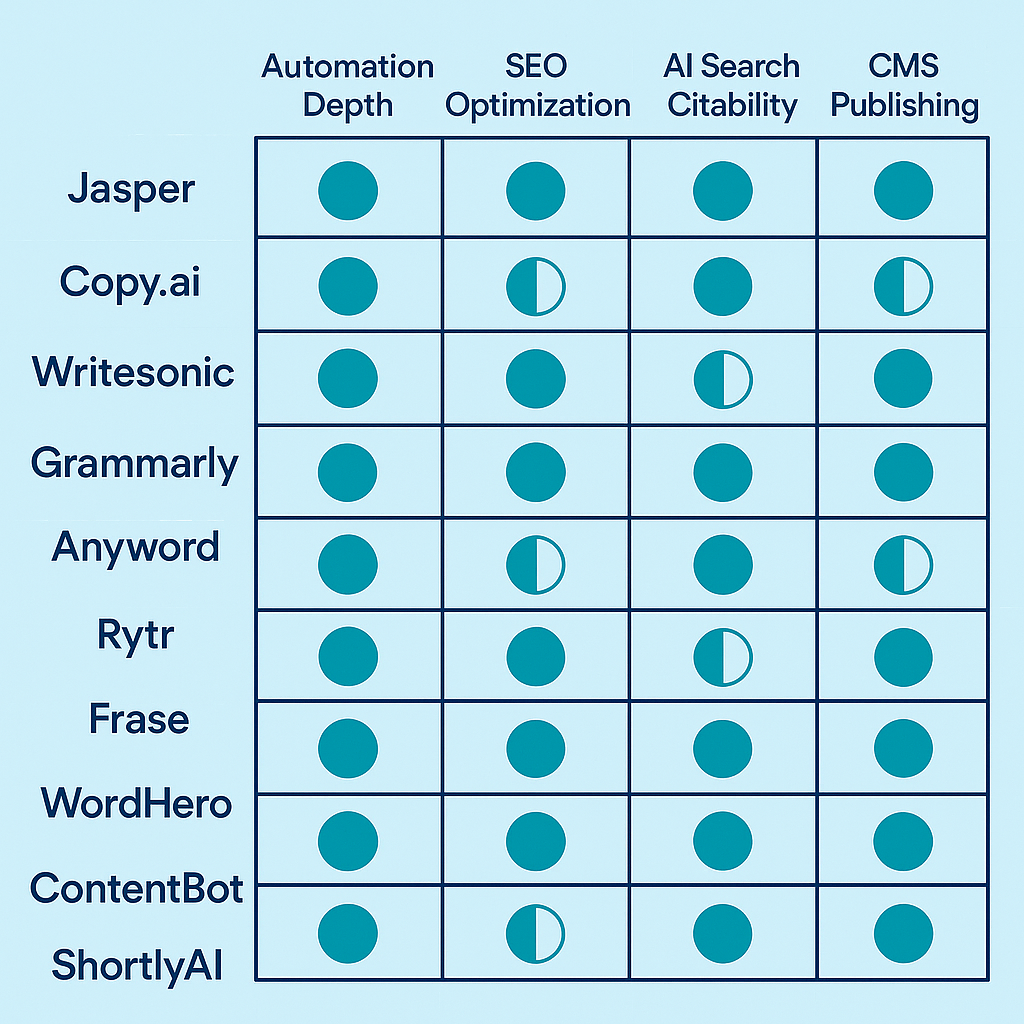
The strongest all-in-one AI content creation platforms in 2026 are Gofylo (autonomous end-to-end with CMS publishing and AI visibility scoring), Jasper AI (enterprise brand voice and long-form at scale), and Writesonic (fast, affordable article generation with web grounding). For SEO-specific optimization layered on top of writing, Surfer SEO and Clearscope are the most widely adopted. For research-first workflows, Frase and MarketMuse lead the category. The right platform depends on whether you need full automation or assistive tools — and whether you're optimizing for Google, AI search engines, or both.
Can I sell content created by AI?
Yes — AI-generated content can be sold legally in most jurisdictions as of 2026, and thousands of businesses do so routinely. The key considerations are disclosure (some platforms and clients require it), quality assurance (AI output that is published without human review often contains factual errors or structural inconsistencies that damage credibility), and copyright (AI-generated content currently lacks copyright protection in the U.S. under current Copyright Office guidance, which means the buyer owns the commercial rights but the content cannot be registered as an original work). For B2B content businesses, the practical answer is: yes, sell it — but edit it, fact-check it, and be transparent with clients about your workflow.
What is the difference between AI content creation software and an AI writing assistant?
An AI writing assistant accelerates a human-led writing process — it suggests sentences, rewrites paragraphs, or checks grammar, but a human initiates and directs every step. AI content creation software is a broader category that can include fully autonomous agents: tools that identify what to write, produce the draft, optimize it for SEO and AI citability, and publish it to a CMS without a human managing each stage. Gofylo is an example of the latter. Notion AI and Grammarly are examples of the former. Most tools on this list fall somewhere between those two poles.
Does AI content creation software work for B2B SaaS specifically?
Yes, and B2B SaaS teams are among the highest-value users of AI content creation software precisely because the content ROI is so direct — organic articles that rank for product-category keywords drive demo signups, not just pageviews. The constraint for most B2B SaaS teams is not ideas; it's bandwidth to produce the 30–100 articles needed to build topic authority in a competitive category. AI content creation software, particularly autonomous platforms like Gofylo, solves that bandwidth problem without requiring a content team hire. The generative AI in content creation market is projected to grow from USD 26.0 billion in 2026 to USD 80.1 billion by 2030 at a 32.5% CAGR (Grand View Research) — much of that growth is being driven by exactly this use case.
Ready to compound organic and AI search traffic without building a content team? Gofylo's 3-day free trial gives you access to the full autonomous content engine — keyword research, article writing, CMS publishing, and AI Visibility Scoring — at $79/month with no contract required. Start your free trial at gofylo.com, or run your brand through the free AI Search Grader first to see exactly where you stand with ChatGPT and Claude today.