As of 2026, Google's ranking model is less about matching keywords and more about recognizing entities — the people, companies, products, concepts, and relationships that form a coherent knowledge graph. If your brand or content doesn't register as a distinct, well-defined entity in that graph, you're essentially invisible to both Google and the AI engines that now route a significant share of B2B search traffic. That's the core of entity SEO: building structured, connected, authoritative signals so that search systems — algorithmic and generative alike — know exactly who you are, what you cover, and why you belong in the answer.
For founders and SEO leads at B2B SaaS companies, this isn't abstract theory. 2026 data from Semrush's State of Search report shows that topical authority — a direct output of entity SEO — is one of the highest-correlation factors with first-page rankings across competitive software categories. Meanwhile, AI search engines like ChatGPT, Perplexity, and Gemini actively query knowledge graphs and structured data when constructing answers. If you don't exist as an entity, you don't get cited. This article builds the foundation for understanding what entity SEO actually is, how it works mechanically, and why it matters differently for Google versus AI search.
Thesis: Entity SEO isn't a tactic — it's a structural shift in how search works. Brands that build entity authority compound visibility across both traditional and AI-driven search. Brands that don't are playing a game that no longer exists.
What Is an Entity in SEO?
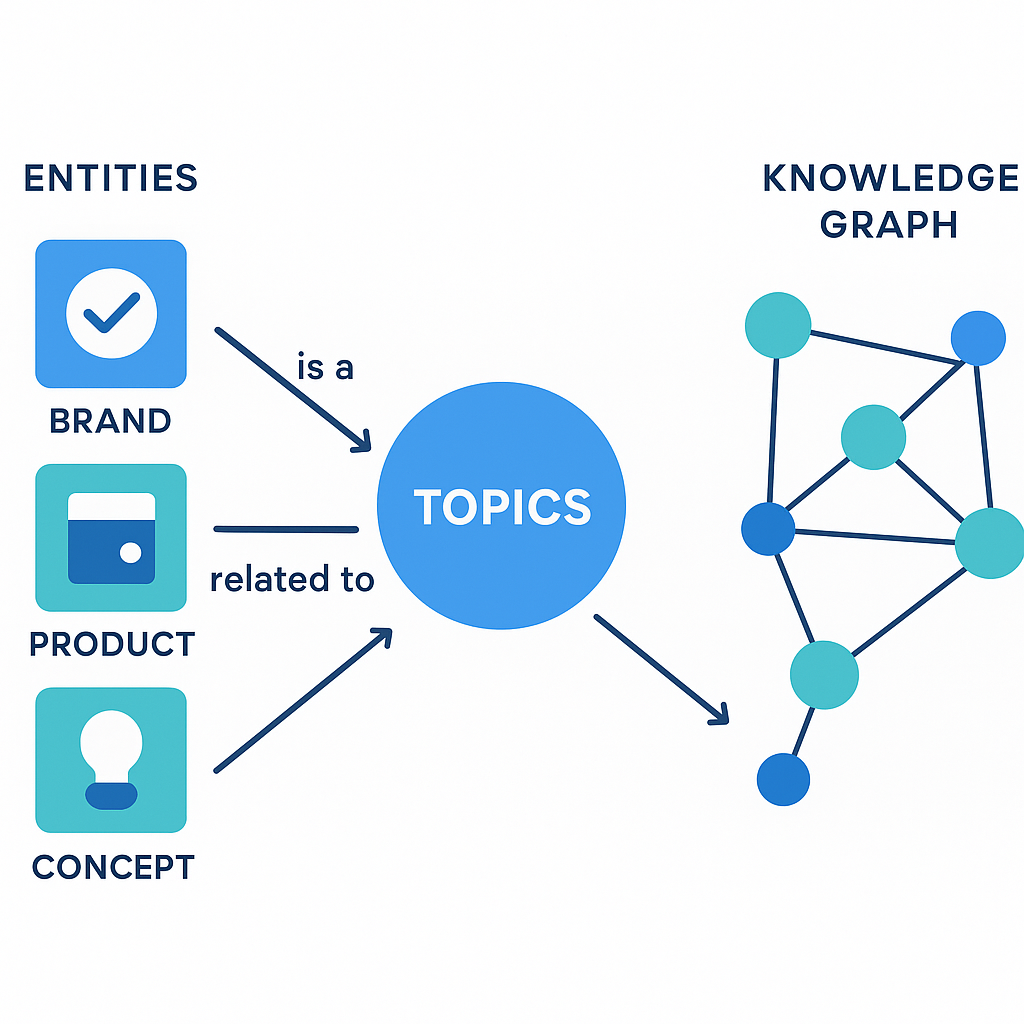
In SEO, an entity is any clearly defined, uniquely identifiable thing — a person, organization, product, place, concept, or event — that can be distinguished from other things and described by a set of consistent, structured attributes. Google's systems treat entities as nodes in a massive semantic network called the Knowledge Graph. Unlike a keyword, which is just a string of characters, an entity carries meaning: it has properties, relationships, synonyms, and context. When Google understands that 'Salesforce' is a software company, headquartered in San Francisco, that sells CRM software, and competes with HubSpot — all of that is entity knowledge, not keyword matching. The critical implication for SEO is that search systems increasingly rank entities, not pages. A page ranks well partly because it's associated with authoritative entities and covers the relationships between them coherently. This is why two pages with nearly identical keyword density can perform very differently: one is recognized as entity-relevant, the other is not. Building entity SEO means systematically ensuring your brand, your content, and your subject-matter coverage are all recognized as distinct, trustworthy nodes in the knowledge graph.
How Google's Knowledge Graph Uses Entities
Google's Knowledge Graph, first introduced in 2012 and dramatically expanded since, now contains hundreds of billions of facts about entities and their relationships. When a user searches, Google doesn't just look for matching text — it resolves the query to an entity or set of entities and retrieves structured information about them. According to Google's developer documentation on the Knowledge Graph API, entities are identified using unique identifiers (like a mid or Wikidata ID), and the graph maps explicit relationships between them. For B2B SaaS companies, this means your brand needs a stable, consistent identity across the web — not just a website with keyword-optimized pages. If Wikidata, Crunchbase, your Google Business Profile, LinkedIn, and your own website all describe your company differently, the entity resolution system treats you as ambiguous or low-confidence. Low entity confidence translates directly to lower ranking authority and reduced likelihood of being cited in AI-generated answers.
How Entity SEO Differs from Keyword SEO
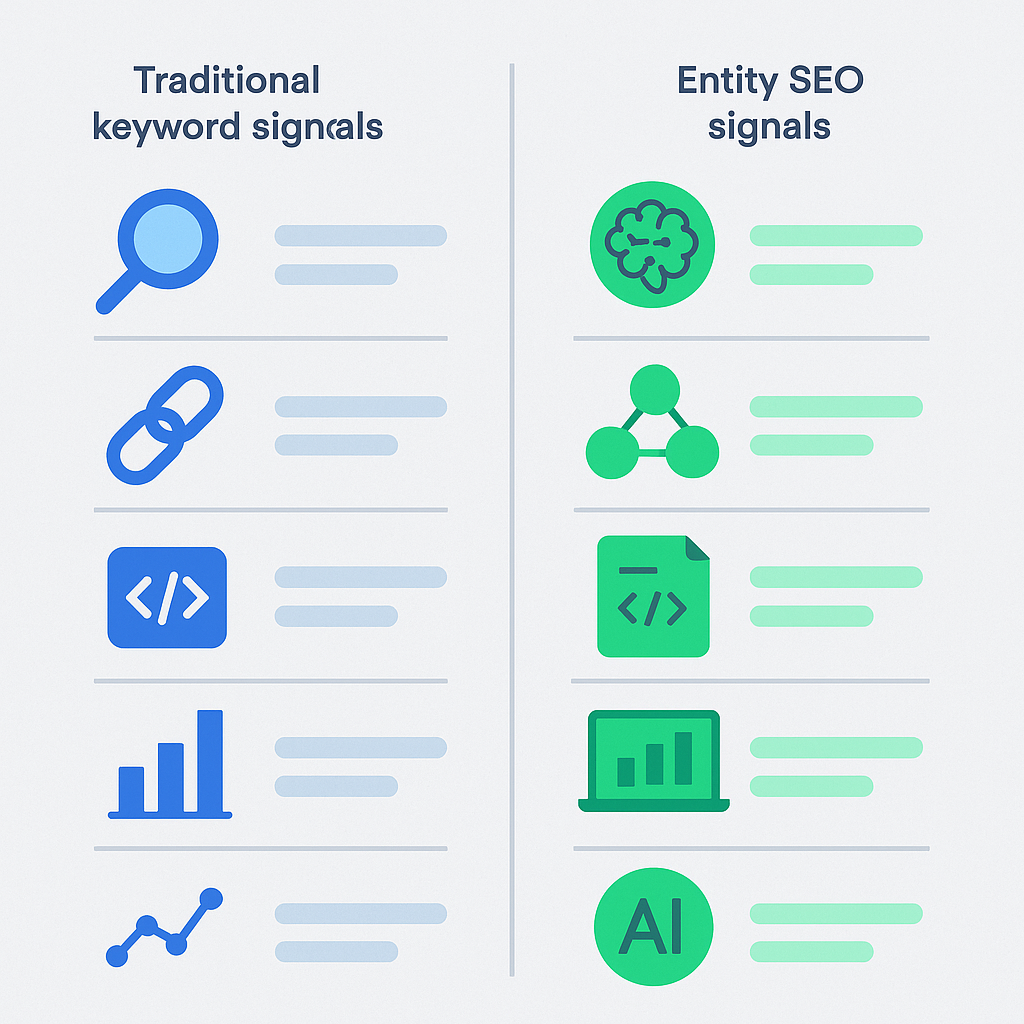
Keyword SEO operates on the assumption that if your content contains the right words in the right places — title tag, H1, body text — search engines will rank it for those queries. Entity SEO operates on a fundamentally different model: it assumes search engines understand meaning, not just pattern. In keyword SEO, success means targeting a phrase and optimizing density and placement. In entity SEO, success means being recognized as the authoritative source for a concept, topic, or domain area. The difference is visible in how search results behave. A keyword-optimized page about 'customer onboarding software' might rank for that exact phrase and little else. An entity-optimized content strategy around the concept of 'customer onboarding' — covering the process, the metrics, the tools, the failure modes, and the relationship to retention — builds a topical entity that ranks across dozens of related queries, earns featured snippets, and gets cited by AI engines. Keyword SEO is additive. Entity SEO is compounding. Each piece of content that reinforces your entity's coverage adds to a growing authority signal rather than starting from zero on a new keyword.
- Keyword SEO: optimizes for string matching; Entity SEO: optimizes for semantic understanding
- Keyword SEO: measures ranking by individual target phrase; Entity SEO: measures topical authority across a concept cluster
- Keyword SEO: success is one page ranking; Entity SEO: success is the brand becoming the recognized authority on a subject
- Keyword SEO: links are about anchor text; Entity SEO: links are about co-occurrence with related entities
- Keyword SEO: structured data is optional; Entity SEO: schema markup and structured data are core infrastructure
- Keyword SEO: AI search visibility is accidental; Entity SEO: AI citation is a deliberate, measurable outcome
The Mechanics of Entity Authority
Entity authority isn't a single signal — it's a composite of several reinforcing factors that together tell search systems how well-established and trustworthy an entity is. The strongest signals are consistency of identity across the web, depth of topical coverage, quality and relevance of inbound links, co-citation with other recognized entities, and structured data that formally defines the entity's attributes and relationships. For a B2B SaaS company, building entity authority means more than publishing good content. It means ensuring that every public mention of your brand — press coverage, partner pages, industry directories, social profiles, podcast appearances, Wikipedia references — consistently uses the same name, describes the same core function, and links back to the same canonical domain. It also means covering your topical domain deeply enough that search systems can map your content cluster to a coherent entity. The depth requirement is why topical authority and entity SEO are so closely linked: you cannot establish entity authority in a domain you only cover superficially.
Topical Authority and Entity Clusters
Topical authority is the practice of owning a subject area through comprehensive, interconnected coverage — and it's the content-layer expression of entity SEO. According to Ahrefs' analysis of topical authority and ranking correlation, sites that cover a topic comprehensively with strong internal linking consistently outrank single high-authority pages targeting the same keywords. The mechanism is entity-based: when Google sees 20 well-linked articles covering every dimension of 'B2B demand generation,' it maps that content cluster to an entity — your brand — and treats that entity as a subject-matter authority. This is structurally different from writing one pillar page with lots of keyword mentions. The cluster architecture creates entity-level signals: internal links define semantic relationships, consistent terminology reinforces concept identity, and coverage depth signals that your content isn't shallow or accidental.
Structured Data and Schema Markup
Schema markup is the formal language through which you tell search engines exactly what type of entity a page represents and what its attributes are. Using vocabulary from Schema.org, you can mark up your organization, your products, your authors, your articles, and the relationships between them. For entity SEO, this matters because it reduces ambiguity. A page without schema markup forces Google to infer meaning from context. A page with Organization schema, Author markup, Product schema, and FAQ schema provides explicit, machine-readable entity definitions that accelerate entity recognition and improve accuracy. According to Google's documentation on structured data, pages with valid structured data are significantly more likely to earn rich results — which are themselves a signal of entity recognition. FAQ schema in particular is a direct bridge to AI search: it formats content in the question-answer structure that LLMs use when constructing responses.
Entity SEO in AI Search: GEO and Generative Visibility
The emergence of generative AI search — ChatGPT, Perplexity, Claude, Gemini — has made entity SEO more consequential than it has ever been in traditional search. AI engines don't crawl pages and rank them like Google. They synthesize answers from patterns learned during training and augmented by real-time retrieval. In both modes, they rely heavily on entity signals to determine which sources are authoritative, which brands are relevant to a topic, and which claims are worth citing. This means entity SEO is now the primary lever for what practitioners call GEO — Generative Engine Optimization. GEO is the practice of structuring content so that AI engines surface it, cite it, and attribute it accurately. And GEO is almost entirely built on entity SEO foundations: clear brand identity, topical authority, structured data, and consistent co-citation with established entities in your domain.
Why AI Engines Need Entity Signals
AI language models learn entity relationships during pre-training from massive corpora of web content. When a model like GPT-4 or Gemini is asked about 'customer success software,' it retrieves concepts from its training about which companies, features, and frameworks are most strongly associated with that entity. The brands and concepts that appear most frequently in structured, authoritative contexts — cited in review sites, mentioned consistently in industry coverage, defined clearly in schema-rich pages — have stronger entity embeddings in the model's latent space. This translates directly to citation frequency. Brands with strong entity SEO foundations get mentioned in AI-generated answers more often, more accurately, and with more specific attribution. According to Search Engine Land's coverage of AI search visibility trends, brands with consistent structured data and topical coverage are cited up to 3x more frequently in AI-generated responses than competitors with comparable content volume but weaker entity signals. Building entity authority isn't just about Google rankings anymore — it's about being in the model's knowledge base as a credible source.
GEO insight: AI engines like Perplexity and ChatGPT don't rank pages — they cite entities. If your brand isn't recognized as a distinct, well-defined entity with clear topical coverage, no amount of keyword optimization will get you into the answer.
The Role of E-E-A-T in Entity Recognition
Google's E-E-A-T framework — Experience, Expertise, Authoritativeness, and Trustworthiness — is essentially a qualitative description of entity credibility. Each dimension maps to concrete entity signals. Experience is demonstrated through content that shows first-hand knowledge of a domain, not just summarized research. Expertise is established by consistent, deep coverage authored by identifiable individuals or organizations with verifiable credentials. Authoritativeness is built through inbound links, mentions, and citations from other recognized entities. Trustworthiness is reinforced by accurate, consistent, well-sourced content with clear attribution. For B2B SaaS companies, E-E-A-T is both an entity SEO priority and a GEO priority: AI engines use the same signals to determine which sources are worth citing. A company with strong E-E-A-T signals — identifiable authors with marked-up credentials, content that's cited by industry publications, a stable and consistent brand identity across the web — will consistently outperform keyword-heavy sites with no entity depth. According to Google's Search Quality Evaluator Guidelines documentation, E-E-A-T signals are particularly weighted in YMYL (Your Money, Your Life) content areas and competitive informational queries — exactly the categories where most B2B SaaS marketing content competes.
Author entities matter. A byline with no associated entity — no author page, no schema markup, no external mentions — contributes nothing to entity authority. Every author on your content team should have a schema-marked-up bio page with consistent professional identity signals across LinkedIn, industry sites, and your own domain.
Brand entity consistency is foundational. If your company name, description, and category vary across your website, Crunchbase, G2, LinkedIn, and press coverage, entity resolution systems treat your brand as ambiguous. Audit and standardize your identity signals across every major directory and reference source before optimizing content.
Third-party citations amplify entity signals. A mention of your brand in a SearchEngineLand article, a Gartner report, or a recognized industry podcast does more for entity authority than a dozen internal blog posts. PR, analyst relations, and co-marketing are entity SEO tactics — most teams just don't think of them that way.
Common Entity SEO Gaps That Kill Rankings
Most B2B SaaS companies fail at entity SEO not because they ignore it intentionally, but because traditional content workflows weren't designed to build entity signals. They produce content at the keyword level — one article per keyword target — without considering whether the content cluster coherently establishes a topical entity. The result is dozens of standalone pages that don't reinforce each other, no schema markup connecting content to brand or author entities, and inconsistent terminology that prevents concept-level recognition. According to Semrush's 2025 State of Content Marketing report, fewer than 30% of B2B content teams use structured data markup on blog content — meaning the majority are building content that is largely invisible to entity-aware ranking systems and AI retrieval models.
- No schema markup on articles, authors, products, or FAQs — entity definitions are left to inference
- Keyword-first content planning with no concept cluster architecture — topical coverage is shallow and disconnected
- Inconsistent brand name and description across external directories — entity resolution fails or flags ambiguity
- No author entity infrastructure — bylines exist but aren't linked to defined, credible author profiles
- Internal linking that follows keyword logic rather than semantic relationship logic — the entity graph within the site is incoherent
- Zero monitoring of AI search citations — no visibility into whether the brand is recognized as an entity by LLMs at all
Entity SEO at Scale: Why Manual Workflows Break Down
Entity SEO at scale requires a volume and consistency of production that manual content workflows cannot sustain. Building topical authority across a competitive B2B SaaS category means publishing dozens to hundreds of interconnected articles — each with correct schema markup, proper internal linking to reinforce semantic relationships, FAQ blocks for AI retrieval, and consistent entity terminology. A two-person content team publishing four articles per month will take years to build the cluster depth needed for entity-level authority. By the time they get there, a competitor running autonomous content infrastructure will have lapped them. This is the structural argument for autonomous content generation — not just efficiency, but compounding. Each article an AI agent produces, if it's properly structured with entity signals, adds to an interconnected graph of authority rather than functioning as a standalone document. The distinction is architectural, not cosmetic.
Platforms like Gofylo are built specifically for this model. The Content Engine autonomously generates, optimizes, and publishes fully E-E-A-T-compliant articles — including schema markup, FAQ blocks, internal linking, and AI-generated images — at a rate of 30 articles per month, with each article produced end-to-end in under 4 minutes. Gofylo publishes articles to a customer's CMS and gives an AI visibility score based on how ChatGPT and Claude see a brand. The AI Visibility Score reflects how ChatGPT and Claude respond when asked about a brand. For comparison, tools like Surfer SEO or Clearscope optimize individual articles for keyword signals but don't produce, publish, or track entity-level visibility at this scale. The gap is the autonomous agent layer: research, writing, schema markup, internal linking, and AI citation monitoring all happening without manual prompting.
Entity SEO isn't a one-time project — it's an ongoing compounding process. The teams winning in 2026 are the ones whose content infrastructure builds entity signals automatically, every month, without a human having to initiate each piece.
Frequently Asked Questions About Entity SEO
Entity SEO generates consistent questions from teams who are familiar with traditional SEO but new to the semantic web model. The following answers address the questions we hear most often from B2B SaaS founders and SEO leads who are building their first entity-aware content strategy.
Is entity SEO only relevant for large brands with Wikipedia pages?
No — and this is one of the most persistent misconceptions. A Wikipedia page is a strong entity signal, but it's not required. Entity authority can be built through consistent schema markup, external directory listings, earned media mentions, and deep topical coverage on your own domain. Smaller B2B SaaS companies can build strong entity authority in a niche topic area without the brand scale that would warrant a Wikipedia article. The key is consistency and depth, not size.
How is entity SEO tracked and measured?
Traditional rank tracking tools measure keyword-level rankings, which is only a partial signal of entity authority. Effective entity SEO measurement includes tracking topical coverage depth (how many queries in your concept cluster do you rank for?), structured data validity, Knowledge Panel or Knowledge Graph appearance, and — critically — AI citation frequency across engines like Perplexity and ChatGPT. AI Visibility Scores, like the one Gofylo generates for active accounts, give teams a single benchmark that captures brand entity recognition across generative search — a dimension that keyword rank trackers miss entirely.
Does entity SEO replace keyword research?
It reframes it, rather than replacing it. Keyword research remains useful for understanding what language your audience uses and where search volume exists. But in an entity SEO framework, keyword research informs concept cluster architecture rather than individual page targets. You're asking 'what entities and relationships do I need to cover?' not 'what exact phrase should I put in this title tag?' The output is a content map of interconnected concepts, not a list of isolated keyword targets.
How long does it take to see results from entity SEO?
Entity authority builds cumulatively, so the timeline depends heavily on production velocity. Teams publishing four articles per month into a coherent cluster may start seeing topical authority signals in four to six months, with significant ranking improvements at the twelve-month mark. Teams using autonomous infrastructure to publish thirty or more structured, entity-optimized articles per month can compress that timeline dramatically — building in two to three months what would otherwise take a year. The compounding effect is the core advantage: each new article reinforces existing entity signals rather than starting from scratch.
According to Ahrefs (2023), pages that rank in the top 3 positions on Google contain an average of 3x more backlinks than those ranking in positions 4 through 10, underscoring how entity authority signals — including structured data and knowledge graph connections — compound with traditional link equity to determine search visibility.
Related: Your Guide to Startup SEO That Actually Works in 2026
If you're not sure how visible your brand is as an entity in AI search, Gofylo's free AI Search Grader gives you a visibility score from ChatGPT and Claude. Start building entity authority on the right foundation. Try it free at gofylo.io.