Backlinks remain one of the most durable signals in search — and as of 2026, their role has expanded beyond Google rankings into AI-generated answers. When ChatGPT, Perplexity, Claude, or Gemini surface a source in a response, that source almost always carries a strong external link profile. The mechanism is the same: third-party sites linking to your content are casting votes of authority, and both traditional crawlers and the retrieval layers behind large language models weight those votes heavily.
That said, a backlink strategy is not a single tactic. It is a system — a deliberate set of decisions about which pages deserve links, which sources you want links from, how you earn them, and how you measure the outcome. Most teams treat it as a checklist. The ones compounding organic traffic treat it as infrastructure. This guide breaks down the core concepts behind that infrastructure so you can build the right mental model before picking any specific tactic.
Core thesis: A backlink strategy is a system of acquiring authoritative, relevant external links to specific pages in a deliberate sequence — not a random collection of outreach tasks. Teams that understand the underlying mechanics consistently outperform those chasing individual links.
What a Backlink Actually Is — and Why the Definition Matters
A backlink is any hyperlink from an external domain pointing to a page on your site. When a SaaS review site links to your pricing page, when a journalist cites your research in an article, or when a developer's blog references your documentation — those are all backlinks. The underlying HTML is straightforward: an anchor tag with an href attribute pointing to your URL. But the strategic significance of that link depends almost entirely on context — which site it comes from, which page it points to, what anchor text is used, and whether the link carries PageRank signals or has been marked to pass none. Understanding this distinction is the prerequisite to building any backlink strategy worth running. Without it, teams either waste budget acquiring links that move nothing or, worse, accumulate links that actively trigger quality penalties from Google's link spam systems. The definition also matters because in 2026, backlinks have a second job: signaling credibility to AI retrieval systems. A page that is frequently cited by authoritative domains is more likely to appear in AI-generated answers, not just in blue-link SERPs. That dual function changes the cost-benefit calculus for every link type.
The Link Quality Framework Most Teams Skip
Link quality is the single most important dimension of any backlink strategy, and it is the one most teams underinvest in understanding. A high-quality backlink is not simply a link from a site with a high domain rating. It is a link that is topically relevant to your content, placed editorially within the body of a page rather than a footer or sidebar, comes from a domain that itself attracts real organic traffic, and points to a page on your site that Google has reason to index and rank. According to data aggregated by Backlinko and cited in Ranktracker's 2025 backlink study, position #1 results average 213 backlinks, while positions 2–10 average 56 — a nearly 4x gap that illustrates how heavily quality and quantity interact at the top of competitive SERPs. But that same data set makes an even more pointed observation: top-ranking pages have 3.8x more backlinks than pages ranking in positions 2–10, according to Backlinko 2024 data via Ranktracker. That multiplier is not about raw link count — many of those lower-ranked pages have hundreds of links too. It is about the concentration of high-authority, highly relevant links pointing at a specific page. Most teams skip the quality framework because assessing quality takes judgment, not just a metric. Domain rating and domain authority scores are proxies, not verdicts.
Authority and Relevance Are Not the Same Thing
These two dimensions are frequently conflated, and conflating them is one of the most common reasons backlink strategies underperform. Authority is a measure of how much PageRank a domain accumulates based on its own inbound link profile — sites like major news outlets, government domains, and large industry publications score high on authority. Relevance is about topical alignment: does the linking page discuss a subject closely related to the linked page? A backlink from a high-authority domain in an unrelated vertical — say, a fitness site linking to your SaaS security documentation — contributes less ranking signal than a contextually adjacent link from a mid-authority domain in the same software category. Ahrefs' link quality research has consistently shown that topical relevance amplifies the value of authority, rather than the two operating independently. In practice, building a backlink strategy means identifying a tier of target domains that are both reasonably authoritative and topically adjacent — and then building the content and outreach infrastructure to earn links from that specific tier.
Follow vs. Nofollow: Does It Still Matter?
The follow/nofollow distinction has evolved significantly. When Google introduced nofollow in 2005, it was a binary instruction: pass no PageRank. By 2019, Google reclassified nofollow as a hint rather than a directive, meaning crawlers might choose to follow and credit those links anyway. In 2026, the practical implication is this: a nofollow link from a high-traffic, authoritative publication is not worthless. It may carry indirect ranking value, it drives referral traffic, and — critically — it signals credibility to AI retrieval systems that do not parse rel attributes the same way a search crawler does. Sponsored and UGC tags exist for specific use cases, but for editorial content strategy, the follow/nofollow distinction matters less than domain quality and traffic. That said, a link profile composed almost entirely of nofollow links is a weak one. The goal of any well-structured backlink strategy is a natural mix weighted toward followed editorial links from relevant, trafficked domains.
How Backlinks Function in AI Search, Not Just Google
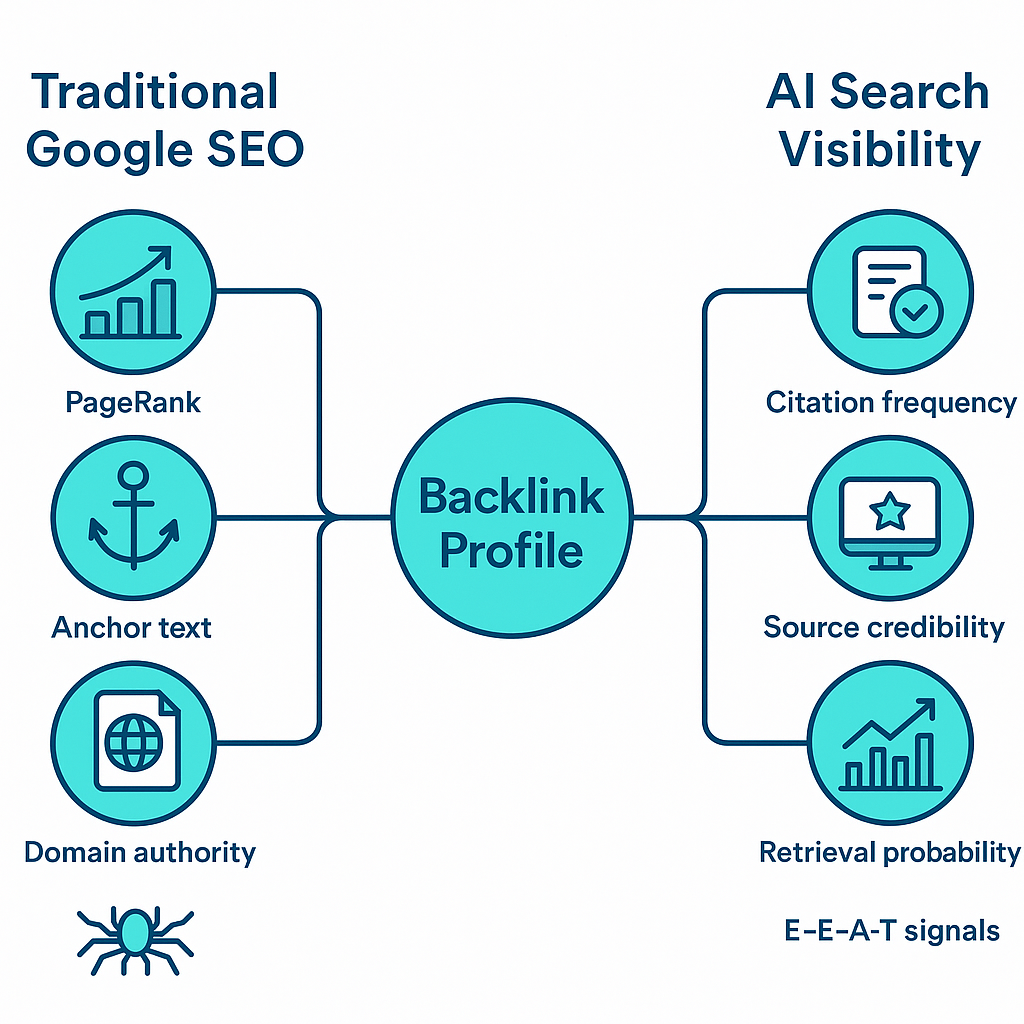
The relationship between backlinks and AI search visibility is not as direct as the relationship with traditional rankings, but it is real and increasingly consequential. AI engines like ChatGPT, Claude, Perplexity, and Gemini do not crawl the web in real time for every query — they use a combination of pre-trained knowledge (derived from web data that correlates heavily with linked, authoritative pages) and retrieval-augmented generation (RAG) systems that fetch live content from indexed sources. Both layers favor pages that are well-linked. During pre-training, content from frequently cited, high-authority domains is statistically over-represented in the training corpus. In RAG retrieval, the same signals that make a page rank well in Google — strong inbound link profiles, high E-E-A-T signals, structured content — make it more likely to be retrieved and surfaced in an AI answer. The strategic implication is that a backlink strategy designed for Google also builds AI search visibility, provided the content itself is structured for citation: clear definitions, attributed statistics, FAQ blocks, and concise topical depth. Teams that are only optimizing for blue-link rankings are leaving a growing share of organic visibility on the table.
Why AI Engines Weight Linked Sources Differently
Traditional PageRank is a graph algorithm — it propagates authority through link relationships mathematically. AI engines do not use PageRank directly, but they achieve a similar outcome through a different mechanism: the frequency with which a source appears as a citation in training data or retrieval indices acts as a proxy for credibility. A page that is cited by many authoritative domains is statistically more likely to be included in training corpora, more likely to rank in the Bing or Google index that Perplexity and others query, and more likely to satisfy retrieval confidence thresholds. This means that a backlink strategy in 2026 is simultaneously a traditional SEO play and a GEO (generative engine optimization) play. The domains that link to you are not just passing PageRank — they are endorsing your content for inclusion in the knowledge graph that AI engines draw on. This is why brand citation monitoring across ChatGPT, Claude, Perplexity, and Gemini has become a meaningful performance metric alongside traditional rank tracking. Tools like Gofylo's AI Visibility Tracker quantify this directly with an AI Visibility Score, giving teams a benchmark for how often their content surfaces in AI-generated answers — a metric that traditional backlink checkers do not capture.
GEO insight: Every high-authority backlink you earn from an editorially relevant domain is also a vote for inclusion in the retrieval layer of AI search engines. Building a backlink strategy today means building authority for both Google and LLM-based answer engines simultaneously.
The Core Acquisition Channels Worth Understanding
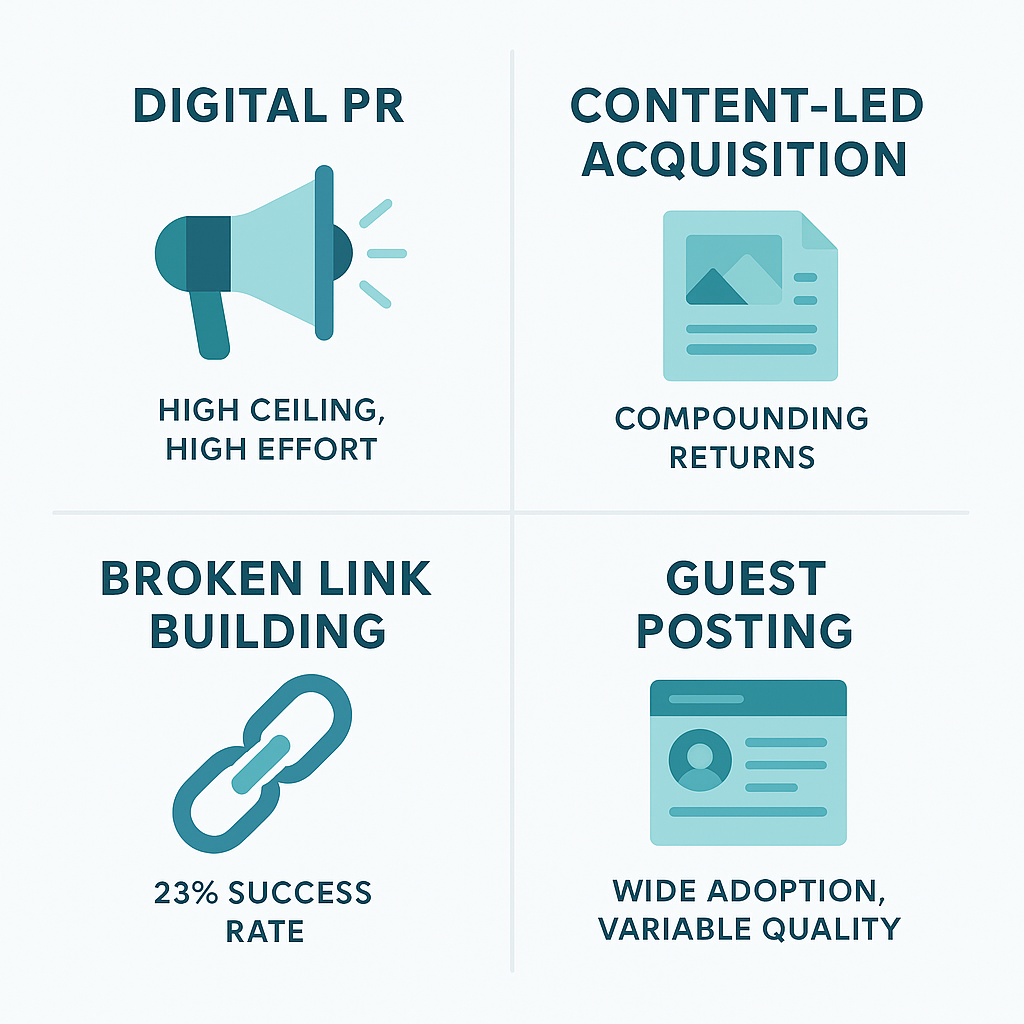
There are dozens of tactics described in backlink building guides, but the underlying acquisition channels are a much smaller set. Understanding the channel — not just the tactic — lets you evaluate whether a given approach fits your resources, content maturity, and competitive context. The four channels that consistently produce durable, high-quality links for B2B SaaS companies are digital PR and editorial placements, content-led acquisition, broken link reclamation, and strategic guest publishing. Each has a different mechanism, different cost structure, and different ceiling for scale. Knowing which channel to prioritize at which stage of your domain's authority development is the strategic question most teams skip because they are too focused on executing any tactic at all. A well-constructed backlink strategy answers the channel question before it answers the tactic question.
Digital PR and Editorial Links
Digital PR involves creating content, data, or narratives that journalists, analysts, and industry publications want to reference — original research, proprietary data sets, survey results, contrarian takes backed by evidence, or deeply reported industry analyses. According to data from Meetanshi's 2025 link building statistics report, digital PR is the most popular link building method, used by 67.3% of marketers. The reason is structural: a single piece of well-executed digital PR — a data study, a benchmark report, an industry survey — can generate dozens of editorial links passively, from publications you never contacted directly. These links are almost always followed, almost always from high-authority domains, and almost always contextually relevant because the publication is covering your exact subject matter. The ceiling for this channel is high, but the cost of entry is also high: creating genuinely original, citable content requires either significant research investment or access to proprietary data. For B2B SaaS companies, the most accessible version of digital PR is publishing benchmark data from your own product's usage — anonymized aggregate statistics from your customer base or platform activity. That data is inherently proprietary, inherently relevant, and difficult for competitors to replicate.
Content-Led Link Acquisition
Content-led acquisition is the strategy of publishing pages so useful, comprehensive, or uniquely valuable that other sites naturally link to them as references. This is sometimes called 'linkable asset creation' and it is the foundational channel underneath most other acquisition methods. The data on content depth is clear: according to Backlinko 2024 data cited by Ranktracker, long-form content averaging 3,000+ words acquires an average of 8.5 backlinks versus 4.8 for shorter content — a nearly 2x advantage driven not by length itself but by the correlation between depth and the probability that a piece becomes a reference. Linkable assets for B2B SaaS typically include definitive category guides, original data studies, tool comparison pages, free calculators, and template libraries. The mechanism is not passive luck — teams promote these assets through outreach, social amplification, and distribution into communities where potential linkers (journalists, bloggers, researchers) are active. Content-led acquisition is also the channel with the strongest compounding effect: a strong asset built in 2026 will continue to accumulate links for years, while outreach-dependent tactics require continuous effort to sustain link velocity.
Broken Link Building
Broken link building is the practice of finding external links on relevant sites that point to dead pages (404s), creating or identifying content on your own site that replaces the dead resource, and then reaching out to the linking site to suggest your page as a replacement. It is one of the most efficient outreach-based link acquisition methods available: according to data cited by Ranktracker's 2025 backlink statistics compilation, broken link building has a 23% success rate, making it one of the strongest conversion rates in outreach-based link building. The reason for the high conversion rate is the value exchange framing: you are doing the site owner a favor by flagging a broken link on their page, and the request to swap it for your resource is a natural next step rather than a cold ask. For B2B SaaS companies, this channel works best when applied to resource pages, comparison guides, and category-level content in adjacent verticals. Tools like Ahrefs' broken link checker or SEMrush's backlink audit tool are the standard instruments for finding these opportunities at scale. The investment is in the outreach and content creation, not in placement fees — which makes this one of the most cost-efficient channels relative to the average cost of acquiring a link through other means.
Guest Posting: Reach vs. Return
Guest posting occupies an interesting position in the backlink strategy landscape. According to Ranktracker's 2025 backlink statistics report (citing Backlinko 2024 data), guest posting generates backlinks for 64% of marketers who use it, making it one of the most widely adopted link building methods — however, only 31% report it as their most effective strategy. That gap between adoption and effectiveness tells an important story: guest posting is easy to start but hard to scale with consistent quality. The channel works best when the publication you are writing for has genuine topical relevance to your domain, has real editorial standards that ensure your contribution is substantive, and has an audience that overlaps with your target buyers. Guest posts placed purely for the backlink — on low-traffic 'contributor networks' or sites that accept anything — provide minimal SEO value and zero GEO value. The strategic framing that makes guest posting worth the effort is to treat it as brand reach with a backlink as a bonus, rather than a link acquisition tactic where content is the afterthought. That inversion produces better placements, better relationships with publication editors, and better downstream outcomes including referral traffic and AI citation probability.
Why Backlink Strategy Is Inseparable from Content Strategy
One of the most persistent misconceptions about link building is that it is a separate workstream from content — something the SEO team handles while the content team publishes articles. In practice, the two are architecturally connected. A backlink strategy without a content strategy is just outreach, and outreach without something genuinely worth linking to fails at scale. The pages that accumulate the most links are almost always pages with exceptional content: deep category guides, original research, free tools, or data-rich comparisons. The content provides the reason to link; the outreach surfaces that reason to the right audiences. This is why content velocity matters for backlink acquisition. A team publishing 30 well-optimized, topically authoritative articles per month across a consistent cluster is building significantly more linkable surface area than a team publishing three shallow posts. More pages means more entry points for inbound links, more opportunities for internal link distribution once links arrive, and more raw material for outreach campaigns. According to Ahrefs data, only 6% of all published pages ever acquire even a single external backlink — which means the strategic question is not just 'how do we get more links' but 'how do we ensure our content lands in the 6% worth linking to.' The answer to that question is almost entirely about content quality, depth, and differentiation.
Topical authority amplifies links. When a domain consistently publishes deep, authoritative content in a specific category, it accumulates topical signals that make future pages in that cluster easier to rank — and easier to link to. A site with 80 well-structured articles about B2B SaaS security will find that a new piece on that topic attracts links faster than an isolated article on a site with no topical depth. Building topical authority through content clusters is therefore a force multiplier on your backlink acquisition efforts, not a separate initiative.
Internal linking distributes link equity. When an external link lands on any page of your site, its PageRank flows outward through internal links. A well-structured internal linking architecture ensures that high-authority external links power up your most important target pages — not just the specific URL that got the link. This is why backlink strategy and internal link strategy must be designed together. A page with 10 strong external links but no internal link support will underperform a page with 6 external links and robust internal linking from related cluster pages.
Content depth drives passive link acquisition. The 8.5 vs. 4.8 backlink differential between long-form and short-form content is not about word count — it is about the probability that a piece becomes the definitive reference on a topic. When your article is the best-sourced, most complete treatment of a subject, journalists, bloggers, and researchers reference it without being asked. This is the highest-efficiency link acquisition mechanism available, because it requires no ongoing outreach investment once the asset is live and ranking.
Programmatic content scales linkable surface area. For growth-stage B2B SaaS companies with small content teams, one of the structural advantages of autonomous content generation is the ability to publish at scale without proportional headcount. Platforms like Gofylo generate 30 fully optimized, E-E-A-T-compliant articles per month — complete with internal linking, FAQ blocks, and schema markup — in under 4 minutes per article. With 48,000+ articles generated across the platform, the pattern is clear: higher content velocity creates more surface area for inbound links to land, distributing authority across the domain more broadly than a low-volume publishing program can achieve.
The Compounding Dynamics of a Link Profile
A backlink strategy compounds in ways that most teams underestimate early in their execution. The compounding works through several reinforcing mechanisms. First, as your domain authority grows from accumulated links, new pages on your site start with higher baseline authority — meaning they rank faster and higher from day one, attracting more organic traffic, which attracts more natural links. Second, as your content volume grows, the probability of earning natural inbound links (from writers referencing your work, from journalists finding your data) increases proportionally with your search visibility. Third, the relationship equity you build through outreach — with editors, journalists, analysts — becomes easier to activate over time as your domain becomes more recognizable in your category. According to data cited by LinkPanda's 2026 link building statistics analysis, 35 quality backlinks to a single page can yield a 30–100% traffic increase within 3 months — a range that reflects the difference between low-relevance and high-relevance link acquisition, not random variation. The average cost per quality backlink is $508.95, according to a survey of 518 SEO professionals by editorial.link, which means the decision to invest in a content-led, organically compounding approach versus a pure outreach-and-placement model is also a significant financial one. Over a 12-month horizon, a domain that compounds its link profile through strong content and strategic outreach will accumulate authority at a structurally lower cost-per-link than one that relies on manual placement purchases.
Compounding in practice: A SaaS company that spends 6 months building topical authority through consistent content and strategic link acquisition will enter month 7 with a domain that ranks new pages faster, earns more natural links, and requires less outreach effort per incremental link — because authority begets authority.
What Separates a Functional Strategy from a Fragile One
Many teams run what looks like a backlink strategy — they do outreach, they publish guest posts, they track domain authority — but their link profile is structurally fragile. Fragility shows up as over-reliance on a single acquisition channel, link profiles dominated by a single anchor text pattern, clusters of links from a narrow set of domains that may devalue simultaneously, or high volumes of low-relevance links that satisfy a quantity metric without building real authority. A functional backlink strategy is diversified across acquisition channels, pages, anchor text types, and linking domains. It is also aligned with the content architecture of the site — links point to pages that have strong internal link support, not isolated pages with no downstream distribution path. As SEMrush's link building research has consistently shown, the sites that sustain ranking gains through algorithm updates are those with diverse, editorially earned link profiles rather than programmatic or manipulative ones. Fragility is also a growing risk in the AI search context. If your backlink strategy produces rankings without credibility signals — links from thin sites, purchased placements, low-relevance directories — those pages will not be cited in AI-generated answers, regardless of their traditional SERP position. In 2026, a link profile that looks strong on a domain authority dashboard but lacks genuine editorial endorsement from relevant, trafficked sources is a link profile that is failing at the GEO layer even as it appears to succeed at the SEO layer. A full-stack backlink strategy in 2026 must pass both tests: traditional ranking performance and AI citation probability. That means 93.8% of link builders who, according to Digital Web Solutions' 2024 research, prioritize link quality from reputable and relevant websites are making the right structural bet — the remaining 6.2% chasing volume over quality are building a profile that will degrade in value as AI search displaces traditional SERP clicks.
Diversification prevents single-channel dependency. A backlink profile that draws 80% of its links from guest posts on a narrow set of contributor networks is fragile because it depends on the continued domain authority of those networks and the continued permissiveness of their editorial standards. Diversifying across digital PR, content-led acquisition, broken link reclamation, partnership-based links, and podcast and interview citations creates a profile that is resilient to individual channel disruptions.
Anchor text distribution signals intent. Overuse of exact-match anchor text — linking to a SaaS pricing page with the anchor 'best project management software' across dozens of placements — is one of the oldest and most reliably penalized patterns in Google's link spam detection systems. A natural anchor text distribution includes a mix of branded anchors (your company name), naked URLs, partial-match phrases, and generic anchors ('read more', 'this guide'). Building this distribution deliberately from the outset is far easier than cleaning up an unnatural pattern after it has accumulated.
Velocity management matters as much as volume. A sudden spike in link acquisition — common when teams launch outreach campaigns or publish viral content — can look unnatural to algorithmic quality filters if it is not preceded by a baseline of organic link growth. Consistent, moderate link velocity sustained over time builds a more credible profile than episodic bursts. This is one structural advantage of content-led acquisition: it generates links at a pace that mirrors organic discovery rather than a paid campaign.
Frequently Asked Questions
What is an example of a backlink?
A backlink is any hyperlink from an external website pointing to a page on your domain. A concrete example: if TechCrunch publishes an article about B2B SaaS funding trends and includes a link to your company's blog post about pricing models, that link is a backlink to your site. Another example is a software review platform like G2 or Capterra linking to your product page from a category comparison article. The link itself is an HTML anchor tag with your URL as the href — the strategic value comes from the authority and relevance of the site doing the linking, not from the mechanics of the tag itself.
Are backlinks still relevant in 2026?
Yes — and in 2026, their relevance has extended beyond traditional Google rankings into AI search visibility. According to Backlinko 2024 data cited in Ranktracker's 2025 backlink statistics report, top-ranking pages have 3.8x more backlinks than pages ranking in positions 2–10, confirming that link authority remains a primary ranking signal. Additionally, 79.7% of SEO experts consider link building an essential part of their optimization strategy, according to Digital Web Solutions' 2024 research. For AI engines like ChatGPT and Perplexity, pages with strong editorial link profiles are statistically more likely to appear in AI-generated answers — making backlinks a dual-function asset in the current search landscape.
What are three effective backlink strategies?
Three channels with strong, documented track records are: (1) Digital PR — creating original research or data studies that earn editorial links passively from journalists and publications, used by 67.3% of marketers according to Meetanshi's 2025 link building statistics; (2) Broken link building — identifying dead links on relevant external pages and pitching your content as a replacement, with a 23% outreach success rate per Ranktracker's 2025 data; and (3) Content-led acquisition — publishing deep, comprehensive assets (guides, comparisons, free tools) that attract natural inbound links because they become reference resources in their category. Each strategy operates through a different mechanism and suits different stages of domain authority development.
What is the 80 20 rule of SEO?
In SEO, the 80/20 principle (Pareto principle) suggests that roughly 80% of your organic traffic and ranking gains will come from 20% of your efforts — typically your highest-quality pages and your most authoritative backlinks. Applied to backlink strategy, this means a small number of high-authority, topically relevant links will drive the majority of your ranking improvements, while a large volume of low-quality links may produce little measurable outcome. The practical implication is to concentrate outreach and content investment on acquiring links from a carefully selected tier of authoritative, relevant domains rather than pursuing maximum link volume indiscriminately.
If you are building a backlink strategy from scratch — or auditing whether your current one is actually compounding — Gofylo's AI Search Grader gives you a free baseline score for your brand's visibility across ChatGPT, Claude, Perplexity, and Gemini. Gofylo's Content Engine then autonomously generates, publishes, and internally links the depth of content that earns links at scale — 30 articles per month, fully optimized, without a content team. Start your 3-day free trial at gofylo.com, no credit card required.