
As of 2026, the question isn't whether keyword research matters — it's whether your keyword intelligence is wired into both Google's index and the AI assistants that now answer a growing share of B2B queries. Founders and marketing leads at SaaS companies who treat keyword research as a one-time spreadsheet exercise are leaving compounding traffic on the table. The ones growing fastest are the ones who understand keyword research not as a task, but as a structural input to every piece of content their brand produces.
This article isn't a how-to — Keyword Research Explained covers the mechanics in depth. Instead, we're going deep on the why: what keyword research actually does to your organic growth trajectory, why its role has expanded in 2026 to include AI engine visibility, and what happens structurally when a SaaS company treats it as a continuous signal rather than a periodic project. Whether you're a solo operator or running a demand gen team at a growth-stage company, understanding the underlying mechanism changes how you prioritize every content decision you make.
Thesis: Keyword research is the connective tissue between what your market is asking and what your content actually covers. Without it, content production is guesswork. With it — especially when paired with AI search optimization — it becomes a compounding asset that grows without proportional effort.
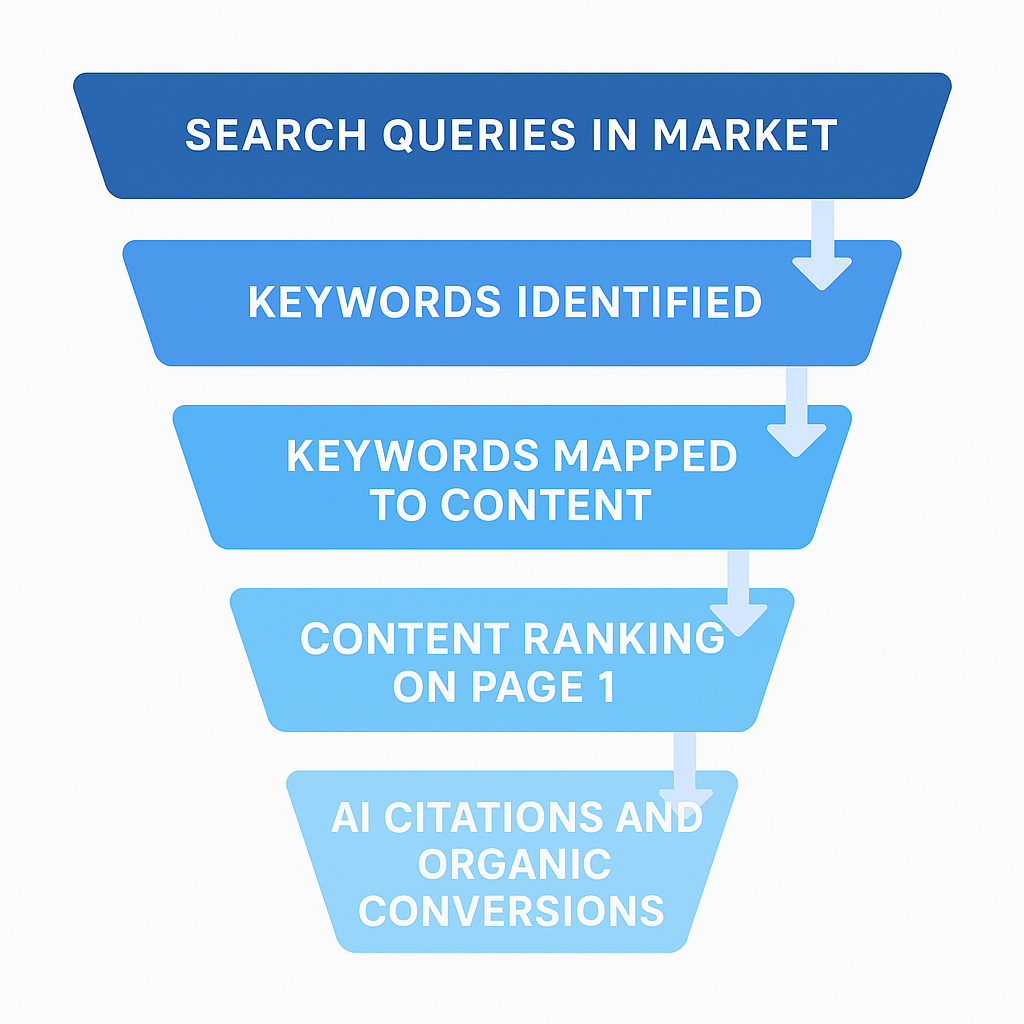
The Core Mechanism: What Keyword Research Actually Does
Keyword research maps the exact language your market uses when they have a problem your product solves. That sounds simple, but the operational consequence is significant: without that map, every content decision — topic selection, headline framing, internal linking, metadata — is a guess. With it, content strategy becomes evidence-based. A keyword tells you not just what people type, but how many of them have that problem, how competitive the landscape is, and critically, what stage of the buying journey they're in. In B2B SaaS, where buying cycles are long and trust is built through repeated content exposure, that intent signal is worth more than almost any other input a marketing team has access to.
The mechanism works at three levels simultaneously. At the discovery level, keyword research surfaces demand you didn't know existed — queries your potential customers are already typing, which means demand you can capture rather than create. At the qualification level, it separates high-intent queries from low-intent noise, so your team focuses on terms where a click is more likely to progress toward a pipeline conversation. At the structural level, it defines your content architecture: which topics deserve pillar pages, which belong in supporting articles, and how those pieces should link to each other to signal topical authority to search engines and AI models alike.
Why Keyword Research Is Still Essential in 2026
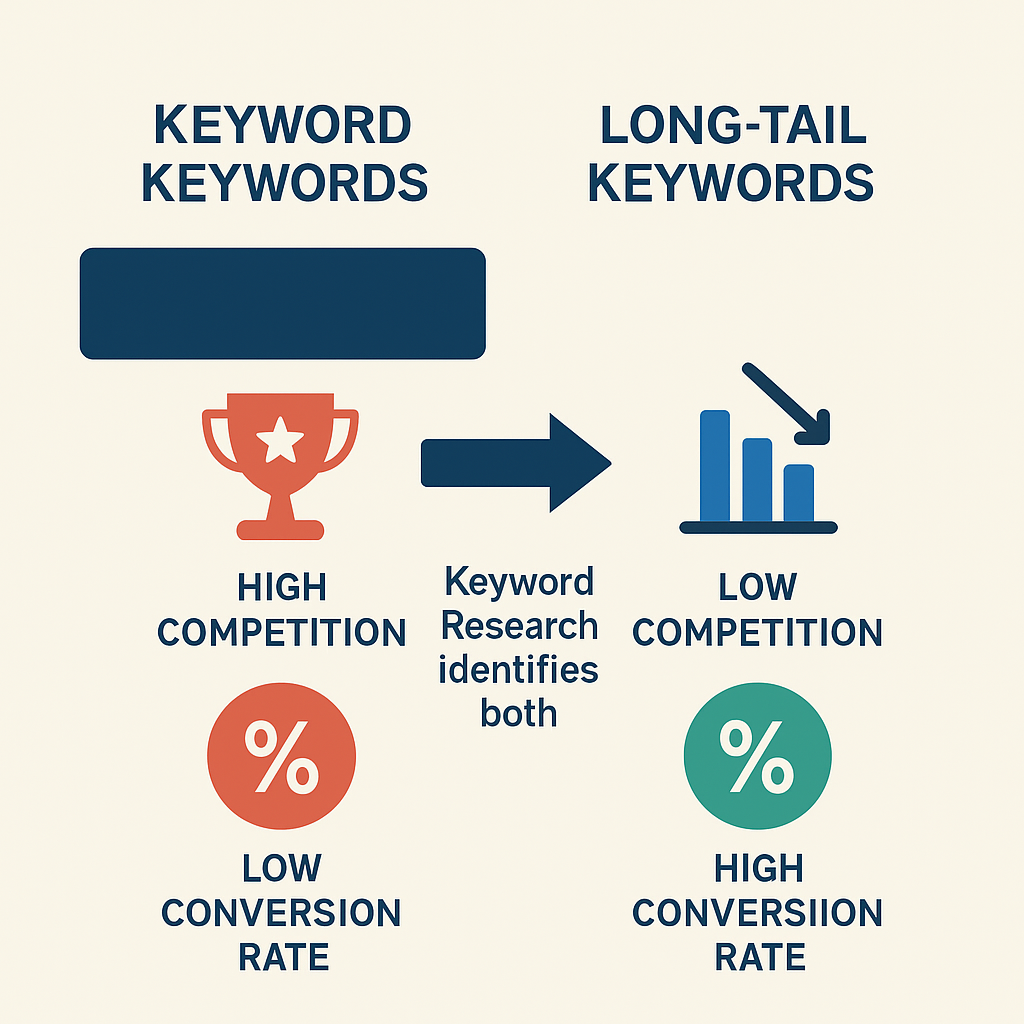
The prediction that keyword research would become obsolete — overtaken by semantic search and AI-generated content — has not materialized. In 2026, organic search remains the dominant acquisition channel for most SaaS companies, and the structural role of keywords has not diminished; it has become more nuanced. According to Ahrefs' analysis, between 70–92% of all search traffic comes from long-tail keywords of three or more words, a figure that underlines how granular and specific real search behavior actually is. Broad terms like 'project management software' generate enormous impressions; specific terms like 'project management software for remote engineering teams' generate demos. Keyword research is the tool that maps which specific terms drive which specific outcomes.
What has changed is the stakes. In 2026, keyword research isn't just about ranking on Google's blue links — it's about being the source that ChatGPT, Claude, Perplexity, and Gemini pull from when they answer a query in your category. AI assistants are trained on the web, and they preferentially cite content that is topically authoritative, well-structured, and aligned with the specific language a user's query contains. That alignment starts with keywords. A SaaS company that publishes content without keyword grounding is not just invisible in traditional search — it is increasingly invisible in AI-generated answers, which in 2026 are handling a fast-growing share of research-phase B2B queries.
Organic is still the biggest channel. SEO generates 53% of website traffic and converts at 2–4%, according to data cited by Anchor Group, making it the most sustainable acquisition channel available to growth-stage SaaS companies — outperforming paid and social on a cost-per-acquisition basis at scale.
Keyword research anchors that advantage. Without it, even a prolific content operation produces articles that miss the specific language the market uses — and those articles don't rank, don't get cited by AI, and don't convert. The channel's efficiency is entirely dependent on the quality of keyword targeting upstream.
Conversion quality depends on intent. SEO leads close at 14.6% compared to 1.7% for outbound leads, according to Search Engine Journal — but only when the keywords driving traffic reflect real purchase intent. Keyword research is what separates traffic that converts from traffic that bounces.
How AI Search Has Expanded the Purpose of Keyword Research
Before AI assistants became a primary research interface for B2B buyers, keyword research served one master: Google's ranking algorithm. In 2026, it serves two masters simultaneously — the traditional search index and the language models that power AI-generated answers. The implications are real and underappreciated. When a buyer asks Claude 'what's the best way to automate SEO content for a SaaS startup,' Claude doesn't pull from a ranked list — it synthesizes from sources it was trained on or retrieves via retrieval-augmented generation. The sources it favors are those that use precise, query-matched language, answer questions directly, and have demonstrated topical authority across multiple related articles. That is exactly the output of good keyword research operationalized into content.
This dual-surface reality means keyword research now has to account for two distinct patterns: how humans phrase queries in a search bar (often fragmented, three to five words) and how they phrase them to AI assistants (often conversational, full sentences, question-form). The good news is that both patterns are discoverable through keyword research — question-form keywords like 'how do I reduce churn in SaaS' are already surfaced by tools that track People Also Ask data and forum queries. The teams that understand why keyword research is important in 2026 are mapping both query formats and building content that satisfies both at once: concise definitional answers early in the article (for AI extraction) and deep supporting analysis further in (for dwell time and ranking signals).
AI assistants cite content that uses precise, query-matched language. Keyword research is how you know what language your market is using — in both search bars and AI chat interfaces. Skipping it means skipping the alignment that drives citations.
The 80/20 Rule in SEO and How Keywords Reflect It
The 80/20 rule in SEO describes the reality that a small fraction of your keyword targets will drive the overwhelming majority of your organic traffic and conversions. Specifically, a small number of well-chosen, high-intent keywords — often long-tail, often topically clustered — will outperform a large pool of scattered, high-volume terms. This is not a productivity principle borrowed from business consulting; it reflects something structural about how search demand is distributed. Backlinko's analysis of 306 million keywords found that 91.8% of all search queries are long-tail keywords — meaning the vast bulk of actual search behavior happens in the long tail, not in the handful of broad head terms that dominate most SEO conversations.
For B2B SaaS specifically, the 80/20 dynamic is even more pronounced. Head terms like 'CRM software' or 'marketing automation' are dominated by enterprise players with enormous domain authority and content budgets. The competitive reality means that a growth-stage SaaS company targeting those terms is unlikely to rank on page one regardless of how much content it produces. The 20% of effort that drives 80% of results is almost always found in the long tail — specific, intent-rich phrases where the competitive field is smaller and the buyer is further along in the purchase process. Keyword research is the mechanism that identifies exactly where that productive 20% lives for your specific product and audience.
Understanding the 80/20 distribution also changes how you allocate content investment. Rather than spreading effort across dozens of loosely related topics, the highest-ROI content operations concentrate on topic clusters anchored by a core keyword and surrounded by supporting articles that target related long-tail variations. This cluster architecture tells search engines — and AI models — that your domain has genuine depth on a subject, not just a single thin piece. Keyword research identifies both the anchor and the supporting terms, making cluster architecture possible.
Why Keyword Research Has Changed in 2026
Keyword research in 2026 is materially different from what it was even two years ago, and the gap is widening. The most significant structural shift is the emergence of AI-generated search results — Google's AI Overviews, Bing Copilot, and standalone AI assistants — which intercept a growing share of queries before a user clicks any organic result. This means that ranking on page one for a keyword is no longer the sole outcome keyword research should optimize for. The new outcome is being cited inside an AI-generated answer, which often requires a different kind of content: structured, direct, question-answering, and linked from a topically authoritative domain.
A second shift is query volatility. According to data cited by Ranktracker from Google's own reporting, 15% of Google searches have never been searched before — meaning a meaningful portion of your potential audience is inventing new query language every month. In 2026, with generative AI influencing how buyers describe their problems, that new-query rate may be even higher. Static keyword research conducted once a quarter misses this signal entirely. Competitive keyword research needs to be continuous, pulling live data from search consoles, SERP changes, and competitor content to catch emerging query patterns before rivals do.
A third shift is the rise of conversational and question-form queries driven by voice search and AI chat habits. Buyers increasingly phrase queries as full questions — 'what's the fastest way to scale organic traffic without hiring a content team?' — rather than compact keyword strings. Traditional keyword research tools have adapted to surface these variants, but teams that haven't updated their research workflow since 2023 are working from an outdated picture of their market's actual language.
The Strategic Role of Long-Tail Keywords in B2B SaaS
Long-tail keywords — phrases of three or more words, often highly specific — are the dominant force in search volume even though individual terms have low monthly search counts. For B2B SaaS companies, they are also the dominant force in conversion quality, because specificity in a query almost always correlates with specificity of intent. A buyer typing 'best CRM' is early-stage browsing. A buyer typing 'best CRM for seed-stage SaaS with Slack integration' is close to a decision. Keyword research surfaces both, but the long tail is where SaaS pipeline is actually built.
Why volume alone misleads B2B buyers
One of the most persistent mistakes in SaaS content strategy is prioritizing keywords by monthly search volume. A term with 10,000 monthly searches sounds more valuable than one with 200. But for a B2B product with a $500 monthly contract value, a single converted visitor from the 200-search term may generate more revenue than fifty visitors from the 10,000-search term who were browsing casually. Keyword research matters not just because it identifies volume — it matters because it identifies the relationship between volume, competition, and intent. Stripping out that intent context makes keyword data close to useless as a strategic input.
Long-tail and buyer intent in SaaS
In the context of keyword research and analysis for SaaS products, long-tail keywords map almost perfectly to the middle and bottom of the funnel: comparison pages, use-case pages, integration pages, and alternative pages. These are the content types that generate trials and demos, not just impressions. A structured keyword research process identifies which long-tail clusters your product can realistically compete for, maps them to the right content formats, and generates a pipeline of articles that collectively cover a topic with the depth that earns topical authority — both in Google's index and in AI model training data.
Keyword Research as a Competitive Signal
Keyword research is not just about your own content — it is one of the sharpest competitive intelligence tools available to a SaaS marketing team. When you analyze which keywords your competitors rank for, which ones they're targeting in their content clusters, and which valuable queries they've left uncovered, you build a picture of market positioning that no analyst report can replicate. This is the core logic behind keyword gap analysis: identifying the terms where your competitors are visible and you are not, and conversely, the terms where neither of you is ranking and first-mover advantage is available.
For growth-stage SaaS companies, competitive keyword intelligence often reveals more actionable opportunities than any other research method. It shows you which product categories your competitors are positioning around, which customer pain points they're addressing in content, and which segments they're ignoring. A company that systematically mines competitor keyword data and uses it to inform content production is effectively getting a continuous market research feed for free — updated every time a competitor publishes a new page or earns a new ranking. Understanding What Separates Winnable Competitive Keywords from traps is the difference between smart targeting and wasted content effort.
- Identify high-value queries your competitors rank for but you don't — these are your first-priority gaps
- Find queries neither you nor competitors rank for — these are first-mover opportunities in your space
- Detect competitor content clusters to understand their topical authority strategy
- Spot queries where competitor content is thin or outdated — a ranking you can displace with better depth
- Track new keywords competitors are targeting to anticipate their product and market positioning moves
- Use gap data to prioritize content investment toward ROI-positive topics rather than vanity traffic
What Happens When Keyword Research Is Absent
The failure mode of content without keyword research isn't usually that no content gets published — it's that a lot of content gets published and almost none of it ranks or converts. This is an especially common pattern at early-stage SaaS companies where a founder or a single marketing hire produces content based on what they find interesting or what customers have asked in sales calls. Both are useful inputs, but neither is a substitute for systematic keyword research. Sales call language rarely maps to the exact phrases buyers use in search. Founder interests rarely align with the queries that have realistic ranking potential for a domain with limited authority.
The compounding cost of missing keyword research is significant. Every article published without keyword grounding is an opportunity cost — that content budget and team time could have targeted a query with real search demand and realizable ranking potential. Over twelve months of weekly publishing, the gap between a keyword-informed content program and an uninformed one can be the difference between several thousand organic sessions a month and a few hundred. At 2–4% conversion to trial and a typical SaaS trial-to-paid rate, that traffic gap translates directly into pipeline.
The same dynamic applies to AI search visibility. AI models preferentially cite content from domains that have demonstrated topical authority — meaning a body of interlinked, well-structured content on a specific subject. A content program without keyword research produces scattered articles that don't cluster, don't interlink logically, and don't signal topical depth. The result is a domain that neither Google nor AI assistants treat as an authoritative source on any particular topic, regardless of how much content exists on the site.
Organizations with a documented content strategy — which starts with keyword research — report conversion rates 6× higher than those without one, according to 2026 data from Deep Marketing. Keyword research is not a nice-to-have; it is the foundational input that makes content strategy documentable in the first place.
The Main Purpose of Keywords in Content Strategy
Keywords serve as the bridge between a searcher's intent and a piece of content's relevance. In content strategy, their primary purpose is to ensure that the content you create is aligned with actual demand — that someone is searching for what you're writing about, that the language you use matches the language they use, and that the specificity of your content matches the specificity of their query. Without that alignment, content is produced in a vacuum. The main purpose of keywords, at the most practical level, is to make content discoverable by the people who need it.
But in a mature content strategy, keywords do more than enable discovery. They define structure: which topics merit standalone articles, which should be sections within a larger piece, and which belong in FAQ blocks designed to capture People Also Ask positions. They signal intent: a keyword containing 'best,' 'vs,' or 'alternative' tells you the searcher is in comparison mode and wants a direct evaluation, not an educational overview. A keyword containing 'how to' signals they want instructions. A keyword containing 'what is' signals they want a definition. Matching content format to keyword intent is one of the highest-leverage optimizations available to a content team — and it only becomes possible once keyword research has made intent visible.
For AI search specifically, keywords serve an additional purpose: they are the tokens that language models use to evaluate whether a piece of content is relevant to a query. An article that uses the exact phrase a user asked — along with semantically related terms — is far more likely to be surfaced in an AI-generated answer than one that covers the same concept in different language. This is why keyword research for AI search optimization doesn't stop at identifying terms; it extends into ensuring those terms appear naturally in headers, early paragraphs, and FAQ blocks — the structural zones that AI models weight most heavily when extracting answers.
How Autonomous Content Systems Operationalize Keyword Research
Understanding why keyword research is important is one thing. Operationalizing it continuously — so that every piece of content your brand publishes is grounded in live search data — is the harder challenge for growth-stage SaaS companies with small or no dedicated content teams. The traditional approach requires a researcher to pull data from one or more tools, build a spreadsheet, map keywords to a content calendar, brief a writer, and then repeat the cycle monthly. At 30 articles a month, that workflow is a full-time job before a single word is written.
Autonomous content platforms like Gofylo are built to collapse that gap. Gofylo researches keywords from live search results and competitor content, groups them into topic clusters, writes articles in your brand voice, and publishes them to your CMS — 30 articles a month, each completed in a few minutes. Keyword research isn't a separate upstream step; it's embedded in the agent's workflow so that every article is grounded in real demand data from the moment it's initiated. The platform also monitors published articles using Google Search Console data and rewrites pieces that are sitting just off page one — the highest-ROI optimization move in traditional SEO — without requiring a human to identify which articles need attention.
The AI visibility layer extends this into AI search: Gofylo's AI Visibility Score measures how ChatGPT and Claude see your brand, giving you a concrete signal of whether your keyword-informed content is being cited in AI-generated answers. This dual measurement — traditional ranking signals and AI citation frequency — closes the feedback loop that manual keyword research workflows leave open. You can see not just which keywords your content ranks for, but whether that content is being surfaced when buyers ask AI assistants about your category. The keyword research and analysis infrastructure that once required a team of two or three people to maintain is compressed into a continuous, automated loop.
- Keyword research embedded in content generation — every article targets real search demand from the start
- Competitor keyword mining to identify gaps and first-mover opportunities automatically
- Topic cluster grouping so content builds topical authority rather than scattered coverage
- Search Console integration to identify near-page-one articles and prioritize rewrites
- AI citation tracking via AI Visibility Score on ChatGPT and Claude
- Publishing to WordPress, Webflow, Shopify, Ghost, Wix, and more with schema markup and internal links built in
- Support for 18+ languages so keyword research compounds across international markets
The structural difference between this and a manual content workflow is not speed — it's continuity. Manual keyword research happens in bursts: a quarterly audit, a monthly planning session, an ad hoc competitive check when a competitor launches something new. Autonomous systems treat keyword research as a continuous signal that updates with the live market, which is how compounding organic growth actually works. Each article Gofylo publishes is informed by current data, not a research snapshot from three months ago. That recency matters: according to Ranktracker, 15% of Google searches have never been searched before, meaning new query language emerges constantly. A system that researches continuously captures that demand; one that researches quarterly misses most of it.
Frequently Asked Questions
What is the purpose of keywords in research?
Keywords in research serve as the precise language markers that connect a searcher's intent to a piece of content. In content and SEO strategy, they define what a page is about in terms that both search engines and AI models can evaluate against a query. Without keywords, neither Google nor AI assistants have a reliable signal that a given article is relevant to a specific question — meaning the content is unlikely to surface when a potential buyer is actively looking for a solution.
What is the 80/20 rule in SEO?
The 80/20 rule in SEO describes the principle that a small proportion of keyword targets — typically long-tail, high-intent, and topically clustered — drive the vast majority of organic traffic and conversions. Backlinko's analysis of 306 million keywords found that 91.8% of all search queries are long-tail terms, confirming that real search demand is concentrated in specific, niche phrases rather than broad head terms. For B2B SaaS, this means the 20% of effort spent on well-researched long-tail clusters typically delivers 80% of the pipeline-relevant traffic.
What are the top 5 keyword research tools?
The most widely used keyword research tools in 2026 include Ahrefs, Semrush, Google Search Console, Moz Keyword Explorer, and Google Keyword Planner. Each has different strengths: Ahrefs and Semrush are strongest for competitive analysis and gap identification; Search Console provides first-party data on your own rankings; Moz excels at difficulty scoring; and Keyword Planner is useful for volume estimates aligned with Google Ads data. The right stack depends on whether your priority is competitive intelligence, content optimization, or paid search alignment.
What is the main purpose of keywords?
The main purpose of keywords is to align content with the language a target audience actually uses when searching for information, products, or solutions. In practice, this alignment makes content discoverable in search engines and citable by AI assistants. Keywords also signal intent — the difference between 'what is CRM software' and 'CRM software alternative to Salesforce' tells a content strategist entirely different things about what the searcher needs and where they are in the buying process.
Why is keyword research important for AI search engines?
AI assistants like ChatGPT, Claude, and Perplexity surface content from sources that use precise, query-matched language and have demonstrated topical authority through a body of interlinked content. Keyword research ensures your content uses the exact phrases your buyers use — both in traditional search bar format and in the conversational question-form that AI chat interfaces generate. Without that language alignment, content is unlikely to be cited in AI-generated answers, regardless of how accurate or high-quality it is.
How often should a SaaS startup refresh its keyword research?
For most growth-stage SaaS companies, keyword research should be treated as a continuous process rather than a quarterly project. Google reports that 15% of searches are entirely new queries, meaning market language evolves constantly. At minimum, reviewing keyword performance data monthly — and competitive keyword gaps quarterly — keeps a content strategy aligned with live demand. Autonomous platforms that embed keyword research into every content generation cycle eliminate the refresh problem entirely by working from current data by default.
If you're a founder or marketing lead at a SaaS startup trying to understand where your brand stands in AI search right now, Gofylo's free AI Search Grader gives you an immediate visibility score — no setup required. And if you're ready to turn keyword research into a continuous, compounding content engine, Gofylo's $79/month plan includes 30 SEO articles a month, Search Console refresh, and AI visibility scoring on ChatGPT and Claude. Start a 3-day free trial at gofylo.com and see what systematic keyword intelligence actually produces.