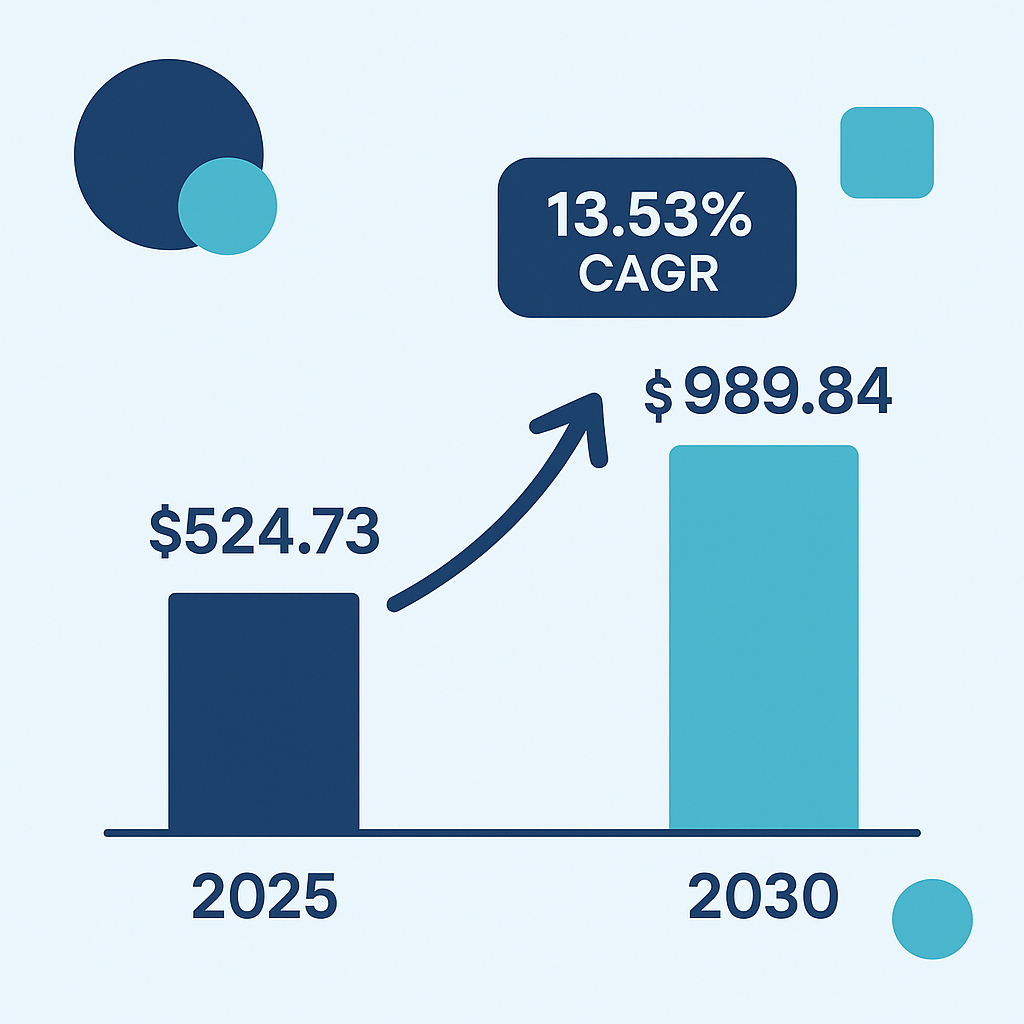
As of 2026, the content marketing industry is larger than most people realize. According to Mordor Intelligence, the market reached USD 524.73 billion in 2025 and is projected to grow at a 13.53% CAGR to nearly USD 990 billion by 2030. That scale means the vendor landscape is crowded — agencies, platforms, freelance networks, and now autonomous AI systems all compete for the same budget line item. Choosing the wrong one costs you six to twelve months of compounding time you can't recover.
This roundup is built specifically for B2B SaaS founders, marketing leads, SEO managers, and demand gen teams who are past the "what is content marketing" stage. You need to know which companies actually move the needle on organic traffic and AI search visibility in 2026 — not which ones have the slickest pitch decks. We cover traditional agencies with proven track records alongside autonomous platforms that replace the entire content team workflow. The evaluation criteria we use mirror what sophisticated buyers actually care about: strategy alignment, expertise expression, content promotion, case study depth, and increasingly, AI search coverage.
The best content marketing companies in 2026 aren't just producing articles — they're engineering compounding organic and AI search visibility simultaneously. Traditional SEO is table stakes. The differentiator is whether your content gets cited by ChatGPT, Claude, Perplexity, and Gemini.
How We Evaluated These Companies
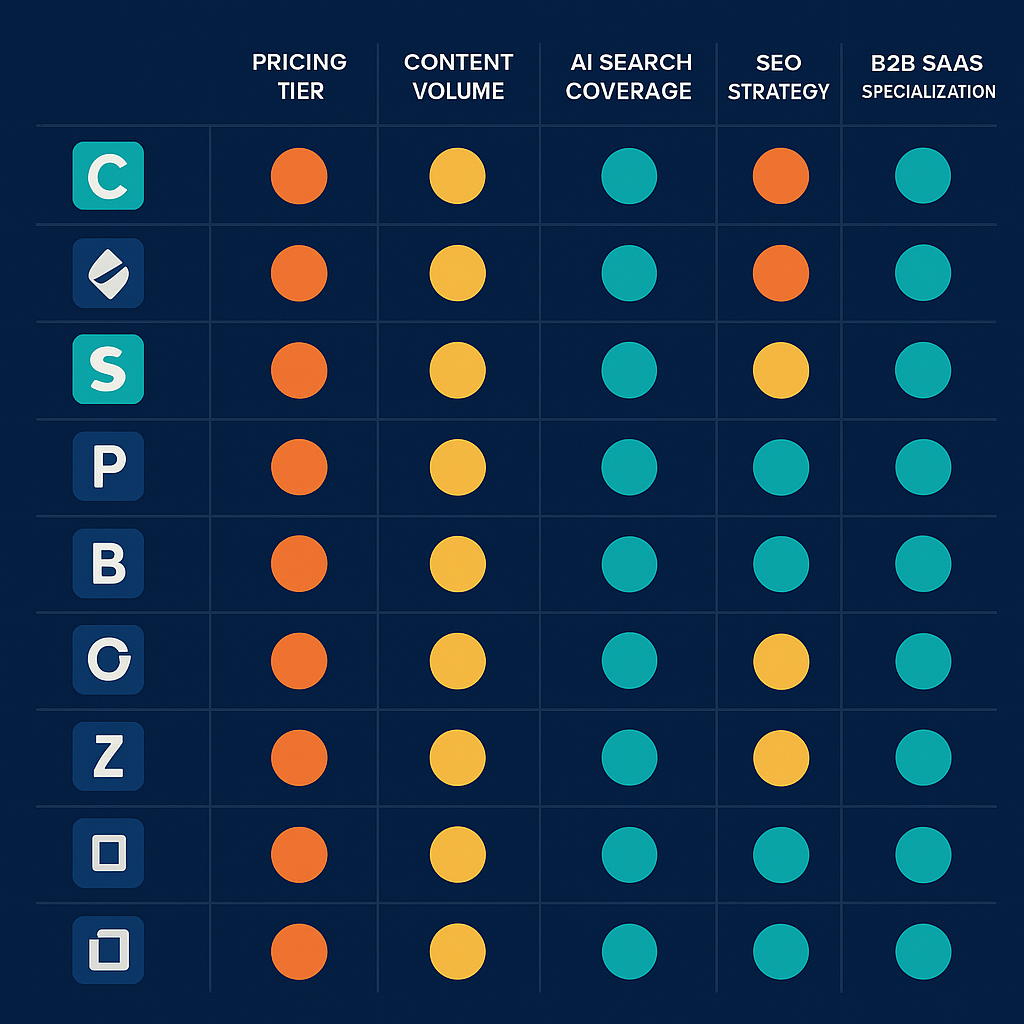
Every list on the internet ranks agencies by reputation, logo count, or who paid for the placement. We ranked these twelve by factors that actually predict outcomes for B2B SaaS companies: goal alignment, expertise expression, content promotion methodology, case study transparency, pricing accessibility, and — critically in 2026 — their capability to generate content that ranks in both Google and AI search engines. That last criterion is almost entirely absent from competitor roundups, and it's the one that will separate winners from losers over the next 24 months.
We also weighted for stage-appropriateness. A bootstrapped founder needs a different partner than a Series B SaaS company with a marketing team of six. We call this out explicitly for each entry. Where public pricing is available, we note it. Where retainers are opaque and quote-based, we say so. According to Ahrefs' content marketing research, the biggest predictor of content program failure is misalignment between the buyer's primary goal and the agency's primary optimization metric — so goal clarity comes first in every entry.
The 4 Factors That Separate Good Content Partners From Great Ones
Before diving into the ranked list, it's worth making the evaluation framework explicit. These four factors apply regardless of whether you're considering a traditional agency, a freelance network, or an autonomous content platform. Use them as a scoring rubric when you talk to any vendor.
Factor 1: Is Their Strategy Aligned to Your Actual Goal?
Content marketing has at least three distinct goals that require different execution strategies: driving organic traffic volume, capturing email subscribers, or generating qualified leads and pipeline. Most agencies default to traffic as the success metric — because it's the easiest to report on and the hardest to dispute. But if you're a B2B SaaS company, traffic without lead attribution is vanity. Before signing any contract, get specific: ask the agency how they differentiate between bottom-of-funnel and top-of-funnel keyword targeting, how they prioritize topics based on commercial intent, and what their attribution model looks like. Agencies that can't answer those questions in concrete terms are selling you impressions, not revenue.
Factor 2: Do They Express Real Domain Expertise?
Generic content is invisible content. In B2B SaaS, the best-performing articles demonstrate product expertise, customer insight, and category depth — not just keyword stuffing around a pain point. The best content marketing companies use some form of subject matter expert (SME) interviews, proprietary data, or original frameworks to differentiate their output. Ask to see three recent articles they've produced for a SaaS client. If every article reads like it could have been written for any software company in any category, they're not building differentiated authority — they're producing commodity filler. Google's Search Quality Evaluator Guidelines explicitly weight E-E-A-T (Experience, Expertise, Authoritativeness, Trustworthiness) as a core ranking signal, and AI models like Claude and Perplexity are trained to prefer citing sources that demonstrate first-hand expertise.
Factor 3: Do They Actively Promote What They Publish?
Publishing without promotion is writing into a void. The best content programs treat distribution as a first-class discipline — not an afterthought. This means link building, social amplification, newsletter syndication, community seeding, and increasingly, AI search optimization (structuring content so it gets cited by large language models). Ask agencies how they build backlinks to articles they write for you, what their standard promotion cadence looks like, and whether they have any methodology for GEO (generative engine optimization). Most agencies have a vague answer to the first question and no answer to the latter two.
Factor 4: Can They Show You Detailed Case Studies?
Case studies are the only real proof of efficacy. Not testimonials — case studies. The distinction matters: a testimonial tells you a client was happy, a case study tells you how much organic traffic grew, over what time period, from what baseline, targeting which keywords, with which content volume. The best content marketing companies publish detailed, transparent case studies with actual traffic numbers, ranking timelines, and lead attribution data. If an agency can only show you logos and quotes, treat that as a red flag. According to Digital Silk, 83% of B2B marketers say content marketing helps build brand awareness, while 77% credit it with generating demand and leads — but those numbers only materialize with a strategy built around measurable outcomes.
Top 12 Content Marketing Companies Ranked for 2026
The following twelve companies represent the range of approaches available to B2B SaaS teams in 2026 — from boutique strategy-first agencies to autonomous AI platforms. They are not listed in pure quality order; they're listed so the first entry is the strongest overall recommendation for the majority of our readers (growth-stage SaaS teams with small or no content teams), followed by the best alternatives for specific use cases and budget levels.
1. Gofylo — Best for Autonomous Compounding Growth
Gofylo occupies a different category than every other entry on this list. It isn't an agency and it isn't a writing tool — it's an autonomous organic growth platform that replaces the entire content team workflow with six specialized AI agents: keyword research, article writing, CMS publishing, AI visibility tracking, social monitoring, and competitor intelligence. For B2B SaaS companies that want to compound organic traffic without hiring writers, editors, SEO managers, or strategists, the economics are dramatically different from any human-staffed alternative.
The Content Engine has generated over 48,000 articles and publishes fully optimized, E-E-A-T-compliant pieces in under 4 minutes per article — 30 articles per month on the standard plan. Each article includes schema markup, internal linking, FAQ blocks, AI-generated images in five styles, and auto-embedded YouTube videos. Content is generated in 18+ languages and supports programmatic landing page generation. The platform integrates natively with WordPress, Webflow, Shopify, Wix, Ghost, Framer, Notion, and Feather, with an API webhook for custom CMS setups.
What separates Gofylo structurally is the AI Visibility Tracker — a dedicated agent that monitors brand citations and ranking presence across ChatGPT, Claude, Perplexity, and Gemini. Active accounts average an AI Visibility Score of 94, a single benchmark for AI share of voice that no traditional agency offers. According to Semrush's content marketing research, most content programs fail because they optimize for one channel. Gofylo is built to optimize for both search and AI simultaneously — which in 2026, is the only durable strategy.
Pricing: $79/month, all-in-one plan. 3-day free trial, no credit card required, no-questions-asked cancellation. A free AI Search Grader tool is available as a standalone entry point to grade your current AI search visibility before committing.
Best for: Growth-stage B2B SaaS companies, startups, and content-driven businesses with small or no dedicated content teams who want to scale organic search and AI search visibility simultaneously at a fixed monthly cost.
Limitation: If you require heavy strategic consulting, custom editorial voice development, or white-glove campaign management, Gofylo's autonomous model means you own the strategy decisions. The platform executes at scale; the positioning work is yours.
2. Grow and Convert — Best for Lead-Focused Content Strategy
Grow and Convert built its reputation on a single contrarian claim: most content marketing optimizes for traffic when it should optimize for leads. Their Pain Point SEO methodology focuses on identifying keywords that signal buyer intent — not just informational curiosity — and producing long-form articles that convert readers into trial signups and demo requests. According to Grow and Convert's own published case studies, this approach consistently produces pipeline attribution that vanity-traffic-first agencies can't match.
Pricing: Retainer-based, typically starting in the $10,000–$15,000/month range for full-service engagements. Not disclosed publicly; requires a discovery call.
Best for: Series A–C SaaS companies with sufficient budget and a clear need to attribute content to pipeline, not just traffic. Strong fit for companies where content is the primary acquisition channel.
Limitation: Volume is deliberately limited per client. If you need 30+ articles per month, the model doesn't scale to that pace. AI search optimization is not a documented part of their methodology as of 2026.
3. Animalz — Best for Thought Leadership and Brand Depth
Animalz is widely cited among B2B SaaS marketers as the gold standard for editorial quality and thought leadership. Their writers have deep domain expertise in SaaS, fintech, developer tools, and enterprise software — and their content reads like it was written by practitioners, not generalists. They invest heavily in original research, expert interviews, and long-form strategic pieces that build genuine category authority over time. According to Animalz's publicly available case studies, clients often see significant brand authority gains even before organic traffic metrics move.
Pricing: High-end retainer model; typically $15,000–$25,000/month for full programs. Selective about client intake.
Best for: Later-stage SaaS companies or well-funded startups where brand depth and thought leadership are strategic priorities — not just traffic volume.
Limitation: Volume constraints mean slower content compounding. No documented AI search visibility strategy. Cost-prohibitive for early-stage teams.
4. Siege Media — Best for SEO-Driven Editorial Volume
Siege Media has scaled into one of the most recognized names among the best content marketing companies in the USA for data-driven SEO content. They combine editorial quality with a disciplined link-building program — every piece they produce is built with link acquisition as a core distribution goal. Their team includes dedicated outreach specialists who actively build backlinks to client content, which meaningfully accelerates ranking timelines compared to publish-and-pray approaches.
Pricing: Retainer-based. Starts around $5,000–$8,000/month for content-only packages; full SEO + content programs run higher.
Best for: SaaS companies with established product-market fit that need to scale content volume with active link building. Strong for companies targeting competitive keywords where DA/backlink profile matters most.
Limitation: Primarily a traditional Google SEO play. GEO and AI search visibility are not documented service offerings. Content is high quality but not AI-generation-assisted, so volume is capped by human writer capacity.
5. Foundation Inc. — Best for B2B Distribution Strategy
Foundation Inc., led by Ross Simmonds, has built a differentiated position around the concept that content distribution deserves as much investment as content creation. Their methodology maps content to every channel where the target audience actually lives — Reddit, LinkedIn, Quora, newsletters, communities, and search — and then builds distribution plans for each piece. This is rare in an industry where most agencies treat distribution as an afterthought. For B2B SaaS teams that have struggled to get traction from publishing alone, Foundation's model addresses the root cause directly.
Pricing: Mid-to-high retainer range. Custom scoping required; publicly positioned as a premium service.
Best for: B2B companies that have tried SEO content and found it underperforming — often because distribution was weak, not because content quality was low.
Limitation: Strategy-heavy; requires strong internal alignment on distribution channels and audience communities. Not ideal for teams that need immediate volume output.
6. Brafton — Best for Full-Service Content Production
Brafton is one of the largest content marketing agencies in the USA, with capabilities that span blog writing, video, infographics, email, and social — all under one roof. For marketing teams that need a single vendor to handle multiple content formats without coordinating across multiple agencies, Brafton's breadth is a real operational advantage. Their platform also includes basic analytics and content performance tracking. They work across industries but have accumulated significant SaaS and tech client experience over more than a decade of operation.
Pricing: Modular and project-based options available. More accessible than boutique agencies; packages start in the $2,000–$5,000/month range depending on content mix.
Best for: Marketing teams at mid-size SaaS companies that need multiple content formats managed cohesively. Good for companies that have moved past startup chaos and need a reliable production partner.
Limitation: At this scale and breadth, editorial quality and strategic depth can vary. Less suited for companies where differentiated thought leadership is the primary goal.
7. WebFX — Best for SMB Teams Wanting Managed SEO + Content
WebFX is a large full-service digital marketing agency headquartered in Pennsylvania, frequently appearing on lists of the best content marketing companies in the USA for their integrated SEO and content offering. They are particularly well-regarded among SMBs and growth-stage companies that want managed SEO, content, paid search, and analytics in one account team. Their proprietary MarketingCloudFX platform provides campaign reporting and attribution visibility that smaller agencies typically can't match.
Pricing: Transparent pricing available on their website. Content marketing packages start around $3,000/month; bundled SEO + content plans run higher.
Best for: SMBs and early growth-stage SaaS companies that want a single vendor managing multiple digital channels with clear reporting. Also a strong option for teams in California and Texas looking for US-based, regionally accessible agencies.
Limitation: Scale means less strategic customization per client. B2B SaaS-specific expertise varies by account team. AI search optimization is not a documented practice.
8. 97th Floor — Best for Enterprise Content + Paid Integration
97th Floor is a Utah-based performance marketing agency with a strong content and SEO practice. What distinguishes them from pure-play content shops is their ability to integrate content strategy with paid media — ensuring that organic content and paid amplification reinforce each other. For enterprise SaaS teams with both organic and paid budgets, this integration reduces the fragmentation that commonly results from managing separate agencies for each channel.
Pricing: Enterprise retainer model. Custom scoping required; generally positioned for mid-market and enterprise budgets.
Best for: Enterprise or late-stage growth SaaS companies with meaningful paid + organic budgets who want unified strategy across both channels.
Limitation: Overkill for early-stage teams. Content volume at the quality level they deliver is constrained by human writer bandwidth.
9. Power Digital — Best for Growth-Stage Brands Scaling Channels
Power Digital is a tech-enabled growth agency that combines performance marketing, SEO, content, and influencer marketing under one platform they call nova — a proprietary business intelligence layer that maps marketing spend to revenue impact. Their content practice benefits from this data layer, meaning content topics and formats are informed by cross-channel performance signals rather than keyword volume alone. For growth-stage SaaS brands that are scaling multiple channels simultaneously, the visibility this provides across the full marketing mix is valuable.
Pricing: Custom scoping. Mid-to-high retainer range. Suited for well-funded growth-stage or enterprise companies.
Best for: Series B+ SaaS companies scaling multiple acquisition channels and wanting content to be informed by cross-channel performance data.
Limitation: Less specialized in B2B SaaS specifically than some boutique alternatives. Platform complexity can mean longer onboarding.
10. Infrasity — Best for Affordable Startup Content Programs
Infrasity occupies the accessible end of the content agency market, positioning directly at startups and early-stage SaaS companies that need professional content without enterprise agency pricing. Their model combines AI-assisted content production with human editorial oversight to deliver higher volume at lower cost than fully human-staffed agencies. For bootstrapped founders and solo operators who need consistent publishing cadence without a five-figure monthly retainer, Infrasity is a reasonable entry point.
Pricing: Startup-accessible pricing; typically well below $5,000/month for standard content programs. Specific packages vary by scope.
Best for: Pre-Series A startups and bootstrapped teams that need a consistent publishing cadence but can't absorb boutique agency retainers.
Limitation: Strategic depth and differentiation are limited at this price point. Strong editorial voice and domain expertise require significant client involvement. AI search visibility is not a documented service.
11. 310 Creative — Best for HubSpot-Integrated Content Marketing
310 Creative is a certified HubSpot Diamond Partner agency based in California, making them a natural fit for B2B SaaS companies already running on HubSpot's CRM and marketing hub. Their content programs are tightly integrated with HubSpot's analytics and lead management workflows, meaning content ROI attribution is cleaner than with agencies that treat the CMS as an afterthought. For companies where the HubSpot ecosystem is central to their go-to-market, 310 Creative's deep platform integration is a genuine differentiator.
Pricing: Retainer-based. Mid-market pricing range. Best evaluated after a scoping call to assess HubSpot configuration complexity.
Best for: HubSpot-centric B2B SaaS teams in California and surrounding regions that want content tightly integrated with their CRM and lead attribution workflows.
Limitation: Specialization in HubSpot means less flexibility for teams on other CMS or marketing automation stacks. AI search optimization is not in their documented methodology.
12. Verblio — Best for Scalable Freelance Content at Volume
Verblio operates a managed freelance writer marketplace that lets content teams scale article volume without hiring in-house writers. You specify topic briefs, style guidelines, and audience parameters; Verblio matches you with vetted writers from their network and handles quality review. It's not a full-service agency — there's no SEO strategy, keyword research, or distribution built in — but for teams that have the strategy and need execution capacity, Verblio fills that gap efficiently.
Pricing: Per-article pricing model, starting around $60–$120 per article depending on word count and complexity. Volume discounts available.
Best for: In-house content teams that have editorial strategy but need to scale production capacity without expanding headcount. Good fit for Texas and California-based teams looking for US-writer networks.
Limitation: No strategy, SEO, distribution, or AI search optimization. Quality consistency depends on writer matching. Requires significant internal editorial management to work well.
AI Search Visibility: The Criterion Every Agency Is Missing
Every competitor roundup on this topic focuses exclusively on Google rankings — organic traffic, domain authority, backlink profiles. That was the right frame in 2023. In 2026, it's insufficient. A growing share of B2B buyer research now happens through AI chat interfaces: ChatGPT, Claude, Perplexity, and Gemini. When a potential customer types "best project management software for engineering teams" into Perplexity, the answer they get is synthesized from content that AI models have indexed, evaluated, and deemed authoritative. If your content isn't structured to be cited by those models, you're invisible to a fast-growing segment of your total addressable audience.
This is the core reason why Gofylo ranks first on this list. It's the only platform here that has a dedicated AI Visibility Tracker — monitoring brand citations and ranking presence specifically across ChatGPT, Claude, Perplexity, and Gemini. The AI Visibility Score (averaging 94 across active accounts) gives teams a concrete benchmark for AI share of voice, something no traditional agency offers and that most marketing teams have no visibility into at all. According to Reboot Online, 72% of people used generative AI tools for content-related tasks in 2024 — a figure that reflects how embedded AI search behavior already was before 2026, when the shift has accelerated further.
Content that performs well in AI search has distinct structural characteristics. It answers specific questions directly and early. It includes FAQ blocks with schema markup. It cites credible sources inline. It uses clear heading hierarchy. It is factually grounded and avoids vague generalizations. These are the same characteristics that Gofylo's Content Engine bakes into every article by default — schema markup, FAQ sections, internal linking, E-E-A-T compliance — which is why autonomous platforms designed for the 2026 search landscape are structurally better at GEO than agencies designed for the 2020 Google landscape.
If you're evaluating content marketing companies and none of them mention ChatGPT, Claude, Perplexity, or Gemini in their deliverables, their strategy has a blind spot that will cost you compound visibility over the next 12–24 months. Ask every vendor: 'How do you optimize content to be cited by AI search engines?' The quality of the answer tells you everything.
How to Use This List Based on Your Stage and Budget
Not every company on this list is right for every team. Here's a practical decision framework based on where you are in your growth journey:
- Pre-revenue or pre-PMF: Don't start a content program yet. Content compounds over time, and without clear ICP and messaging, you'll create the wrong content at scale. Validate first, then invest. Gofylo's free AI Search Grader is useful here to understand your baseline visibility before you start.
- Bootstrapped / solo operator (< $5k/month budget): Gofylo at $79/month is the only entry that scales content production and AI visibility tracking at this budget. Verblio works if you have the strategy and just need execution bandwidth.
- Seed to Series A ($5k–$15k/month budget): Grow and Convert, Siege Media, or Infrasity depending on whether your priority is lead conversion, link acquisition, or volume. Layering Gofylo on top for AI visibility tracking at $79/month is an additive bet worth making.
- Series B and beyond ($15k+/month budget): Animalz, Foundation Inc., 97th Floor, or Power Digital for strategic depth, thought leadership, and multi-channel orchestration. Pair with Gofylo's autonomous content layer if you want to scale publishing beyond what your agency retainer covers.
- HubSpot-centric teams: 310 Creative for the CRM integration; evaluate whether their strategy methodology matches your content goals before signing.
- Teams needing multi-format output: Brafton or WebFX for full-service production spanning blog, video, and social — particularly for Texas and California-based teams wanting regionally accessible US agencies.
- Teams that want to replace the agency model entirely: Gofylo's autonomous agents research, write, publish, promote, and track — without a single human in the content production loop. The $79/month all-in pricing is 80–95% less than any agency on this list.
Agency vs. Platform: The Structural Difference That Compounds
The most important meta-question on this list isn't which agency is best — it's whether an agency is the right structural choice for your situation at all. Traditional content marketing agencies sell human time and expertise. The economics are linear: more articles cost more money, always. There's no compounding in the cost structure because there's no automation in the production loop. Each article requires researcher time, writer time, editor time, SEO review time, publishing time, and promotion time. That pipeline caps at a volume ceiling that scales with headcount, not with your ambition.
Autonomous content platforms like Gofylo are architecturally different. The six agents that handle keyword research, writing, publishing, AI visibility tracking, social monitoring, and competitor intelligence run in parallel, at machine speed, without the coordination overhead of a distributed agency team. A single article goes from keyword brief to published, internally linked, schema-marked, image-embedded piece in under 4 minutes. Thirty articles per month ship on the standard plan — that's a volume level that would cost $15,000–$30,000/month at any boutique agency that produces comparable editorial quality. According to the Content Marketing Institute (cited via Salesgenie), 68% of businesses report increased ROI from content marketing and SEO as a result of AI — and the mechanism is exactly this: AI removes the marginal cost of content production while maintaining quality.
The compounding dynamic is what matters most over a 12-to-24-month horizon. Every article you publish creates a permanent organic asset. That asset earns backlinks over time. Backlinks improve domain authority. Domain authority lowers the difficulty of ranking future articles. More ranked articles generate more traffic, more AI citations, and more inbound backlinks. The velocity of this compounding loop is entirely dependent on how many high-quality articles you publish per month — and autonomous platforms win that race by a structural order of magnitude. This is the mechanism that neither traditional agencies nor freelance networks can replicate: the content production pace that makes compounding possible at startup budgets.
According to Digital Silk, worldwide content marketing revenue will reach $107.5 billion by 2026 — which means the market for content marketing services is more competitive than ever, and the companies that compound fastest will capture a disproportionate share of organic and AI search visibility before the window closes.
It's also worth being direct about what autonomous platforms don't do. Gofylo won't run a strategic workshop to reposition your messaging. It won't conduct in-depth interviews with your customers to surface qualitative insights. It won't design a custom content series tied to your product roadmap. For teams at the stage where that strategic consulting is the bottleneck, a good agency is still the right choice. For teams where publishing volume and AI search visibility are the bottleneck — which is the majority of growth-stage SaaS companies we talk to — the autonomous model resolves that constraint at a price that makes the decision obvious.
The related disciplines of SEO content creation, internal link strategy, and content quality at scale all feed into this compounding loop. The best content marketing companies — whether agencies or platforms — understand that each article is not a standalone deliverable. It's a node in a growing content graph, and the quality of that graph is what drives durable organic and AI search dominance over time. Agencies that treat each article as a discrete project miss this. Autonomous platforms built around graph-aware publishing don't.
Frequently Asked Questions
What is the best content marketing agency?
The best content marketing agency depends on your primary goal, budget, and growth stage. For lead-focused B2B SaaS content, Grow and Convert is widely regarded as the most rigorous methodology. For thought leadership and editorial depth, Animalz leads the category. For autonomous, compounding content production with AI search visibility tracking at startup-accessible pricing, Gofylo operates in a different category than any agency — generating 30 fully optimized articles per month at $79/month, with dedicated tracking across ChatGPT, Claude, Perplexity, and Gemini. The 'best' is the one whose output model matches your stage and acquisition strategy.
Which brands are considered the best for content marketing?
In the B2B SaaS space, companies like HubSpot, Intercom, Drift, and Ahrefs are consistently cited as exemplary content marketing practitioners — not because they hired the biggest agency, but because they built content programs with clear goal alignment, deep domain expertise, and consistent publishing cadence compounded over years. In 2026, the brands winning at content marketing are also the ones investing in AI search visibility — making sure their content appears in LLM-generated responses, not just Google's blue links.
Who are the big 4 in marketing?
The traditional 'Big 4' in marketing services refers to the holding companies: WPP, Omnicom, Publicis Groupe, and Interpublic Group (IPG). These are global conglomerates that own dozens of agency brands across advertising, PR, digital, and marketing technology. They are generally not relevant to B2B SaaS startups or growth-stage companies — their scale, pricing, and engagement model are built for enterprise and consumer brand clients with nine-figure marketing budgets. For SaaS teams, the relevant 'big' players are the specialist content and SEO agencies covered in this list.
What are the top 5 marketing companies?
For B2B SaaS specifically in 2026, the top five content marketing companies we'd recommend across different use cases are: Gofylo (autonomous growth platform for compounding organic + AI search), Grow and Convert (lead-focused content strategy), Animalz (thought leadership and editorial depth), Siege Media (SEO content with active link building), and Foundation Inc. (content distribution methodology). Each leads its category. The right choice depends on whether your constraint is strategy, production volume, distribution, or AI search visibility.
Are content marketing agencies worth the cost for early-stage startups?
For most pre-Series A startups, the ROI math on a $10,000–$20,000/month agency retainer is difficult to justify before product-market fit is confirmed and a clear ICP is established. The compounding nature of content marketing means the investment pays off over 12–18 months, not 30 days — which creates a cash flow challenge at early stages. Platforms like Gofylo at $79/month change this calculus by eliminating most of the upfront cost, allowing startups to begin compounding organic and AI search visibility without the financial risk of a long-term agency commitment.
How do I evaluate content marketing companies without wasting months on a bad fit?
Use the four-factor framework from this article: goal alignment first, then expertise expression, content promotion methodology, and case study transparency. Require concrete answers to these before any contract discussion. Specifically ask: what metrics do you report on and at what cadence? Can you show me three articles you've produced for a SaaS company in a similar category? How do you build backlinks to the content you create? And — critically in 2026 — how do you optimize content to appear in AI-generated responses from ChatGPT, Claude, and Perplexity? The last question will immediately reveal which companies are operating with a 2026 strategy versus a 2022 playbook.
If you're comparing content marketing companies and want to know where you stand before committing to anything, start with Gofylo's free AI Search Grader — it scores your current AI search visibility across the major LLMs in minutes. Then, if you're ready to start compounding, the full platform is $79/month with a 3-day free trial, no credit card required. That's less than a single blog post from most agencies on this list — and it ships 30 per month.