As of 2026, the SEO AI tools market has crossed USD 22 billion in annual value, with the broader category projected to reach USD 54 billion by 2032 according to GII Research. That growth isn't driven by novelty — it reflects genuine workflow replacement. According to SQ Magazine's 2026 AI SEO statistics, AI strategy adoption among SEO professionals rose from 65% in 2024 to 86% in 2026, a 21-point jump in a single cycle. The tools in this list reflect that shift: they're not writing assistants bolted onto an SEO dashboard. The best ones operate as systems — researching keywords, generating content, optimizing for AI search engines like ChatGPT, Claude, Perplexity, and Gemini, and publishing autonomously. We've organized this list by what the tool actually does, who it's built for, and whether it covers both traditional search and the AI search layer that now drives a meaningful share of B2B discovery.
The average enterprise SEO team runs 4.2 different AI tools concurrently, per Aira's State of SEO Report cited by SQ Magazine. That fragmentation is expensive. This list is structured to help you identify which tools are genuinely specialized versus which ones attempt full-stack coverage — and what trade-offs come with each. For B2B SaaS founders and content leads, the most important distinction in 2026 isn't 'does this tool use AI?' — it's 'does this tool cover AI search visibility, not just Google rankings?'
The tools below are ranked by depth of capability across both traditional SEO and AI search (GEO). Tools that only optimize for Google rankings are less valuable in 2026 than tools that also track and improve your brand's presence in LLM outputs.
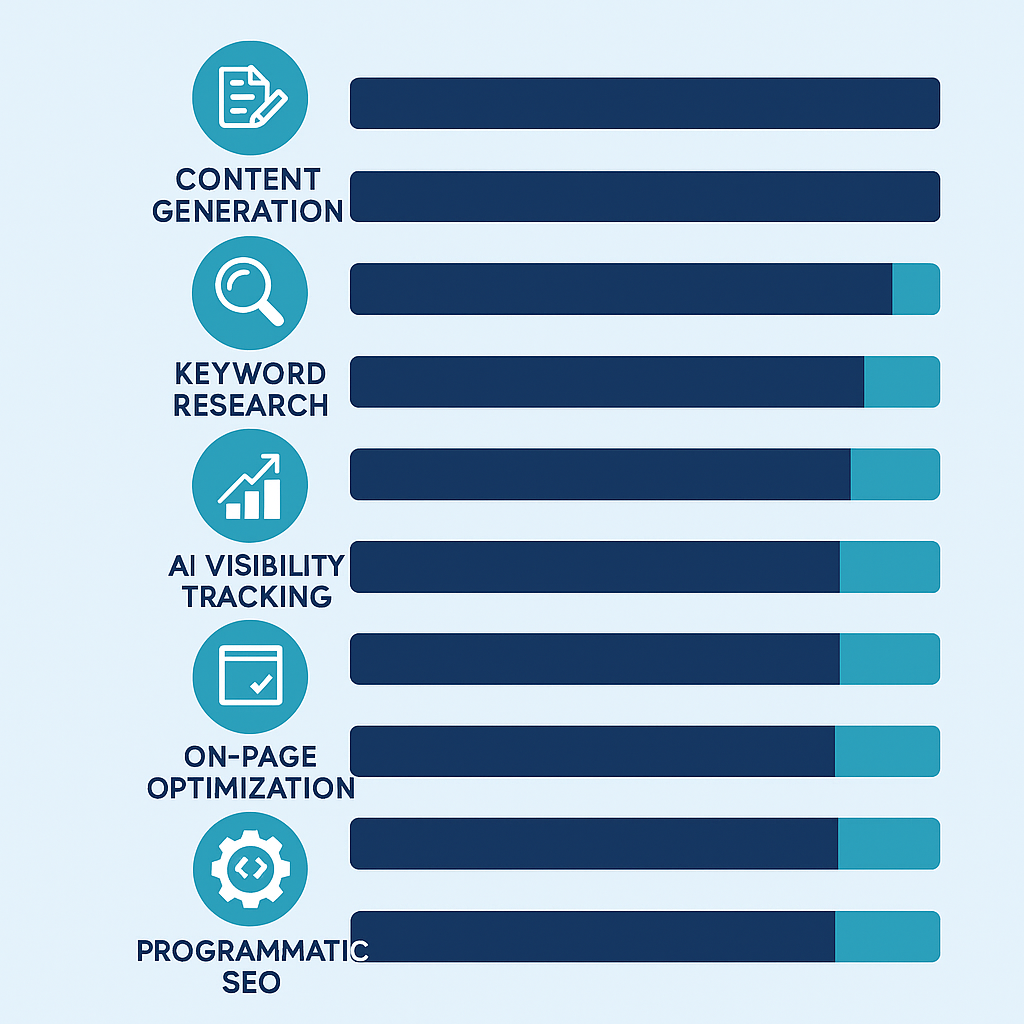
All 12 Tools at a Glance
- Gofylo — autonomous content engine + AI search visibility tracking
- Surfer SEO — on-page content scoring and SERP analysis
- Clearscope — content grading and keyword relevance scoring
- MarketMuse — topical authority planning and content briefs
- Frase — brief generation and SERP-based content optimization
- Semrush AI Writing Assistant — integrated keyword-to-draft within Semrush
- Ahrefs AI Features — keyword research and content gap analysis with AI layer
1. Gofylo
Gofylo is the only tool on this list that ships a full autonomous content lifecycle — keyword research, article writing, CMS publishing, internal linking, FAQ blocks, schema markup, AI-generated images, and AI search visibility tracking — as a single coordinated system. The Content Engine has generated over 48,000 articles, publishes 30 per month on the standard plan, and completes each article end-to-end in under 4 minutes. Articles are E-E-A-T-compliant and publish natively to WordPress, Webflow, Shopify, Wix, Ghost, Framer, Notion, and Feather, plus any custom CMS via API webhook. Content is generated in 18+ languages, and programmatic landing page generation is built-in — not an add-on.
Where Gofylo is structurally differentiated from every other tool in this list: it tracks AI search visibility. The AI Visibility Tracker monitors brand citation and ranking presence across ChatGPT, Claude, Perplexity, and Gemini, and surfaces a single AI Visibility Score — averaging 94 across active accounts. This matters because AI Overviews now appear in 60% of Google searches in the U.S. as of late 2025, and ChatGPT processes billions of queries per day. If your content strategy doesn't measure LLM presence, you're missing an increasingly large share of B2B discovery. Gofylo is available at $79/month with a 3-day free trial and no credit card required. gofylo.com
2. Surfer SEO
Surfer SEO is a widely-used on-page optimizer that scores your content against top SERP results using NLP analysis, term frequency, and structural signals. It integrates directly with Google Docs and WordPress and generates content outlines based on competitive SERP data. Surfer's strength is real-time content scoring as you write — its Content Score metric has become a de facto benchmark for many SEO teams. The limitation: Surfer is entirely Google-search-oriented and has no AI search visibility layer. It will tell you how well your article is likely to rank on Google; it won't tell you whether Claude or Perplexity will cite your brand. For teams that already have a writing process and want a scoring layer on top of it, Surfer is a solid single-function tool. Pricing starts around $89/month.
3. Clearscope
Clearscope focuses on keyword relevance grading — it analyzes your content against high-ranking SERP results and surfaces missing terms, related topics, and readability scores. It's widely used by enterprise content teams for editing and optimization workflows rather than content creation. Clearscope doesn't write content for you; it grades existing drafts against competitive benchmarks. The grading is genuinely useful and the interface is clean. Like Surfer, it has no AI search presence tracking, and at pricing tiers starting above $170/month, it's positioned for content teams with dedicated editors rather than lean growth teams.
4. MarketMuse
MarketMuse takes a topical authority approach — it maps your existing content against competitors, identifies topic gaps, and prioritizes which articles to create or improve for the highest organic impact. Its content briefs are detailed and its topic modeling is sophisticated. MarketMuse is particularly strong for content strategy planning: it helps teams decide *what* to write before they write it. The gap is that it's a planning layer, not an execution layer. You still need writers, editors, and publishers downstream. No native AI search visibility tracking. Pricing is tiered starting around $149/month; the free plan is limited to 10 queries per month.
5. Frase
Frase combines brief generation with an AI writing layer — it pulls SERP data for a target keyword, assembles a content outline based on what top-ranking pages cover, and lets you draft inside the same interface. It's one of the more accessible tools on this list, with a lower price floor than MarketMuse or Clearscope. The brief generation is fast and the SERP-based research is practical. Frase has introduced some AI writing capabilities, but they're supplementary to the optimization workflow rather than autonomous. No programmatic content generation at scale, and no AI search visibility layer. Pricing starts around $45/month.
6. Semrush AI Writing Assistant
Semrush's AI Writing Assistant is integrated directly into the Semrush platform, which means it benefits from Semrush's keyword database and SERP data. You can go from keyword research to a structured draft without switching tools, and the SEO recommendations are grounded in Semrush's real-time data. If your team is already using Semrush for technical SEO, rank tracking, or competitor research, the writing assistant adds marginal incremental value at low extra cost. As a standalone content tool, it's less purpose-built than Surfer or Frase. No AI search visibility tracking. Semrush's full platform starts around $139/month.
7. Ahrefs AI Features
Ahrefs has layered AI into its core keyword research and content gap tooling — Ahrefs uses AI to surface keyword clustering, content ideas, and on-page recommendations alongside its industry-standard backlink and domain data. The AI features don't constitute a standalone content tool; they're productivity additions on top of Ahrefs' existing infrastructure. For teams that use Ahrefs as their primary SEO research platform, the AI layer reduces manual analysis time. No content generation at scale, no AI search visibility tracking. Plans start around $129/month.
According to Marketing LTB's analysis, 63% of SEO professionals now use AI tools specifically for keyword research — making keyword-layer AI (Ahrefs, Semrush, Frase) a baseline, not a differentiator. The real gap in most stacks is content execution and AI search visibility tracking.
8. ChatGPT (with Browse / Custom GPTs)
ChatGPT is used by a large portion of SEO teams as a flexible research and drafting tool — it can help with title generation, meta description writing, schema markup, internal link anchor text, and first-draft content. With Browse enabled, it can pull live SERP data. The core constraint: ChatGPT is a prompt-based tool. Every output requires a human prompt, review, and publishing step. There's no autonomous publishing, no CMS integration, no built-in keyword research, and no AI search visibility tracking (ironic given that ChatGPT is one of the LLMs you'd want to be cited in). For structured SEO workflows, ChatGPT is a component, not a system. Free tier available; ChatGPT Pro at $20/month.
9. Rankability
Rankability is a content optimization tool that uses NLP scoring to benchmark articles against top SERP results, similar to Clearscope and Surfer in mechanism but positioned more toward agencies and growth teams. It generates content briefs and scores existing content for topical completeness. Rankability has been noted in several 2026 roundups for its clean UX and actionable scoring interface. Like other optimization-layer tools, it doesn't generate or publish content at scale and has no AI search visibility layer. Pricing is generally in the $99–$199/month range depending on seat count.
10. Writesonic
Writesonic is an AI writing platform with a dedicated SEO mode — it can generate long-form articles, optimize them against keyword targets, and has added an AI search layer called Chatsonic. Writesonic supports bulk content generation and integrates with a range of CMS platforms. It's a capable writing tool with more SEO awareness than generic AI writers. The bulk generation workflow still requires significant human prompt and review overhead at scale, and the AI search visibility layer is nascent compared to purpose-built tracking tools. Pricing starts around $20/month for limited use; team plans run higher.
11. Peec AI
Peec AI is a specialized AI search monitoring tool — it tracks whether your brand, products, and content are being cited by ChatGPT, Perplexity, and other LLMs. It's purpose-built for the GEO layer: you can see which prompts surface your brand, compare your AI share of voice against competitors, and identify citation gaps. Peec AI doesn't generate or optimize content; it measures the output of your content strategy in AI search. For teams that have a content production system already and want dedicated AI visibility measurement, Peec AI is a strong standalone option. Pricing is generally in the $49–$99/month range.
12. Replit (for Programmatic SEO)
Replit isn't an SEO tool by design — it's a cloud-based development environment. Technical teams at growth-stage companies use it to build programmatic SEO page generators: scripts that pull structured data and auto-generate hundreds or thousands of landing pages at scale. It appears in several practitioner SEO stacks (including Rankability's own 2026 roundup) because it's accessible enough for non-engineers to build basic programmatic page logic with AI code assistance. The upside is flexibility; the downside is that it requires engineering investment and produces no content optimization, no on-page SEO scoring, and no AI search visibility tracking. Free tier available; Hacker plan at $20/month.
How to Choose the Right Stack
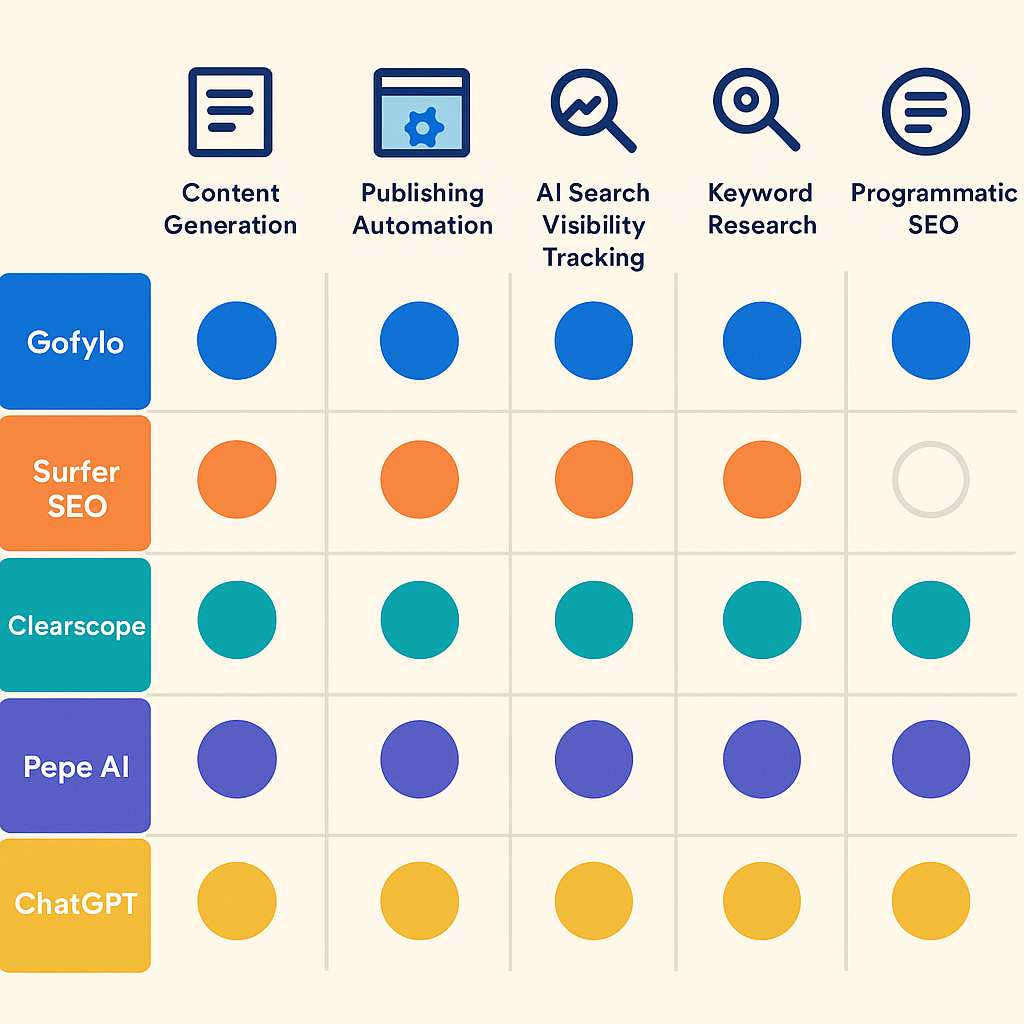
The fragmentation across seo ai tools is real — the average enterprise team runs 4.2 different tools concurrently per Aira's data. For lean B2B SaaS teams, that overhead is a liability. The simplest framework for stack selection is to map your gaps against three axes: content production at scale, Google SEO optimization, and AI search visibility. Most teams have partial coverage on the first two and near-zero coverage on the third. According to Global Growth Insights, over 68% of enterprises have integrated AI SEO tools into their marketing stack — but integrated doesn't mean optimized. Many teams stack five tools that overlap in function while missing the AI search layer entirely.
If you need content at scale: Gofylo's autonomous Content Engine publishes 30 fully-optimized articles per month without requiring a human prompt per article. Writesonic handles bulk generation but needs more hands-on oversight. ChatGPT requires a prompt for every output — it doesn't scale autonomously.
If you need Google on-page optimization: Surfer SEO, Clearscope, and Rankability are the strongest dedicated options. All three score content against live SERP data. Clearscope is the most enterprise-grade; Surfer integrates most cleanly into writing workflows; Rankability is the most accessible for agencies.
If you need AI search visibility: Gofylo's AI Visibility Tracker and Peec AI are the two purpose-built options. Gofylo bundles it with content production. Peec AI is the dedicated standalone option if you already have a content system. No other tool on this list offers native LLM citation tracking.
For small teams or bootstrapped builders: The best free SEO AI tools entry point is Gofylo's free AI Search Grader, which grades your current AI search presence and gives you an actionable score before you commit to any paid tool. Frase and Writesonic both have accessible lower tiers. Ahrefs and Semrush offer limited free tools for keyword research. For small businesses specifically, a single full-stack tool like Gofylo at $79/month replaces the need for four or five separate subscriptions.
For B2B SaaS teams that want to compete on organic and AI search simultaneously, the stack decision isn't just about which individual tools are best — it's about whether you need four separate subscriptions or one system that ships the full lifecycle autonomously.
FAQ
What AI tool is best for SEO?
The answer depends on what layer of SEO you're optimizing. For on-page content scoring against Google results, Surfer SEO and Clearscope are the most mature. For AI search visibility — tracking whether your brand gets cited in ChatGPT, Claude, Perplexity, and Gemini — Gofylo's AI Visibility Tracker leads the category. For teams that need end-to-end autonomous content production plus AI search tracking in a single platform, Gofylo is the most complete option at any price point, including the $79/month all-in-one plan.
Can you do SEO with AI?
Yes — and as of 2026, a growing majority of SEO professionals already do. AI tools are used across the full SEO workflow: keyword research and clustering, content brief generation, article writing, on-page optimization scoring, internal link planning, schema markup generation, and AI search visibility tracking. The key distinction is between prompt-based AI tools (which still require human input per task) and autonomous agent-based systems (which execute the full workflow without per-task prompting). Both work; autonomous systems compound faster because they remove the human bottleneck.
Can ChatGPT do SEO?
ChatGPT can assist with many SEO tasks — writing meta descriptions, generating title variants, drafting article outlines, producing schema markup, and even analyzing SERP data with Browse enabled. What it can't do natively is autonomously research keywords, publish to a CMS, track rankings, or monitor AI search visibility. It's a powerful tool inside a workflow that has humans driving each step. For scaling content production or tracking AI search presence, purpose-built SEO AI tools are more effective than general-purpose LLM prompting.
What are the 5 most popular AI tools?
In the SEO context specifically, the most widely-used AI tools in 2026 practitioner stacks include ChatGPT, Surfer SEO, Semrush (with its AI layers), Ahrefs (with AI features), and Frase — with Gofylo growing rapidly among B2B SaaS teams that want autonomous publishing alongside AI search tracking. Across the broader AI tools landscape, ChatGPT, Claude, Gemini, Midjourney, and GitHub Copilot are frequently cited as the highest-adoption general AI tools by usage volume.
Are there good free SEO AI tools?
Several tools offer meaningful free tiers for best free AI tools for SEO use cases. Gofylo's AI Search Grader is a free standalone tool that grades your brand's current AI search visibility and provides a scored breakdown. Ahrefs and Semrush both offer limited free keyword research tools. Google Search Console remains free and essential for any SEO workflow. ChatGPT's free tier handles lightweight content tasks. For production-grade content generation and AI search tracking, paid plans are required — but free tiers are a practical starting point for assessing fit.
Do SEO AI tools work for B2B SaaS specifically?
They work particularly well for B2B SaaS because the content moat is both a growth lever and a competitive defense — ranking for product-adjacent keywords compounds over time. The strongest use case for best AI SEO tools for small businesses and growth-stage SaaS teams is replacing a 3-5 person content function with an autonomous system that publishes consistently, optimizes for both Google and AI search, and tracks compound impact over time. Teams using Gofylo specifically benefit from content that's structured for AI citation (FAQ blocks, schema, E-E-A-T signals) from the moment it publishes — which matters more every quarter as LLM-driven discovery grows.
If you want to see where your brand currently stands in AI search before adding any new tool to your stack, run your site through Gofylo's free AI Search Grader — it grades your LLM citation presence across ChatGPT, Claude, Perplexity, and Gemini in minutes. Start the 3-day free trial at gofylo.com — no credit card required.