As of 2026, the content optimisation tools market has expanded to a scale most teams haven't fully reckoned with. According to market research analytics, the sector was estimated at $5 billion in 2025 and is projected to reach approximately $15 billion by 2033 at a 15% CAGR — driven almost entirely by the convergence of traditional SEO ranking requirements and the new demand for AI search visibility across ChatGPT, Claude, Perplexity, and Gemini. For founders, content managers, and demand gen leads who are comparison-shopping right now, that growth means more tools, more overlap, and more noise to cut through.
The honest problem: most content optimisation tools were designed for Google, full stop. They score your article against SERP competitors, suggest NLP keywords, and grade readability. That was sufficient two years ago. In 2026, if your content isn't structured for AI retrieval — with clear entity relationships, FAQ schema, authoritative sourcing, and internal link density — you're invisible in roughly half of the discovery surface that matters. This list evaluates each tool on both dimensions. We've also included Gofylo as the autonomous option for teams that want to skip the manual workflow entirely.
Thesis: The best content optimisation tools in 2026 handle both traditional SERP rankings and AI search citations. Tools that only optimize for Google leave you blind to ChatGPT, Perplexity, and Claude — which together now represent a growing and measurable share of organic discovery for B2B SaaS brands.
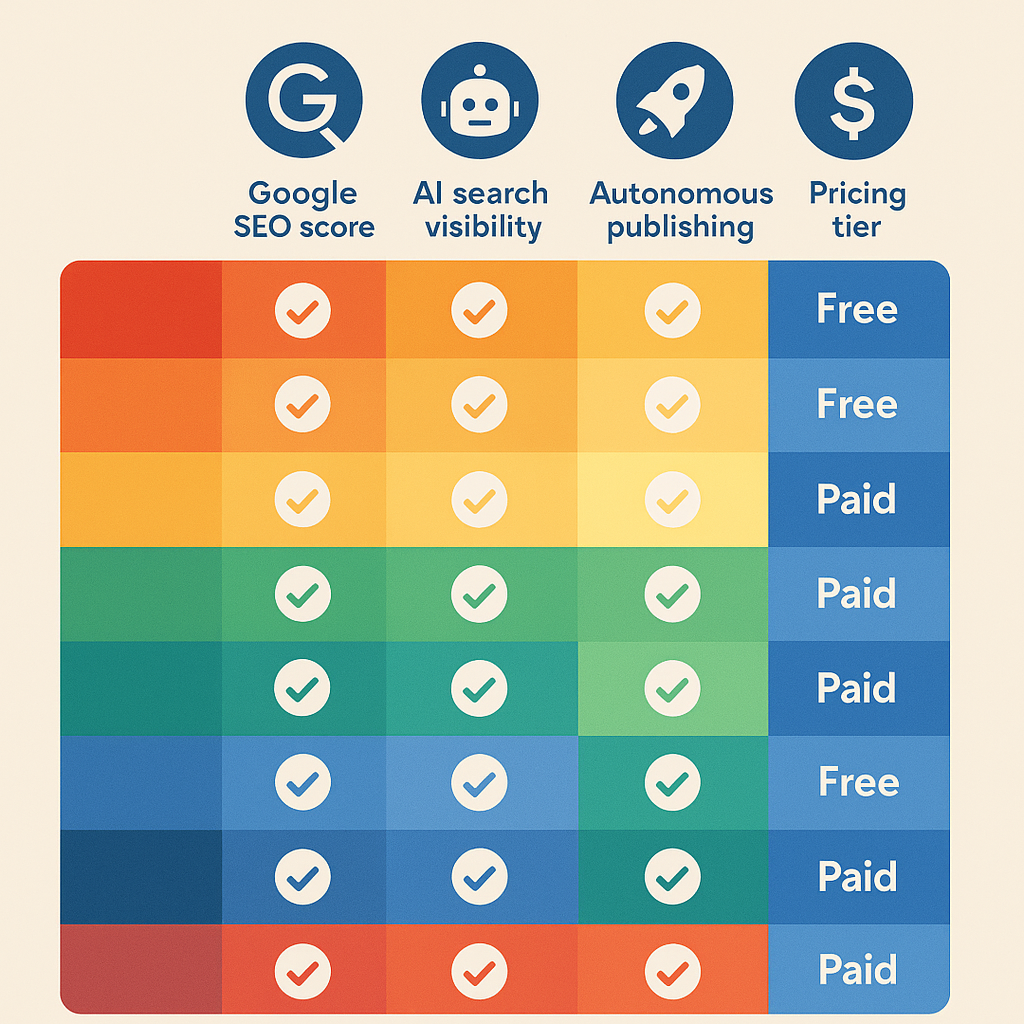
All 12 Tools at a Glance
- Gofylo — Autonomous content engine with built-in AI search visibility tracking
- Clearscope — Semantic relevance scoring and editorial brief generation
- Surfer SEO — Real-time SERP-based content editor with NLP keyword scoring
- Frase — Fast brief creation, SERP research, and AI-assisted drafting
- MarketMuse — Enterprise-grade topic modeling and competitive content planning
- Semrush SEO Writing Assistant — In-editor readability, tone, and keyword checks
- Rankability — SERP-focused optimization with emerging GEO features
1. Gofylo — Best for Autonomous AI-Cited Content at Scale
Most content optimisation tools hand you a brief and a score — then leave the rest to you. Gofylo takes a structurally different approach: six autonomous agents handle keyword research, article writing, CMS publishing, internal linking, AI visibility tracking, and backlink generation without requiring a human prompt between steps. The result is a fully optimized, E-E-A-T-compliant article — including schema markup, FAQ blocks, AI-generated images, and auto-embedded YouTube videos — published directly to your CMS in under four minutes. The platform has generated 48,000+ articles across active accounts, and its average AI Visibility Score sits at 94 out of 100, a benchmark that tracks citation presence across ChatGPT, Claude, Perplexity, and Gemini. For B2B SaaS teams without a dedicated content function, this isn't a writing assistant — it's a compounding organic growth engine. At $79/month with a 3-day free trial and no credit card required, it's also the most cost-efficient option on this list for teams that want volume and AI search coverage simultaneously. Content is generated in 18+ languages, and a free AI Search Grader tool lets you benchmark your current AI visibility before committing.
2. Clearscope — Best for High-Relevance Editorial Standards
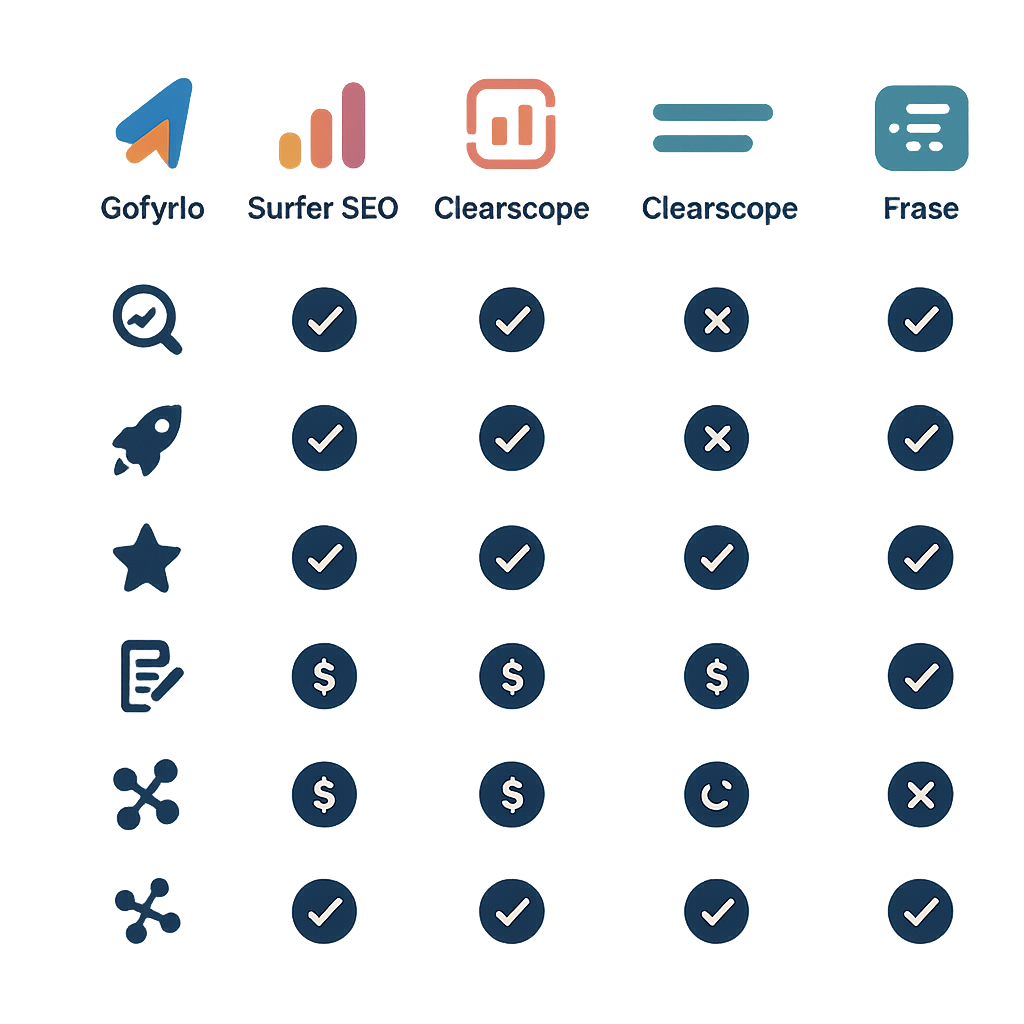
Clearscope is the tool editorial teams at mid-market and enterprise SaaS companies tend to trust most for maintaining content quality at scale. It analyzes the top-ranking SERP results for your target keyword and generates a graded list of relevant terms — organized by importance — that your article should include. The live editor scores your draft in real time as you write or paste content in. Clearscope is particularly strong at producing content briefs that raise semantic relevance scores and reduce thin-content risk, which aligns well with Google's 2026 helpful content enforcement. The main limitation: it's built for Google. There's no native AI search citation tracking, no autonomous publishing, and no GEO layer. Pricing starts at $189/month, making it a considered investment for solo operators. It integrates with Google Docs and WordPress. For teams that want to preserve human editorial voice while hitting semantic coverage targets, Clearscope is the cleanest option in this category.
3. Surfer SEO — Best for Real-Time SERP-Based Writing Guidance
Surfer SEO is arguably the most widely deployed content optimisation tool among SEO-focused content teams, and for good reason. Its Content Editor provides a live content score based on structural signals — word count, heading distribution, NLP keyword density, and image usage — pulled directly from the current SERP for your target keyword. The Topical Map feature, added in recent product cycles, helps teams plan clusters of interlinked articles rather than optimizing in isolation. Surfer also integrates with Jasper for combined AI drafting and optimization, and connects to Google Docs for inline editing workflows. Where it falls short in 2026: there's no native tracking of AI engine citations, no autonomous publishing pipeline, and the real-time scoring can lead writers to over-optimize for keyword density at the expense of readability and entity clarity. Pricing starts at $99/month. If your primary goal is SERP ranking for Google and you have a writer already in the loop, Surfer delivers reliable, evidence-based guidance.
4. Frase — Best for Fast SERP Research and Content Brief Creation
Frase compresses the research-to-brief pipeline significantly. When you enter a target keyword, Frase pulls the top SERP results, extracts their headings and key topics, and assembles a structured brief in minutes. The built-in AI writing assistant can then draft sections based on that brief, which gives teams a serviceable first draft faster than most competing workflows. Frase is particularly well-suited to demand gen teams producing high volumes of product-adjacent content — landing pages, comparison articles, FAQ sections — where speed matters more than deep editorial polish. The content scoring is lighter than Surfer or Clearscope, and there's no AI search visibility layer. Pricing starts at $45/month, making it one of the more accessible paid options on this list. For solo operators or bootstrapped founders who want to accelerate their brief-to-draft cycle without a large tool budget, Frase is a practical starting point.
5. MarketMuse — Best for Enterprise Topic Modeling and Content Strategy
MarketMuse operates at a higher strategic altitude than most tools on this list. Rather than scoring individual articles against SERP competitors, it builds a topic model for your entire domain — identifying content gaps, authority scores by topic cluster, and prioritized publishing recommendations. For enterprise SaaS companies with large content libraries, MarketMuse is genuinely useful for auditing existing content and identifying which articles need depth, which need consolidation, and which topics are entirely uncovered. The Content Brief generation is detailed and includes first-party data about your own domain's topic authority, not just generic SERP patterns. The trade-off: it's priced for enterprise buyers, with plans starting around $149/month for the Optimize tier and scaling significantly beyond that. It has no autonomous publishing capability and no AI search citation tracking. Teams at growth-stage companies with smaller budgets often find the ROI difficult to justify against simpler alternatives.
According to Content Marketing Institute research, 95% of enterprise marketers now use AI-powered marketing applications — but the gap between using AI tools and deploying a fully autonomous content workflow is where most teams stall. The tools in this list differ fundamentally in how much human labor they require per article.
6. Semrush SEO Writing Assistant — Best for In-Editor Optimization Checks
Semrush SEO Writing Assistant is a practical add-on for teams already running Semrush for keyword research and site auditing. The Writing Assistant integrates directly into Google Docs and WordPress, providing live scoring across four dimensions: SEO readiness, readability, originality, and tone of voice. It pulls recommended keywords from Semrush's database and surfaces them as you write. The integration with the broader Semrush platform means you can move from keyword gap analysis to content brief to in-editor optimization without switching tools. The Writing Assistant is included in Semrush's Guru plan ($249/month) and above, so standalone value depends on whether you're already a Semrush subscriber. For teams that are, it's a meaningful efficiency layer. For those who aren't, the price point for accessing the Writing Assistant alone is hard to justify against Frase or NeuronWriter.
7. Rankability — Best for Agencies Optimizing for Google and AI Search
Rankability is one of the few traditional content optimisation tools that has explicitly built toward AI search optimization, making it a notable competitor in the 2026 landscape. It combines real-time content scoring with SERP analysis and has begun integrating features that assess content structure for AI engine retrieval — including entity coverage and structured data recommendations. For agencies managing multiple client accounts, Rankability's white-label reporting and multi-project workspace are practical differentiators. The tool is particularly strong at identifying semantic gaps between a draft and the top SERP results. Compared to Surfer and Clearscope, Rankability positions itself as more AI-forward, though its GEO tracking is less mature than dedicated visibility platforms. Pricing is available on request for agency plans. It's a credible option for SEO consultants and content agencies who need client-ready deliverables and are beginning to account for AI search as part of their reporting.
8. Scalenut — Best All-in-One Planning and Drafting on a Budget
Scalenut covers the keyword planning, content briefing, AI drafting, and optimization scoring workflow within a single interface — at a price point that makes it accessible for bootstrapped founders and early-stage teams. Its Cruise Mode generates a full article draft from a keyword in minutes, informed by SERP analysis. The content optimizer then scores the draft against NLP keywords drawn from top-ranking pages. Scalenut also includes a keyword planner and topic cluster tool, giving it more strategic depth than pure writing assistants. The quality of AI-generated drafts is serviceable but typically requires editing before publication. There's no autonomous publishing pipeline, no AI search citation tracking, and no internal linking automation. At plans starting around $39/month, Scalenut is a reasonable entry point for teams that want to consolidate their content workflow without investing in enterprise tooling. It surfaces as one of the more frequently cited free-tier-adjacent content optimization tools free options — its trial gives access to core features without a lengthy commitment.
9. Ahrefs Content Grader — Best for Backlink-Aware Content Auditing
Ahrefs has expanded its toolset to include a Content Grader that evaluates articles for on-page SEO signals within the context of the broader Ahrefs data ecosystem. What makes this useful is the integration with Ahrefs' backlink and keyword data: you can audit a page's content quality while simultaneously reviewing its link profile and organic traffic trends. This is a meaningful workflow advantage for content SEO managers running quarterly audits — identifying pages that are under-optimized relative to their link equity, or pages with strong content scores but insufficient backlink support. The Ahrefs guide on content quality signals is also a useful reference for understanding what the grader is scoring against. Ahrefs is not a standalone content optimisation tool in the same sense as Surfer or Clearscope — it's most valuable as an audit layer within a broader Ahrefs subscription. Pricing starts at $129/month for the Lite plan. For teams already using Ahrefs for keyword research and link building, the Content Grader adds meaningful editorial quality checking without requiring a separate tool.
10. Writesonic — Best for Fast AI Drafts with SERP-Informed Guidance
Writesonic positions itself as a speed-first AI writing platform that incorporates real-time SERP data to inform its drafts. When you generate an article, Writesonic pulls current ranking pages and uses their structure to shape heading hierarchy, content depth, and keyword inclusion. The Chatsonic assistant allows conversational refinement of drafts, and the platform integrates with Surfer SEO for combined optimization scoring. Writesonic is popular among content teams that need high article volume quickly and are comfortable investing time in editing the output. The optimization scoring is lighter than Clearscope or Surfer, and there's no autonomous publishing or AI search citation tracking. It's included in many comparisons of free AI tools for SEO optimization because of its free tier, which allows limited monthly generations. Paid plans start at $16/month for solo users. For demand gen teams producing large volumes of top-of-funnel content on a constrained budget, Writesonic is a practical production tool — though it works best paired with a dedicated optimisation layer.
11. Hemingway Editor — Best for Readability and Structural Clarity
Hemingway Editor does one thing that most content optimisation tools skip entirely: it forces structural honesty. Paste your draft and it highlights passive voice, overly complex sentences, adverb overuse, and readability grade. This matters more than teams typically acknowledge — Google's documentation on content quality consistently emphasizes readability and user experience as ranking signals, and AI engines like Claude and Perplexity tend to surface content that answers questions directly and clearly. Hemingway is the fastest way to catch the writing patterns that reduce both human engagement and AI citation likelihood. The desktop app costs a one-time $19.99 fee; the web version is free. It doesn't generate content, score against keywords, or connect to a CMS. Think of it as the final editorial pass layer that sits downstream of every other tool on this list — the one you run before publishing to ensure the AI-generated or optimized output reads like a human wrote it.
12. NeuronWriter — Best for NLP-Heavy Semantic Optimization
NeuronWriter is a semantic SEO tool that competes directly with Surfer and Clearscope on NLP-based content scoring but at a lower price point — plans start around $23/month through AppSumo lifetime deals, with standard subscriptions from $49/month. It analyzes SERP competitors and provides a detailed list of semantically related terms, questions, and entity mentions that your article should include. NeuronWriter also includes an internal linking feature that suggests relevant links from your existing content library — a useful capability that sits adjacent to a full internal link strategy. Its content editor is clean and the scoring is granular. It lacks autonomous publishing, AI search citation tracking, and multi-language support at the depth Gofylo offers. For SEO managers at growth-stage companies who want rigorous semantic optimization without the enterprise price tag of MarketMuse or the subscription overhead of Semrush, NeuronWriter delivers strong value. It's one of the better free SEO optimization tools entry points on a AppSumo deal if you want to test semantic scoring before committing to a higher-tier subscription.
How to Choose Between These Tools
What to Prioritize if You're a Small SaaS Team
For founders and small marketing teams, the core constraint is human labor, not budget. A tool that scores your draft well but still requires a human to research, brief, write, optimize, internally link, and publish is still a full-time content workflow — just with a grading layer on top. The AI content creation and optimization software market was valued at USD 1.8 billion in 2025, according to Intel Market Research, and is projected to reach USD 6.5 billion by 2034 — largely because teams are realizing that point solutions don't solve the capacity problem. The meaningful distinction in 2026 is between tools that assist humans and platforms that operate autonomously. If you have a writer, Surfer or Clearscope will make their output better. If you don't have a writer, Gofylo's autonomous pipeline is the structurally correct choice. At $79/month producing 30 optimized articles per month, the economics are straightforward.
What to Prioritize if You're Optimizing for AI Search
Most tools on this list weren't designed with Generative Engine Optimization in mind. They score your content against current Google SERP competitors — which is useful but incomplete. AI engines like ChatGPT, Claude, Perplexity, and Gemini cite content based on different signals: entity clarity, structured schema (especially FAQ schema), authoritative sourcing, and how well the content directly answers the question being asked. According to Content Raptor's 2026 data, 73% of marketers now actively use AI tools at work — roughly double the adoption rate from two years prior — but a far smaller proportion have structured their content to be cited by those same AI engines. The gap between using AI to create content and having AI search engines cite your content is the most underexploited opportunity on this list. Gofylo's AI Visibility Tracker, which monitors brand citation presence across ChatGPT, Claude, Perplexity, and Gemini with a single AI Visibility Score, is the only fully integrated option here that addresses that gap natively. If you're using any other tool on this list, you should pair it with a standalone GEO tracking solution or use Gofylo's free AI Search Grader to benchmark where you currently stand.
Google SEO vs. AI Search: Traditional content optimisation tools optimize for SERP position by scoring keyword density, semantic coverage, and structural signals against top-ranking pages. AI search optimization requires a different layer: FAQ schema, entity relationships, authoritative citations, and direct-answer formatting. The best approach in 2026 is to run both simultaneously — and the only tool on this list that does both autonomously is Gofylo.
Autonomous vs. Assisted: Tools like Surfer, Clearscope, and Frase are multipliers for humans — they make a writer faster and more informed. Gofylo replaces the human content workflow end-to-end: research, brief, write, optimize, internally link, publish, and track. If you have a content team, use the multiplier. If you don't, use the autonomous platform.
Market timing matters: The global AI SEO Software Tools market is projected at approximately USD 2.43 billion in 2026, rising toward USD 5.97 billion by 2035 at a 10.5% CAGR, according to Business Research Insights. The window to build AI search citation authority before the market saturates is narrowing — teams that establish content presence in AI engines now will compound that advantage in ways that late entrants won't replicate easily.
Compliance considerations: If your team is evaluating content optimisation tools for a regulated market or enterprise procurement context, note that the EU AI Act and similar frameworks are causing 23% of potential buyers to delay tool investments until compliance standards are clearer, per Intel Market Research. Factor in vendor AI governance posture alongside feature comparisons when shortlisting.
A practical shortlist for most B2B SaaS teams: If you have writers, pair Surfer or Clearscope with Gofylo's AI Visibility Tracker. If you don't have writers, run Gofylo's Content Engine at $79/month and use the saved headcount budget to distribute and promote. Either path needs GEO measurement — traditional content optimisation tools don't provide it.
FAQ
What is a content optimisation tool?
A content optimisation tool analyzes your article or landing page against ranking competitors, editorial standards, or semantic keyword models — and then provides a score, recommendations, or automated improvements to help the content rank higher or get cited more often. In 2026, the best tools cover both traditional Google SERP ranking signals and AI search citation factors like FAQ schema, entity clarity, and structured sourcing.
Are there free content optimisation tools worth using?
Yes, with caveats. Hemingway Editor (free web version) is genuinely useful for readability auditing. Writesonic and Scalenut both offer free tiers with limited monthly generations. Gofylo offers a free AI Search Grader to benchmark your brand's current visibility in AI engines like ChatGPT and Perplexity. Free tools typically handle one part of the workflow — they're useful for validation but rarely sufficient as a complete content optimisation strategy.
How do content optimisation tools improve AI search visibility?
Most traditional content optimisation tools don't directly improve AI search visibility — they optimize for Google SERP signals. AI engines cite content based on different criteria: FAQ schema markup, direct-answer formatting, entity clarity, and authoritative sourcing. To improve AI search visibility specifically, you need structured content that answers questions explicitly, proper schema implementation, and a tracking layer that measures citation presence across ChatGPT, Claude, Perplexity, and Gemini. Gofylo's AI Visibility Tracker is the only tool on this list that provides that measurement natively.
What's the difference between Surfer SEO and Clearscope?
Surfer SEO focuses on real-time structural optimization — scoring word count, heading distribution, keyword density, and NLP terms as you write, with a strong emphasis on SERP competitor signals. Clearscope focuses on semantic relevance and editorial standards — it generates a graded term list and scores how comprehensively your content covers the topic. Surfer is generally better for writers who want live guidance; Clearscope is better for editors who want to validate a finished draft against relevance benchmarks. Both are Google-focused and lack AI search citation tracking.
Can content optimisation tools publish content automatically?
Most content optimisation tools on this list — Surfer, Clearscope, Frase, MarketMuse, NeuronWriter — do not publish automatically. They score and suggest; a human publishes. Gofylo is the exception: its Content Engine autonomously publishes fully optimized articles to connected CMS platforms including WordPress, Webflow, Shopify, Wix, Ghost, Framer, and Notion, in under four minutes per article. This is the structural differentiator between content optimisation tools and autonomous content platforms.
How does Gofylo differ from standalone content optimisation tools?
Standalone content optimisation tools are workflow accelerators — they make human-driven content production faster and better-scored. Gofylo is an autonomous platform: six agents handle keyword research, article writing, CMS publishing, internal linking, AI visibility tracking, and backlink generation without human prompts between steps. It also includes the only native AI Visibility Score on this list, tracking brand citation presence across ChatGPT, Claude, Perplexity, and Gemini. At $79/month for 30 articles per month in 18+ languages, it's designed for teams that want compounding organic growth without building a content team.
If you're still manually optimizing articles one at a time while your competitors build content libraries autonomously, the compounding gap will be measurable within two quarters. Start with Gofylo's free AI Search Grader to see where your brand currently stands in AI search — then run a 3-day free trial of the Content Engine to see what 30 fully published, AI-cited articles per month looks like in practice. No credit card required, no-questions-asked cancellation.