
Keyword research is the process of identifying the words and phrases people type — or speak — when searching for information, products, or solutions online. That definition sounds simple, but in 2026 it encompasses a much wider surface area than it did even two years ago. Search now happens across Google, Bing, ChatGPT, Claude, Perplexity, and Gemini simultaneously. A keyword strategy that only targets one surface leaves the rest uncontested.
For B2B SaaS founders and marketing leads, keyword research is not a one-time task or a list you build in a spreadsheet and forget. It is the map that determines which content you produce, which pages rank, which questions AI assistants answer using your material, and ultimately which organic channels drive compounding pipeline. Everything downstream — content briefs, topic clusters, internal linking, AI citation signals — depends on getting the keyword foundation right.
Thesis: Keyword research is the strategic intelligence layer beneath all organic growth. Master the mechanics and you control which conversations your brand enters — on Google and inside AI-generated answers.
The Core Definition: What Keyword Research Actually Measures
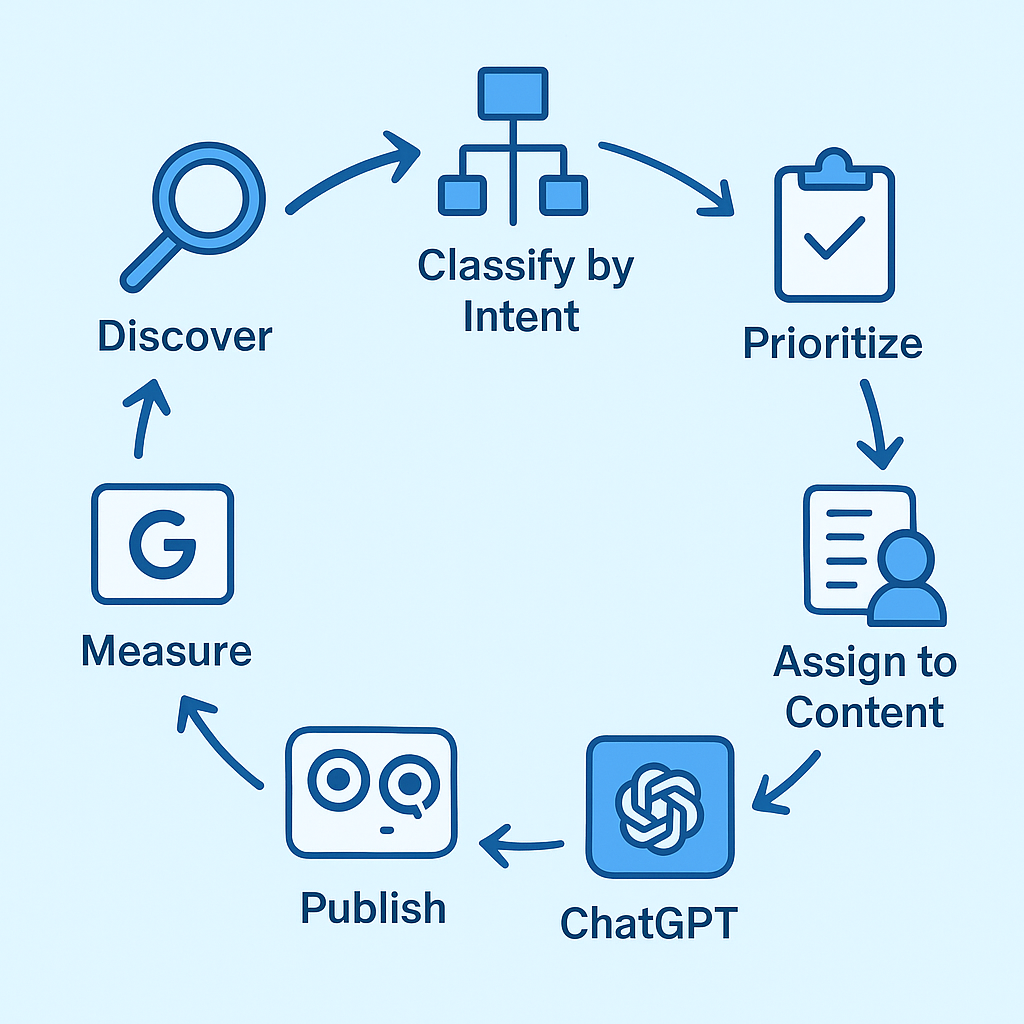
Keyword research is the practice of surfacing and analyzing the specific terms your target audience uses when they search, so you can align your content to those terms before a competitor does. As MarketMuse defines it, keyword research is "the process of identifying the words and phrases people use to search for information online." That framing is accurate but incomplete for 2026: the same process now informs what signals AI language models pick up when deciding which sources to cite inside a generated answer. The output of keyword research is not just a list of phrases — it is a prioritized map of audience demand, organized by intent, difficulty, and business value. Teams that treat it purely as a ranking exercise miss the structural role it plays in content architecture, internal linking, and AI-search citation chains. Solid keyword research answers three questions simultaneously: what does my audience need, where does my site have a realistic shot at ranking, and what does an AI assistant need to see in my content to quote it accurately?
Demand signal, not guesswork. Every keyword carries measurable data: monthly search volume, estimated click-through rate, keyword difficulty score, and the SERP features that currently occupy the top positions. These numbers are not decoration — they are the inputs that separate content bets with a high probability of return from content that disappears on page four.
Two audiences, one process. In 2026, the same keyword research methodology that feeds Google optimization also feeds AI visibility strategy. When you identify a high-intent question your audience asks, that question is simultaneously a candidate for a Google snippet and a candidate for a ChatGPT or Claude citation. The research you do once serves both surfaces.
Accuracy compounds over time. Keyword research that is revisited regularly — against live Search Console data, competitor movements, and new AI search patterns — builds a content library that grows more authoritative with each publish cycle. One-time keyword lists decay; continuous research loops compound.
Why Search Intent Is the Real Unit of Keyword Research
A keyword is only useful when you understand the intent behind it. The phrase "CRM software" and the phrase "best CRM for early-stage SaaS startups" represent entirely different buyer moments, even though they share topical territory. Intent is the reason someone typed those words, and it determines the content format, depth, and call to action that will actually serve them. Google's own guidelines on search quality center on whether content satisfies the user's underlying need — not whether the keyword appears the right number of times. Research that ignores intent produces articles that rank for the wrong query stage, generating traffic that bounces without converting. For B2B SaaS specifically, where sales cycles are long and buyers do significant self-education, aligning keyword intent to funnel stage is the difference between content that generates pipeline and content that generates pageviews from people who will never buy.
The Four Intent Types — and How They Map to the B2B Funnel
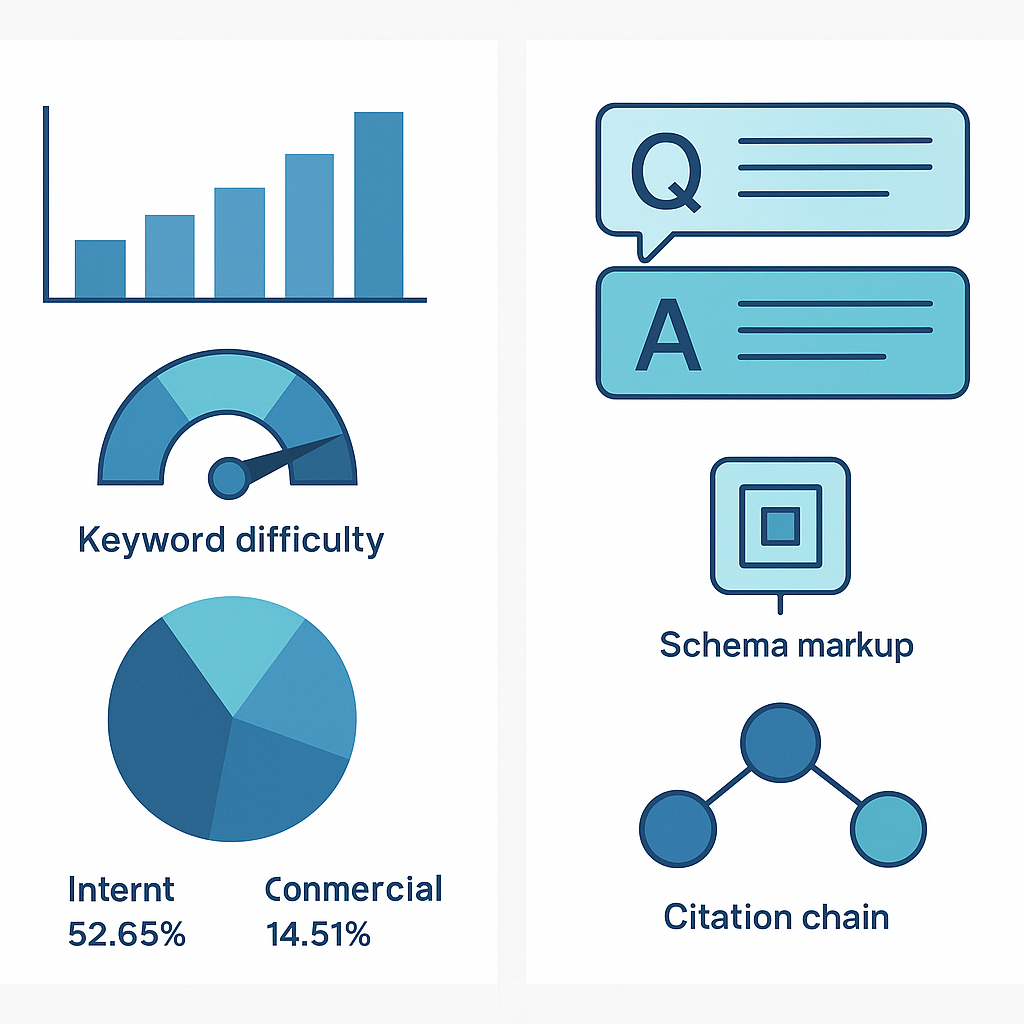
Google classifies search intent across four categories, and understanding the distribution matters enormously for content planning. According to keyword research statistics published by Amra & Elma, Google searches break down as informational (52.65%), navigational (32.15%), commercial (14.51%), and transactional (0.69%). The implication for B2B SaaS content teams is that more than half of all search volume is people trying to learn — not buy immediately. A content strategy that only produces bottom-of-funnel product pages misses the majority of the demand surface.
- Informational intent: The user wants to understand a concept, solve a problem, or learn how something works. Example: 'what is keyword research.' This is where educational content, explainers, and guides live — and where AI assistants most frequently pull citations.
- Navigational intent: The user already knows the destination and is using search to get there faster. Example: 'Ahrefs login' or 'Semrush keyword explorer.' Ranking for competitors' navigational terms is a separate competitive play.
- Commercial intent: The user is evaluating options before making a decision. Example: 'best keyword research tool for SaaS.' This is where comparison articles and feature breakdowns earn qualified traffic.
- Transactional intent: The user is ready to act — sign up, purchase, or request a demo. Example: 'keyword research tool free trial.' Volume is low but conversion rates are highest here.
- Hybrid intent: Many real-world queries blend intent types, especially in B2B. Recognizing hybrid signals prevents you from producing content that satisfies only one dimension of a multi-faceted question.
What a Keyword Example Looks Like in Practice
A keyword is any word or phrase typed into a search engine that reflects a user's need. In the context of a B2B SaaS business, a keyword might be as short as 'SEO tool' or as specific as 'automated content publishing platform for SaaS without a content team.' Both are real keywords. The short one has high volume and brutal competition; the specific one has lower volume but far higher intent and a much more achievable difficulty score. The practical question keyword research answers is: given your site's current authority, which of these terms can you actually win, and in what order should you pursue them? Understanding keyword examples also clarifies that a single page can — and should — target a primary keyword plus a cluster of semantically related secondary keywords. A well-researched article on 'keyword research for SaaS' will naturally rank for 'what is keyword research,' 'keyword research tools,' 'how to find keywords,' and many related variants simultaneously. That natural semantic coverage is what makes thorough topic research more valuable than targeting one isolated phrase.
Short-Tail vs. Long-Tail: Where the Traffic Actually Lives
The SEO industry has long distinguished between short-tail keywords (one or two words, high volume, high competition) and long-tail keywords (three or more words, lower volume, lower competition, higher specificity). The conventional wisdom is to pursue long-tail first because the path to ranking is shorter. The data backs this up: according to Exploding Topics' 2026 SEO statistics roundup citing SparkToro and Datos, long-tail keywords make up 70% of all search traffic. That figure reframes the strategy entirely. The high-volume short-tail keywords your competitors are fighting over represent a minority of actual search behavior. The specific, nuanced, question-based queries your audience types at 2 AM when they're trying to solve a real problem — that is where most of the traffic actually lives.
Examples of Research Keywords Across a B2B SaaS Context
To make keyword examples concrete, consider a B2B SaaS company selling a project management tool for engineering teams. The keyword universe for that product spans dozens of intent categories and specificity levels. The examples below illustrate the range a thorough research process would uncover.
- Broad informational: 'project management for software teams' — high volume, competitive, worth targeting as a hub article once domain authority supports it.
- Problem-aware informational: 'why engineering sprints miss deadlines' — lower volume, high relevance, excellent for a spoke article that links back to the hub.
- Comparison / commercial: 'Jira vs Linear for startup engineering teams' — commercial intent, often triggers AI-generated comparison answers, ideal for a detailed head-to-head page.
- Feature-specific transactional: 'project management tool with GitHub integration free trial' — low volume, very high conversion probability, should map directly to a landing page.
- Voice-optimized conversational: 'what is the best project management app for a small dev team' — phrased as a spoken question, increasingly surfaced by AI assistants and voice searches.
- Competitive brand displacement: 'Jira alternative for small engineering team' — captures buyers already using a competitor who are evaluating a switch.
Keyword Research and Its Role Inside Topic Clusters
Modern SEO architecture organizes content into topic clusters rather than isolated pages. A cluster consists of a hub article that covers a broad topic comprehensively, surrounded by spoke articles that go deep on specific subtopics. Keyword research is the process that defines which spokes need to exist, what angle each should take, and how they link back to the hub. Without systematic keyword research, topic clusters are guesswork — you end up with a hub and a handful of tangentially related articles that share no clear semantic relationship and do not reinforce each other's authority. When keyword research is done correctly, every spoke article targets a distinct but related set of terms, earns its own rankings, and passes topical authority to the hub through internal links. This is the compounding mechanism: each new article increases the cluster's total keyword footprint, which increases the hub's authority, which makes the next article easier to rank. The present article, for example, is a spoke in the Keyword Gap Analysis cluster — it goes deep on one angle rather than covering the entire universe of SEO keyword strategy. That depth is intentional. For the broader map of keyword research and analysis, including the tool selection and competitive intelligence layer, the cluster's hub article covers that ground separately.
Hub vs. Spoke: How Cluster Architecture Works
The hub article in a cluster functions as the authoritative overview — it covers the topic broadly, links out to every spoke, and is the page you'd send a first-time reader who knows nothing about the subject. Spoke articles, by contrast, are written for readers who already know the category exists and want depth on one specific dimension. Understanding What Separates Winnable Competitive Keywords from low-return ones, for instance, is a spoke-level question that goes far deeper than any hub article could address without bloating. The implication for keyword research is that you need to understand both the hub-level terms (broader, higher volume, harder to rank) and the spoke-level terms (specific, lower volume, faster to rank, longer-tail) before you can build a cluster that works. Mapping each identified keyword to either hub or spoke determines your content production roadmap.
Keyword Research for AI Search, Not Just Google
In 2026, keyword research serves two parallel ranking systems: traditional search engines like Google and Bing, and generative AI engines like ChatGPT, Claude, and Perplexity. The mechanics differ, but the underlying research process overlaps significantly. AI engines do not rank pages the way Google does — they synthesize answers from multiple sources and cite the ones that most clearly and authoritatively address the user's query. The implication is that the same question-based, intent-aligned keywords that earn Google featured snippets are also the ones most likely to surface your content as an AI citation source. The difference is in the formatting signal: AI engines favor content that answers a question in a single self-contained paragraph, uses structured subheadings, includes schema markup, and cites other authoritative sources. A piece of content that is well-researched at the keyword level and well-structured at the formatting level performs on both surfaces simultaneously. According to Ahrefs' keyword research guide, covering topics with search demand is the baseline — in 2026, that demand now spans both typed Google queries and conversational AI prompts.
AI engines like ChatGPT and Claude do not index pages — they synthesize answers. The keywords that trigger AI citations are the same question-based, high-intent terms that earn Google featured snippets. One research process, two citation surfaces.
How Voice Search Is Reshaping Keyword Patterns
Voice search is not a niche use case in 2026 — it is a mainstream input method that is actively reshaping keyword patterns. According to Keywords Everywhere's 2025 Google search stats report, in 2024, 61.9% of Millennials in the US used voice assistants monthly, with Gen Z following at 55.2% and Gen X at 51.9%. Smart speaker adoption is similarly widespread: 75% of American households own at least one smart speaker, according to Ranktracker's 2025 keyword research statistics report. The impact on keyword research is structural. Voice queries are longer, more conversational, and more likely to be phrased as complete questions than typed queries. RankTracker's 2025 data shows that 'Tell me about' searches jumped 70% from 2024 to 2025. This means keyword research that only captures short typed phrases misses a growing share of actual audience behavior. Effective keyword research in 2026 includes question-form variants ('what is the best way to...', 'how do I...', 'which tool should I use if...') alongside traditional head terms and long-tail phrases. These conversational variants are also the exact format that AI assistants index most readily for citation.
The Metrics That Make a Keyword Worth Targeting
Not every keyword your research surfaces is worth pursuing. The decision of which terms to target — and when — depends on a set of interconnected metrics that together predict the likely return on the content investment. The core metrics are search volume, keyword difficulty, click-through rate potential, and business relevance. Search volume tells you how many people search a term each month. Keyword difficulty estimates how competitive the existing results are. Click-through rate potential tells you how much of that volume is actually clickable — a critical factor in 2026, since, according to Amra & Elma's keyword research statistics, over 58% of Google searches in the US resulted in zero clicks in 2024, meaning users found their answer directly on the search results page without clicking through. That zero-click trend has accelerated since AI Overviews became standard in Google results — which means the informational keywords that once drove blog traffic now increasingly serve as AI citation sources rather than direct click drivers. The smart keyword research response is to optimize for both: write content that earns the citation (and therefore brand visibility in AI answers) while also structuring pages to capture the clicks that do happen.
Keyword Difficulty and Competitive Landscape
Keyword difficulty scores — available in tools like Ahrefs and Semrush — estimate how hard it would be to rank on page one for a given term based on the authority of pages currently ranking there. Ahrefs maintains a database of over 28 billion keywords, while Semrush covers over 25 billion, according to Exploding Topics' 2026 SEO statistics report. That scale matters because keyword difficulty is only meaningful when compared against your own site's current domain authority. A difficulty score of 45 is trivial for a site with strong topical authority in a niche, and insurmountable for a new site with no backlinks. The practical implication: keyword research should always be contextualized against your site's current competitive position. Targeting keywords where the first five organic results are dominated by publications with domain ratings of 80+ when your site sits at 30 is not a strategy — it is a waiting room. According to keyword research statistics from Amra & Elma, approximately 69% of clicks go to the first five organic results for any keyword. If you cannot realistically reach that top-five window, the volume of a keyword is largely theoretical.
Prioritize winnable terms first. Early-stage sites and new content programs compound faster by targeting lower-difficulty, higher-specificity terms where ranking in the top five is realistic within 60-90 days. Authority built on these wins then unlocks higher-difficulty terms progressively.
Business relevance overrides volume. A keyword with 200 monthly searches that maps directly to your ideal customer's most acute pain point is more valuable than a keyword with 10,000 monthly searches that attracts students and career changers. Volume is a starting filter, not the final decision.
Track share of voice, not just rank. In 2026, keyword success metrics extend beyond rank position to include AI citation frequency — how often your content is referenced by ChatGPT or Claude when a user asks a relevant question. Some platforms now surface this as an 'AI visibility score,' giving teams a quantified view of their brand's presence across both search surfaces.
Is Google Keyword Research Free?
Google does provide free keyword research tools, and they are legitimate starting points — though they have meaningful limitations compared to paid platforms. Google's own Keyword Planner, accessible through a Google Ads account, provides volume ranges and bid estimates for keywords. Google Search Console, also free, shows which queries are already driving impressions and clicks to your existing pages — making it one of the most actionable keyword research inputs available, because it reflects real data from your actual audience. Google Trends is another free tool that shows the relative search popularity of terms over time, useful for identifying seasonal patterns and emerging topics. The limitation of all free Google tools is that they provide ranges rather than precise volumes, they do not show keyword difficulty scores, they do not reveal what competitors rank for, and they offer no competitive intelligence layer. Paid platforms like Semrush and Ahrefs fill those gaps, but they carry subscription costs that may not be justified for early-stage bootstrapped builders. The practical answer is: yes, you can do meaningful keyword research for free using Google's native tools — but you will make better decisions faster with a platform that adds difficulty scoring, competitor keyword data, and click-through rate estimates on top of the volume signal.
Google Search Console is free, always-on keyword research for your own site. It shows exactly which queries bring users to your existing pages — and which pages sit just off page one, making them the highest-ROI refresh targets.
Can I Do SEO Myself Without a Dedicated Team?
Yes, SEO — including keyword research — is learnable and executable without a dedicated team. The question is not whether it is possible but whether the time cost is sustainable at scale. A solo founder or small marketing team can absolutely conduct keyword research, build topic clusters, and publish optimized content. According to Conductor's 2024 State of SEO Survey, 93% of respondents reported that SEO positively impacted website performance and marketing goals. The challenge is throughput: manual keyword research, content brief creation, writing, editing, publishing, and performance tracking across 30+ articles a month is a full-time job for multiple people. The workflows that make DIY SEO work are the ones that automate the repeatable steps — keyword discovery, competitive analysis, content generation, internal linking, and performance-triggered refreshes — so that one person can manage the strategy and let systems handle the production. The deeper resource for the hands-on workflow behind keyword research and analysis maps the tool selection and execution steps for teams running this themselves.
- Start with Google Search Console: Even before any research tool, your existing impressions data tells you which keywords you already have partial authority for — these are the fastest wins.
- Use free tools to build your initial keyword list: Google Keyword Planner, Google Trends, and Semrush's free tier give you enough signal to start. Upgrade to paid tools when you need competitor intelligence and difficulty scoring.
- Organize by topic cluster, not by individual page: Group related keywords into clusters before writing anything. This prevents content cannibalization and builds topical authority faster.
- Match every keyword to an intent: Before assigning a keyword to content, confirm what type of page would satisfy it — blog post, landing page, comparison guide, or FAQ. Mismatched content-intent pairs don't rank.
- Prioritize refresh over new creation for existing sites: Pages already ranking in positions 5-20 need a keyword-informed refresh more than a new article does. This is the fastest path to incremental traffic.
- Automate the production layer once the strategy is set: The bottleneck in solo SEO is usually content production, not strategy. Autonomous platforms that research, write, and publish eliminate that bottleneck without requiring you to hire.
How Autonomous Platforms Change the Keyword Research Loop
Traditional keyword research workflows are human-intensive at every step: a strategist identifies terms, writes briefs, a writer produces content, an editor reviews it, a developer publishes it, and an analyst checks performance weeks later. The loop is slow, expensive, and dependent on team capacity. Autonomous content platforms restructure this loop by running the research, writing, optimization, and publishing steps as a continuous system rather than a sequential manual process. Gofylo, for example, researches keywords from your competitors and live search results, groups them into topic clusters, writes articles in your brand voice, and publishes them to your CMS — 30 articles a month on the standard plan, each produced in a few minutes. That is not simply faster content production — it is a structurally different growth mechanism. A team managing 30 keyword-targeted articles per month compounds organic footprint at a pace that a two-person content team working manually cannot match. Each published article extends the cluster, adds new keyword coverage, contributes internal links, and creates new AI citation opportunities. The platform also refreshes published articles using Google Search Console data, identifying pages sitting just off page one and rewriting them with updated keyword intelligence — without deleting the prior version, so you can restore it if needed. This is where the compounding mechanism closes the loop: research informs writing, writing informs ranking, ranking informs Search Console data, Search Console data informs the next refresh cycle. The AI visibility score layer adds a parallel signal by showing how ChatGPT and Claude perceive your brand across the keyword topics you're targeting — a metric that did not exist in traditional keyword research workflows but is now a direct output of the research and publishing process.
The compounding effect of keyword research is only realized when publishing keeps pace with research. Manual workflows create a bottleneck between strategy and output. Autonomous platforms eliminate that gap — and Gofylo is built specifically to run that loop without requiring a content team. Start with the free AI Search Grader to see where your brand stands in AI search today, then try the full platform for three days at no cost.
Frequently Asked Questions
Is Google keyword research free?
Yes, Google provides several free keyword research tools. Google Keyword Planner (available through a free Google Ads account) provides volume ranges and bid estimates. Google Search Console shows which queries drive impressions to your existing pages, making it arguably the most actionable free keyword research tool for established sites. Google Trends surfaces relative popularity and seasonal patterns at no cost. The main limitation of free tools is that they offer volume ranges rather than precise counts, no keyword difficulty scores, and no competitor keyword intelligence — gaps that paid platforms like Ahrefs or Semrush address.
What is a keyword example?
A keyword is any word or phrase a person types or speaks into a search engine. Examples range from a single word like 'CRM' to a full sentence like 'what is the best CRM for a five-person SaaS startup.' Short, broad keywords have high search volume and high competition; longer, specific keywords — called long-tail keywords — have lower volume but higher conversion intent and are easier to rank for. A well-researched content strategy targets both, assigning each to the appropriate content format and funnel stage.
Can you give me some examples of research keywords?
Research keywords are the terms your audience uses when they are in learning or discovery mode — not yet ready to buy, but actively seeking information. For a B2B SaaS context, research keywords include phrases like 'what is keyword research,' 'how to build a content strategy,' 'keyword difficulty explained,' 'difference between short-tail and long-tail keywords,' and 'how do topic clusters work.' These informational-intent keywords are the ones that earn Google featured snippets and AI assistant citations most frequently, making them high-value targets even when they carry no direct transactional signal.
Can I do SEO myself?
Yes. SEO, including keyword research, content strategy, and technical optimization, is learnable and executable without a dedicated team or agency. Google Search Console, Google's free tools, and a basic subscription to Ahrefs or Semrush give a solo operator or small team everything needed to identify keywords, build topic clusters, and publish optimized content. The realistic challenge is throughput — producing and refreshing enough content at scale to compound organic authority over time. Autonomous platforms like Gofylo are designed specifically to solve the production bottleneck, enabling a single operator to run a 30-article-per-month content program without hiring writers.
Ready to improve your what is keyword research strategy? Gofylo can help you get started. Visit gofylo.io to learn more.