As of 2026, the overlap between Google's traditional top-10 organic results and the sources cited in AI-generated answers has crashed from roughly 75% in mid-2025 to just 17–38%. That single data point reshapes how growth teams need to think about content infrastructure. Ranking on Google is no longer a reliable proxy for appearing in ChatGPT, Claude, Perplexity, or Gemini responses — the citation graph has diverged, and the tools built for traditional SEO cannot close that gap on their own.
Generative engine optimization tools are a distinct category of software designed to help brands get cited by AI assistants, not just indexed by crawlers. In 2026, this market is moving fast: according to MarketsandMarkets, the GEO market is projected to expand at a 41% CAGR from 2026 to 2032, reaching USD 4.25 billion — a trajectory that reflects just how quickly enterprise and startup budgets are shifting. If you want deeper context on why this category emerged and how it differs from classical SEO, the GEO AI Search Explained article in our cluster covers the conceptual foundations without repeating what you'll find below.
Thesis: The best generative engine optimization tools in 2026 do two things simultaneously — optimize content so AI assistants cite it, and measure whether those citations are actually happening. Most tools on this list only do one. Know which gap you're filling before you buy.
All 8 Tools at a Glance
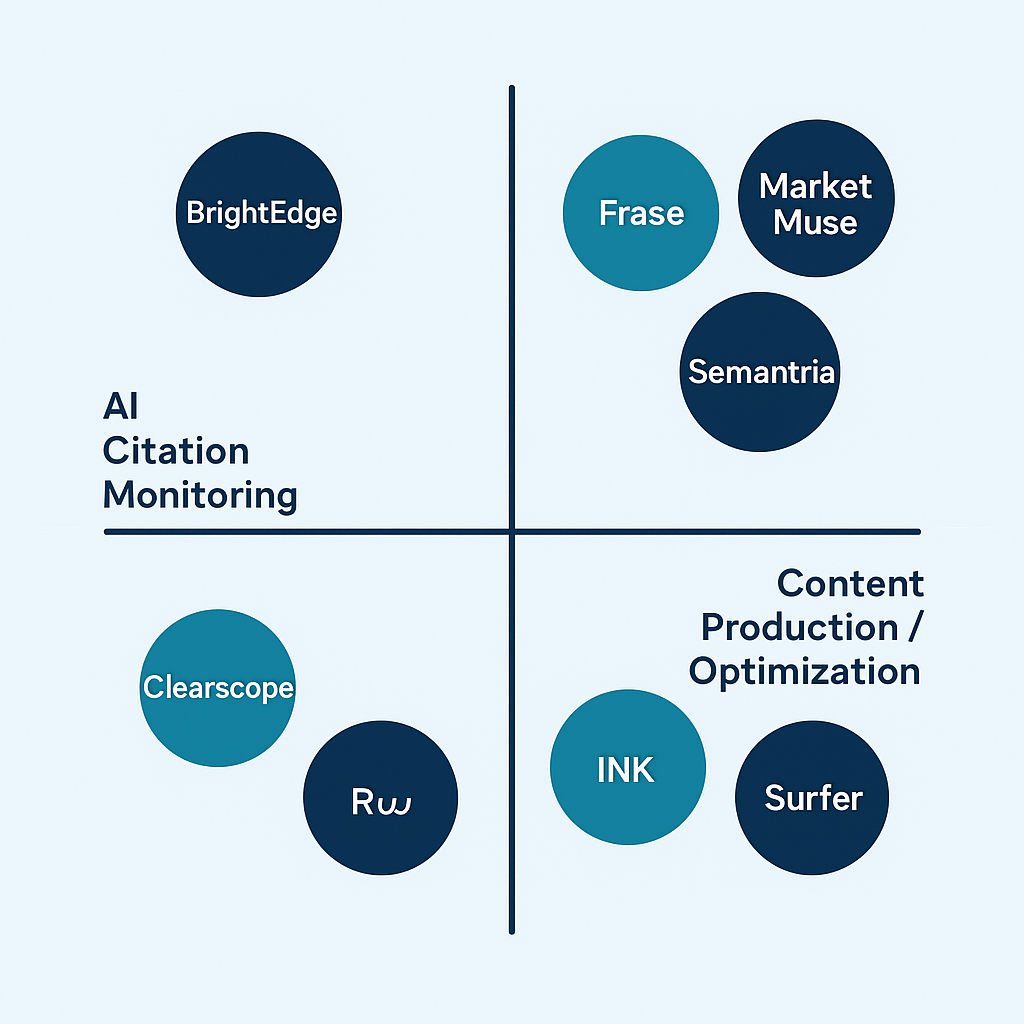
Before diving into each tool, here is the full set covered in this article. Each sits in a different part of the GEO stack — some monitor AI citations, some produce citation-ready content, and a few attempt both. Pick based on the gap you have today, not the feature list that looks most impressive.
- Gofylo — autonomous content production, publishing, and AI visibility scoring
- Profound — enterprise-grade GEO monitoring and share-of-voice tracking
- Peec AI — brand mention tracking across multiple AI engines
- Otterly.AI — prompt-level visibility testing for specific queries
- Scrunch AI — content-to-citation gap analysis and competitive benchmarking
- Semrush AI Toolkit — AI Overview tracking layered onto the existing Semrush data set
- Surfer SEO — on-page optimization with an AI content mode
- Writesonic — AI content generation with GEO-oriented formatting outputs
1. Gofylo — Autonomous Publish-and-Track Engine
Gofylo is the only tool in this list that closes the full loop: it researches competitor keywords from live search results, clusters them into topic maps, writes SEO and GEO-optimized articles in your brand voice, publishes them directly to your CMS, and then scores how ChatGPT and Claude see your brand via an AI Visibility Score. On the standard plan it produces 30 articles a month, each generated in a few minutes, across 18+ languages — with schema markup, internal links, FAQ blocks, and verified source citations baked in. A Search Console refresh loop rewrites articles sitting just off page one using your own GSC data, keeping the prior version restorable. For founders and small marketing teams who want compounding organic and AI search presence without hiring a content team, the mechanism is structurally different from point tools: it is an agent that researches, writes, optimizes, internally links, publishes, and improves — without human prompts between steps. Pricing is a single all-in-one plan at $79/month with a 3-day free trial.
Best for: B2B SaaS founders and growth-stage marketing teams who want simultaneous gains in Google rankings and AI engine citations without managing a content workflow. The AI Visibility Score is the differentiator — it quantifies how ChatGPT and Claude currently perceive your brand, not just whether you rank on page one.
Key limitation: Gofylo's AI Visibility Score currently covers ChatGPT and Claude, with Perplexity and Gemini on the roadmap. If you need multi-engine citation tracking today across all four simultaneously, you'll want to pair Gofylo's production engine with a dedicated monitoring tool from this list.
2. Profound — Enterprise GEO Monitoring
Profound is the most-cited enterprise monitoring platform in the GEO category as of 2026. It tracks how your brand, competitors, and topics appear across AI assistants including ChatGPT, Perplexity, and Claude, and surfaces share-of-voice data alongside citation frequency. Profound's core value is the depth of its query simulation engine — you can test thousands of prompts at scale and see exactly which answers include your brand versus a competitor's. It publishes segment-level reporting that enterprise demand gen teams can route into executive dashboards. Pricing is not publicly listed and appears to run on a custom enterprise contract model, which puts it out of reach for bootstrapped teams. For a more detailed breakdown of what Profound does well and where it falls short, see the Profound GEO article already in this cluster — we won't repeat that analysis here.
Best for: Enterprise marketing and SEO teams that need auditable, scalable AI citation tracking across dozens of product lines and need board-ready share-of-voice reporting. Not the right fit if you need content production alongside monitoring.
Key limitation: Profound is a monitoring-only platform. It tells you where you are not being cited; it does not help you produce the content that would fix that gap. You need a separate production tool in the stack.
3. Peec AI — Brand Mention Tracking Across AI Engines
Peec AI is a brand monitoring tool purpose-built for AI search visibility. It tracks mentions of your brand name and chosen keywords across ChatGPT, Perplexity, Bing Copilot, and other generative surfaces, and surfaces a share-of-mention metric that functions as a GEO equivalent of search rank position. Peec differentiates itself from broader social listening tools by focusing exclusively on the AI response layer rather than social media or news. For B2B SaaS teams comparing Peec to Profound, the practical difference is depth versus breadth: Profound runs deeper query simulations at enterprise scale; Peec offers faster setup and cleaner per-brand dashboards for smaller teams. Our sibling article Top 9 AEO Tools Ranked covers Peec in the context of answer engine optimization tooling if you want a cross-category comparison.
Best for: Growth-stage SaaS companies that want quick visibility into how AI engines are describing their brand relative to two or three named competitors — without the procurement cycle of an enterprise platform.
Key limitation: Peec's tracking is retroactive and sampling-based. It catches mentions that already happened; it does not simulate new prompts at volume the way Profound does. If your query set is large and diverse, the coverage may feel incomplete.
4. Otterly.AI — Prompt-Level Visibility Testing
Otterly.AI takes a prompt-first approach to GEO measurement. Rather than tracking brand mentions passively, Otterly lets you define a specific list of queries — the exact prompts your buyers would type into ChatGPT or Perplexity — and runs those queries on a schedule to see whether your brand, your competitors, or neither appear in the response. It produces a visibility score per query and shows you citation frequency over time. This is particularly useful for B2B SaaS companies running account-based marketing, where the set of target queries is finite and well-defined. Otterly's interface is lightweight and the query library is fully customizable. Pricing has a free tier with limited queries, making it one of the accessible entry points in the monitoring category.
Best for: Demand generation teams and solo operators who want to track visibility on a specific, curated set of buyer-intent prompts rather than broad brand monitoring. The free tier is a genuine starting point, not a crippled demo.
Key limitation: Otterly's value is proportional to the quality of your prompt library. If you haven't mapped your buyer's AI search behavior with precision, the query list you build will miss significant coverage, and the scores will mislead rather than inform.
Context check: According to MarketsandMarkets, AI-referred web sessions surged over 527% year-over-year in the first half of 2025. That growth rate is why monitoring tools like Otterly, Peec, and Profound have a market at all — the traffic channel exists and is scaling fast.
5. Scrunch AI — Content-to-Citation Gap Analysis
Scrunch AI approaches GEO from the content diagnostic angle. It analyzes your existing content library and maps it against AI-cited sources in your category to identify structural gaps — topics you have not covered, citation patterns your competitors have captured, and content formats that AI assistants consistently prefer. The output is a prioritized content brief list, not a monitoring dashboard. Teams using Scrunch typically pair it with a production tool to execute the briefs it generates. It integrates with some CMS platforms and can export to project management tools. Scrunch is a relatively newer entrant in 2026 and its query coverage across AI engines is narrower than Profound or Peec, but its content-gap framing makes it practical for content strategists rather than just data analysts.
Best for: Content and SEO managers who want to know which articles to write next based on AI citation data, not keyword volume alone. Particularly useful for teams that have an existing content library and need to audit it against AI search behavior.
Key limitation: Scrunch generates briefs but does not write, publish, or track the articles it recommends. If your team has limited writing bandwidth, you'll need a production tool to act on Scrunch's output — otherwise it becomes an expensive brief-generator that creates backlog without resolution.
6. Semrush AI Toolkit — AI Overview Tracking Inside a Familiar UI
Semrush has extended its core keyword and rank-tracking platform with an AI Overview module that monitors whether your pages appear in Google's AI-generated search summaries. For teams already paying for Semrush, this is the lowest-friction way to add some GEO measurement — the learning curve is minimal and the data sits alongside existing keyword and backlink reporting. The AI Overview tracking is specifically focused on Google's surface, which matters because according to Semrush's own research published on searchengineland.com, Google AI Overviews now appear on a significant share of informational queries. However, Semrush's GEO coverage does not extend to ChatGPT, Claude, or Perplexity citation tracking — it is Google-first by design. For teams who need to optimize for AI assistants beyond Google, Semrush alone is not sufficient, and this is the gap where dedicated GEO tools earn their place. For a full breakdown of how AI Overviews work and what it takes to rank in them, see the how to rank in google ai overviews article in this cluster.
Best for: SEO teams already on Semrush who want to layer in Google AI Overview monitoring without adopting a new platform. A practical zero-marginal-cost addition for existing subscribers, not a standalone GEO strategy.
Key limitation: Semrush's GEO functionality is Google-only as of 2026. It does not track ChatGPT, Claude, Perplexity, or Gemini citations. If a meaningful share of your target audience is running queries in those assistants — and the usage data says they are — Semrush alone leaves a large blind spot.
7. Surfer SEO — On-Page Optimization With AI Mode
Surfer SEO is primarily an on-page optimization tool that scores your content against the top-ranking pages for a given keyword, then suggests structural improvements: word count, heading distribution, entity coverage, internal link targets, and NLP term frequency. In 2026 Surfer has added an AI content generation mode that writes drafts optimized to its own scoring model. From a GEO standpoint, Surfer's relevance is indirect: content that scores well on entity completeness and structural clarity tends to be more citable by AI assistants, because the same signals that help Google understand topical authority also help language models extract clean, attributable answers. Surfer does not directly track AI citations — it does not know whether ChatGPT or Claude cites your content — but the optimization layer it provides does improve the underlying content quality that makes citation more likely. The connection between AI Optimization practice and Surfer-style content hygiene is worth understanding at the strategic level.
Best for: Content teams that write manually and need a structured scoring system to ensure articles are comprehensive and entity-rich before publication. Also useful as a QA layer on AI-generated drafts before they go live.
Key limitation: Surfer optimizes for Google's ranking signals, not AI citation patterns directly. The correlation between Surfer scores and GEO visibility is real but indirect. Teams expecting Surfer alone to drive AI citation gains will be disappointed — it is a content quality tool, not a GEO monitoring or publishing tool.
8. Writesonic — AI Content Layer With GEO Formatting
Writesonic is a broad AI writing platform that covers landing pages, blog posts, product descriptions, and ad copy. Its relevance to GEO comes from its article generation mode, which produces long-form content with FAQ sections, heading structures, and schema-friendly formatting — the same structural patterns that make content more citable by AI assistants. Writesonic added a Surfer SEO integration that allows on-page scoring inside the same workflow. For solo operators and bootstrapped teams who need content at volume without a dedicated agency, Writesonic reduces the per-article production time substantially. The platform does not include AI citation tracking, brand visibility scoring, or CMS publishing automation, which means teams using it for GEO purposes still need to handle distribution, monitoring, and refresh cycles separately.
Best for: Solo operators and small teams that want AI-assisted writing at a lower price point than a full autonomous platform, and are comfortable manually managing publishing and tracking. Good for generating first drafts; less suited for teams that want hands-off content operations.
Key limitation: Writesonic requires significant human-in-the-loop involvement to publish, monitor, and refresh content. For teams that want compounding, autonomous growth — where the system researches, writes, optimizes, and publishes without daily prompting — Writesonic is a writing assistant, not a growth engine.
Free Generative Engine Optimization Tools Worth Knowing
Several entry-level options exist if you want to test GEO measurement before committing to a paid plan. Gofylo's own free AI Search Grader tool grades your brand's current AI search visibility and returns actionable scoring — it's a standalone entry point that does not require a Gofylo subscription to use. Otterly.AI has a free tier with a limited query count that is functional enough to validate whether your brand appears in AI responses for your top three or four target prompts. Google's Search Console (free) surfaces AI Overview impressions and clicks if you navigate to the correct filter within the Performance report, giving you a baseline for Google's generative surface without any third-party cost. For a broader look at free options in the adjacent answer engine optimization category, the existing article on 14 Answer Engine Optimization Tools Ranked for 2026 covers free-tier tools in more depth than we will here. The key point is that free tools are adequate for diagnosis but not for the ongoing monitoring and content production loop that compounds visibility over time.
Market signal: Market research published in Q4 2025 indicates that 67% of Fortune 500 CMOs have identified GEO as a top-three digital priority for fiscal year 2026, up from just 18% in 2024 (MarketIntelo). The budget is moving. Free tools get you oriented; a production-and-monitoring stack is what compounds.
How to Stack These Tools Without Wasting Budget
Most teams end up over-tooled on monitoring and under-invested on production. The math is simple: a tool that tells you ChatGPT doesn't cite your brand is only useful if you have a mechanism to publish content that changes that. The practical stack for a growth-stage B2B SaaS company in 2026 looks like this.
- Production and publishing layer: Gofylo (or Writesonic if you want manual control) — this is the engine that creates the content AI assistants can cite
- AI citation monitoring layer: Peec AI or Otterly.AI for agile teams; Profound for enterprise teams with larger query sets and reporting requirements
- Google surface layer: Semrush AI Toolkit if you're already a subscriber, or Google Search Console's built-in AI Overview reporting for zero additional cost
- Content quality layer: Surfer SEO as a QA step on long-form articles if your team writes manually or edits AI drafts heavily
- Gap analysis layer: Scrunch AI on a quarterly basis to identify topic clusters your competitors are winning in AI responses that you have not covered
The mistake most teams make is treating the monitoring layer as the whole GEO strategy. Knowing your AI visibility score is a diagnostic, not a growth mechanism. The compounding effect — where each new article increases topical authority, which increases citation probability, which increases brand recall in AI responses — requires consistent content production at a pace that manual workflows cannot sustain. That is the structural argument for autonomous platforms over point tools: the loop closes itself rather than depending on your team's weekly capacity.
What to Prioritize in 2026 and Beyond
The GEO services market is projected to grow from USD 1.48 billion in 2026 to USD 17.02 billion by 2034 at a 45.5% CAGR, according to Intel Market Research. At that growth rate, the tooling category will fragment, consolidate, and be disrupted multiple times. What stays constant is the underlying mechanism: AI assistants cite sources that are authoritative, structured, entity-rich, and consistently updated. Tools that help you produce that kind of content at scale — and verify that it's being cited — are the durable investments. Tools that only measure without producing, or produce without measuring, leave half the loop open.
For founders and content leads who want a single framework for evaluating any new GEO tool that enters the market: ask whether it closes the full loop from keyword research to publication to citation tracking and content refresh. Most do not. The ones that do — at a price point accessible to growth-stage teams — are rare. That is precisely the gap Gofylo was built to fill. If you want the broader strategic context for where GEO tooling fits in a full AI Optimization program, that hub article maps the entire category without duplicating what's here.
FAQ
What exactly are generative engine optimization tools?
Generative engine optimization tools are software platforms that help brands appear in AI-generated answers from engines like ChatGPT, Claude, Perplexity, and Gemini — not just in traditional Google search results. They typically do one or more of the following: produce structured, citation-ready content; monitor AI citation frequency and share of voice; or identify content gaps relative to AI-cited competitors. The category is distinct from classic SEO tooling because the ranking signal is not a link graph or keyword density score — it is whether a language model treats your content as a reliable, citable source.
How is GEO different from traditional SEO tooling?
Traditional SEO tools optimize for Google's ranking algorithm — backlinks, keyword usage, page speed, Core Web Vitals. GEO tools optimize for language model citation behavior, which favors entity clarity, topical completeness, structured formatting (FAQ blocks, schema markup), and source credibility signals. The two sets of signals overlap partially, which is why some traditional SEO improvements also help GEO, but the divergence between Google's organic top-10 and AI-cited sources means you cannot rely on one set of tools to handle both jobs.
Which generative engine optimization tools are free?
Gofylo's AI Search Grader is free and grades your brand's current AI visibility with actionable scoring. Otterly.AI has a limited free tier for prompt-level testing. Google Search Console surfaces AI Overview impression data at no cost. These free tools are useful for diagnosis and initial benchmarking, but they do not replace a production and monitoring stack for teams serious about compounding AI search visibility over time.
Can one tool handle both content production and AI citation tracking?
As of 2026, Gofylo is the platform that comes closest to closing the full loop — it produces and publishes content autonomously, then scores AI visibility via its AI Visibility Score for ChatGPT and Claude. Most other tools specialize in either production or monitoring, not both. Teams that want comprehensive coverage across all four major AI engines will need to pair a production tool with a dedicated multi-engine monitoring platform.
How long does it take to see results from GEO tools?
Citation patterns in AI engines update as the underlying models are retrained or their retrieval indexes are refreshed — timelines vary by engine and are not publicly disclosed. In practice, many teams report AI citation gains within four to eight weeks of publishing well-structured, entity-rich content consistently. The compounding effect accelerates as topical authority builds across a cluster of related articles, which is why content velocity — publishing 20–30 articles per month rather than two or three — meaningfully shortens the time to measurable AI visibility improvement.
Do I need a separate GEO tool if I already use Semrush or Ahrefs?
Yes, in most cases. Semrush's AI Toolkit tracks Google AI Overviews but does not monitor ChatGPT, Claude, or Perplexity citations. Ahrefs similarly focuses on traditional Google signals and backlink data. These are essential tools for classic SEO, but they do not cover the AI assistant citation layer where a growing share of organic discovery is now happening. A dedicated GEO production and monitoring stack is additive, not redundant, relative to Semrush or Ahrefs.
Ready to close the loop between content production and AI citation tracking? Gofylo's standard plan publishes 30 GEO-optimized articles per month, scores your AI visibility on ChatGPT and Claude, and refreshes underperforming content from your Search Console data — all for $79/month with a 3-day free trial. Start the trial or run the free AI Search Grader on your brand today to see where you stand in 2026.