As of 2026, the generative AI in content creation market is projected to hit USD 26.0 billion and climb to USD 80.1 billion by 2030 at a 32.5% CAGR, according to Grand View Research. That growth isn't being driven by curiosity — it's being driven by marketing teams that have stopped treating AI as a writing shortcut and started treating it as infrastructure. According to Siege Media's 2026 research, 97% of content marketers plan to use AI to support content marketing efforts this year, up from 64.7% in 2023. The question is no longer whether to use an ai powered content generation tool. It's which one actually compounds organic and AI search performance without adding headcount.
The tools on this list were selected for teams that need output at scale: founders running lean, SEO managers accountable for pipeline, and demand gen leads who can't afford to wait three weeks for a content brief. We've organized them by use case and capability layer — writing, SEO optimization, full-stack autonomous publishing, and AI search visibility — because the right tool depends on which bottleneck you're actually trying to remove. We'll also flag which tools operate in both traditional Google SEO and AI search (GEO) contexts, since most competing roundups still ignore the second half of that equation entirely.
The best ai powered content generation tool for a B2B SaaS team in 2026 is the one that covers the full content lifecycle — research, writing, publishing, and AI visibility tracking — without requiring a dedicated content team to run it.
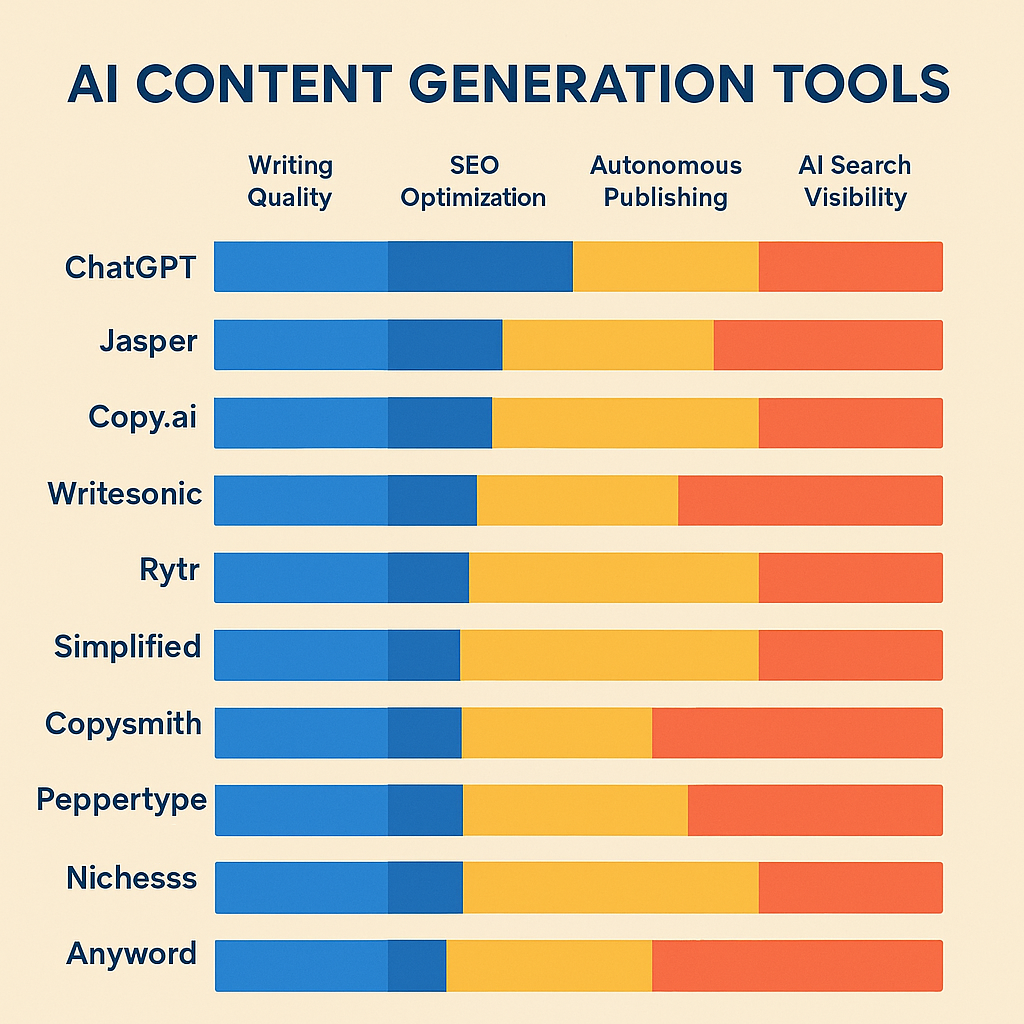
All 11 Tools at a Glance
- Gofylo — Full-stack autonomous content engine with AI visibility tracking
- Jasper AI — Brand voice enforcement and long-form blog writing
- Surfer SEO — Real-time content scoring against live SERP data
- Copy.ai — GTM and sales-oriented content workflows
- ChatGPT (OpenAI) — Flexible general-purpose writing and ideation
- Clearscope — Semantic keyword grading and editorial optimization
- Frase — SERP brief generation and content summarization
1. Gofylo — Autonomous Content Engine with AI Visibility Tracking
Gofylo is the only tool on this list that treats content generation, CMS publishing, and AI search visibility as a single automated loop rather than three separate products you stitch together. The platform ships six autonomous agents that handle keyword research, article writing, internal linking, schema markup, CMS publishing, AI citation tracking, social monitoring, competitor intelligence, and backlink generation — without a human prompt initiating each step. The Content Engine has generated over 48,000 articles, publishes fully E-E-A-T-compliant pieces in under 4 minutes per article, and delivers 30 articles per month on the standard plan. Articles include AI-generated images in 5 styles, auto-embedded YouTube videos, and FAQ schema blocks — all of which directly improve AI search citability. Content is available in 18+ languages and supports programmatic landing page generation.
What separates Gofylo structurally from every other ai powered content generation tool on this list is the AI Visibility Tracker. It monitors brand citation and ranking presence across ChatGPT, Claude, Perplexity, and Gemini, producing a single AI Visibility Score — averaging 94 across active accounts. That score gives marketing leads a benchmark for AI share of voice that no traditional rank tracker provides. Integrations cover WordPress, WordPress.com, Webflow, Shopify, Wix, Notion, Ghost, Framer, and Feather, plus an API webhook for custom CMS setups. Pricing is a single all-in-one plan at $79/month with a 3-day free trial, no credit card required. Visit gofylo.com to start the free trial or use the standalone AI Search Grader to benchmark your current AI visibility before committing.
2. Jasper AI — Brand Voice and Long-Form Writing
Jasper AI is one of the most recognized names in AI-assisted writing, particularly for teams that need to enforce brand voice across a distributed content operation. Its Brand Voice feature ingests existing content samples and trains outputs to match tone, terminology, and style — useful for enterprise SaaS teams with strict editorial guidelines. Jasper integrates with Surfer SEO for on-page optimization scoring and supports templated workflows for blog posts, ad copy, emails, and landing pages. It does not autonomously publish to a CMS or track AI search citations, so it functions as an assisted writing layer rather than a full pipeline. Pricing starts at $49/month for the Creator plan. If you're evaluating Jasper against newer alternatives, our article on Jasper AI alternatives covers the full competitive landscape. Visit jasper.ai for current pricing.
3. Surfer SEO — Content Optimization Against SERP Data
Surfer SEO occupies a focused niche: it analyzes the top-ranking pages for a target keyword and scores your draft against the semantic patterns that correlate with high rankings. The Content Editor gives writers a live NLP keyword list and a content score as they type. Surfer's Audit tool identifies optimization gaps in existing published content. For teams that already produce content manually but want data-driven on-page guidance, Surfer is a strong fit. It does not generate full articles autonomously, does not publish to a CMS, and has no AI search visibility layer. As Ahrefs notes in their content optimization research, on-page semantic optimization remains a meaningful ranking signal — Surfer operationalizes that signal in an editor-friendly interface. Plans start around $89/month. Visit surferseo.com for details.
4. Copy.ai — GTM Content Workflows
Copy.ai has repositioned itself as a go-to-market AI platform rather than a pure writing tool. Its Workflows feature lets revenue teams build multi-step content pipelines — for example, pulling a prospect's LinkedIn profile, generating a personalized cold email, and routing it to a sales sequence without manual copy-pasting. For B2B SaaS teams that blend content and sales outreach, this is a meaningful differentiator. Copy.ai is less optimized for long-form SEO content production and has no built-in SEO scoring or AI visibility tracking. It's better positioned as a sales-content and campaign-copy tool than a blog or topical authority engine. A free tier is available for light use. Visit copy.ai for plan details.
5. ChatGPT (OpenAI) — Flexible Generalist Writing Model
ChatGPT remains the most widely used AI tool in enterprise operations — according to CleverType's 2026 research, 92% of Fortune 500 companies use ChatGPT or similar tools somewhere in their operations. As a raw writing model, it handles brief generation, outline drafting, first-draft production, and ideation at high velocity. ChatGPT's strength is flexibility; its weakness for content teams is the absence of built-in SEO structure, internal linking logic, CMS publishing, or AI visibility tracking. Every output requires human review and manual publishing. The API powers many of the specialized tools on this list, meaning you're often accessing GPT capabilities with more structure through a vertical product. OpenAI's API revenue and ChatGPT subscriptions drove the company's annualized run rate past $3.4 billion by end of 2024, signaling the scale of adoption. Visit openai.com for current ChatGPT plan details.
ChatGPT is a capable raw model. But an autonomous ai powered content generation tool built on top of it — with SEO logic, internal linking, schema, and CMS integration — produces compounding output that a raw chat interface never will.
6. Clearscope — Semantic SEO Scoring
Clearscope is a semantic content optimization platform favored by editorial teams and SEO managers at mid-market companies. It generates keyword reports that identify related terms, questions, and NLP concepts a piece of content should cover to compete on a given query. Writers paste their draft into the Clearscope editor and receive a letter-grade content score in real time. Clearscope is not a content generator — it's an optimization layer that assumes a human (or another AI tool) produced the draft. It's strongest for teams that already have a writing workflow and want to add data-driven scoring on top. No autonomous publishing or AI search visibility features exist. Pricing is on the higher end for smaller teams. Visit clearscope.io for current plan information.
7. Frase — Brief Generation and SERP Summarization
Frase accelerates the research and briefing phase of content production. It crawls the top-ranking pages for a target keyword, summarizes their structure and common talking points, and generates a content brief in minutes. The AI writer can then draft against that brief directly in the platform. For solo operators or small content teams that spend hours on research before writing begins, Frase removes a significant time cost. It lacks robust autonomous publishing capabilities and does not track AI search visibility. It functions well as a research-and-brief tool that feeds into a broader writing workflow. Semrush's content marketing documentation highlights the importance of structured briefs for SEO outcomes — Frase is one of the faster ways to generate them. Visit frase.io for pricing.
8. Writesonic — Multi-Format Content at Scale
Writesonic targets high-volume content teams that need a wide format range — blog posts, social captions, product descriptions, ad copy, and landing pages — from a single platform. Its Article Writer 6.0 can produce long-form content with factual grounding by pulling from real-time web searches, which reduces hallucination risk compared to closed-model generation. Writesonic also includes a Surfer SEO integration for on-page scoring. It does not autonomously publish to a CMS or track AI search citations. For bootstrapped teams that need volume across multiple content formats without a large tool stack, it's a practical choice. A free tier exists with word-count limits. Visit writesonic.com for current pricing.
9. Notion AI — In-Workflow Editing for Ops Teams
Notion AI is best understood as an assistant embedded inside an existing Notion workspace rather than a standalone content generation platform. It helps writers draft, summarize, translate, and edit pages within Notion's document environment. For ops-heavy teams that already live in Notion and want AI assistance without switching tools, it reduces friction. It is not a content SEO tool — there's no keyword research, SERP analysis, schema output, or CMS publishing. Gofylo integrates directly with Notion as a CMS target, which means teams can use Notion as their publishing destination while letting Gofylo handle the full content pipeline. Visit notion.so/product/ai for current availability.
10. Perplexity AI — AI Search-Native Research and Citation
Perplexity is worth including on any 2026 content tool list because it represents both a tool and a distribution channel. As an AI search engine that surfaces cited sources in its answers, Perplexity is a platform your content needs to be found on — not just a tool to write with. As a research tool, it's extremely fast for sourcing facts, pulling expert quotes, and building the citation layer of a well-grounded article. For content strategists thinking about GEO (generative engine optimization), understanding how Perplexity selects and cites sources is directly relevant to how you structure articles. Gofylo's AI Visibility Tracker specifically monitors Perplexity alongside ChatGPT, Claude, and Gemini to track whether your content is being cited in AI-generated answers. Visit perplexity.ai for current plans.
11. MarketMuse — Topical Authority Modeling
MarketMuse is a strategic content intelligence platform that models topical authority at the site level. Rather than optimizing individual articles in isolation, it maps the full keyword universe around a topic cluster, identifies content gaps, and prioritizes which articles to produce next based on competitive difficulty and topical coverage score. For SEO managers building out programmatic content strategies, MarketMuse provides a planning layer that most pure writing tools skip entirely. It does not write autonomously or publish to a CMS. As a planning and prioritization tool, it pairs well with a writing tool like Gofylo or Jasper. Ahrefs' guide to topical authority covers the structural SEO logic that MarketMuse operationalizes. Visit marketmuse.com for enterprise pricing.
How to Choose the Right Tool for Your Stack
Traditional SEO vs. AI Search Visibility: Why Both Matter
Most teams evaluating an ai powered content generation tool are thinking about Google rankings. That's the right instinct — organic search is still a primary acquisition channel for B2B SaaS. But in 2026, a growing share of research queries that used to generate a Google click now resolve inside ChatGPT, Claude, Perplexity, or Gemini without the user ever visiting a search results page. If your content isn't structured to be cited by AI engines — with FAQ schema, strong factual grounding, clear entity associations, and E-E-A-T signals — you are invisible to a meaningful and growing traffic source. According to Search Engine Land's 2026 coverage of AI search displacement, publishers that optimize for AI citation are seeing incremental visibility that doesn't show up in traditional rank trackers at all. Of the eleven tools on this list, only Gofylo actively tracks and scores AI citation presence as a first-class metric.
Autonomous vs. Assisted: Understanding the Workflow Difference
There is a structural difference between assisted tools and autonomous tools that matters at scale. Assisted tools — Jasper, Surfer, Clearscope, Frase — require a human to initiate each workflow step: start a new doc, paste a keyword, review a score, click publish. They make each step faster, but the total workflow still depends on human throughput. Autonomous tools — Gofylo being the clearest example on this list — execute the full loop without a human prompt for each article. The keyword research agent feeds the writing agent, which feeds the internal linking and schema layer, which triggers the CMS publish automatically. At 30 articles per month and under 4 minutes per article end-to-end, the compounding effect is material: a team that published 4 articles per month manually can reach 30 per month on day one without adding a writer. For bootstrapped operators and lean growth-stage teams, this is the most important architectural distinction to understand before selecting a tool.
Volume compounds authority. Topical authority in both Google and AI engines is built through breadth and depth of coverage on a subject. A team publishing 4 articles per month will always lose to one publishing 30 — assuming quality floors are maintained. Autonomous generation closes that gap without proportional headcount increases.
AI search requires different structure. FAQ schema blocks, direct answer formatting, factual sourcing, and entity clarity are the signals that AI engines use to decide whether to cite a piece of content. Most assisted writing tools don't produce this structure by default — you have to add it manually. Gofylo includes FAQ blocks and schema markup in every article by default.
Integration determines publish velocity. A tool that writes an article but requires manual upload to WordPress, formatting correction, image insertion, and internal link placement adds 30–60 minutes of human time per post. Native CMS integrations that handle all of that automatically are the difference between a content calendar that ships and one that stalls.
Visibility scores replace guesswork. Knowing that you published content is not the same as knowing that AI engines are citing it. Gofylo's AI Visibility Score — averaging 94 across active accounts — gives marketing leads a concrete benchmark that traditional rank trackers don't provide.
If your current ai powered content generation tool workflow requires a human to initiate every step and doesn't track AI search citations, you're running an assisted workflow in a world that's rewarding autonomous infrastructure. The market share won't wait for teams to catch up manually.
FAQ
What is an AI powered content generation tool?
An AI powered content generation tool is software that uses machine learning models — typically large language models (LLMs) — to research, draft, optimize, and in some cases publish written content automatically. Tools range from assisted writing platforms like Jasper and Clearscope, which augment human writers, to fully autonomous systems like Gofylo that execute the entire content lifecycle from keyword research through CMS publishing without manual prompting at each step.
Are there free AI powered content generation tools online?
Yes — several tools on this list offer free tiers. ChatGPT has a free plan with GPT-4o access on a usage limit. Copy.ai has a free tier for limited output. Writesonic offers a free plan with word-count caps. Gofylo offers a 3-day free trial with no credit card required and a standalone free AI Search Grader tool for benchmarking current AI visibility. Free tiers are typically sufficient for one-off drafts but not for teams that need consistent monthly volume.
How do AI content tools affect AI search visibility (GEO)?
AI search engines like ChatGPT, Claude, Perplexity, and Gemini select content to cite based on structural signals: FAQ schema, factual grounding, E-E-A-T compliance, entity clarity, and answer-first formatting. Content generated with tools that include these elements by default has a higher probability of being cited in AI-generated answers than plain prose with no schema. Gofylo is the only tool on this list that both generates AI-search-optimized content and tracks whether that content is actually being cited in AI engine responses.
Can AI content generation tools replace a content team?
Autonomous platforms like Gofylo can replace the production and publishing functions of a content team for many B2B SaaS companies — keyword research, writing, optimization, internal linking, schema, and publishing all happen without a human editor per article. Strategic functions — brand positioning, product narrative, customer interview synthesis — still benefit from human input. For bootstrapped teams and early-stage startups, this trade-off is highly favorable: production capacity scales immediately while strategic ownership stays with the founder or marketing lead.
What should B2B SaaS teams prioritize when choosing an AI content tool?
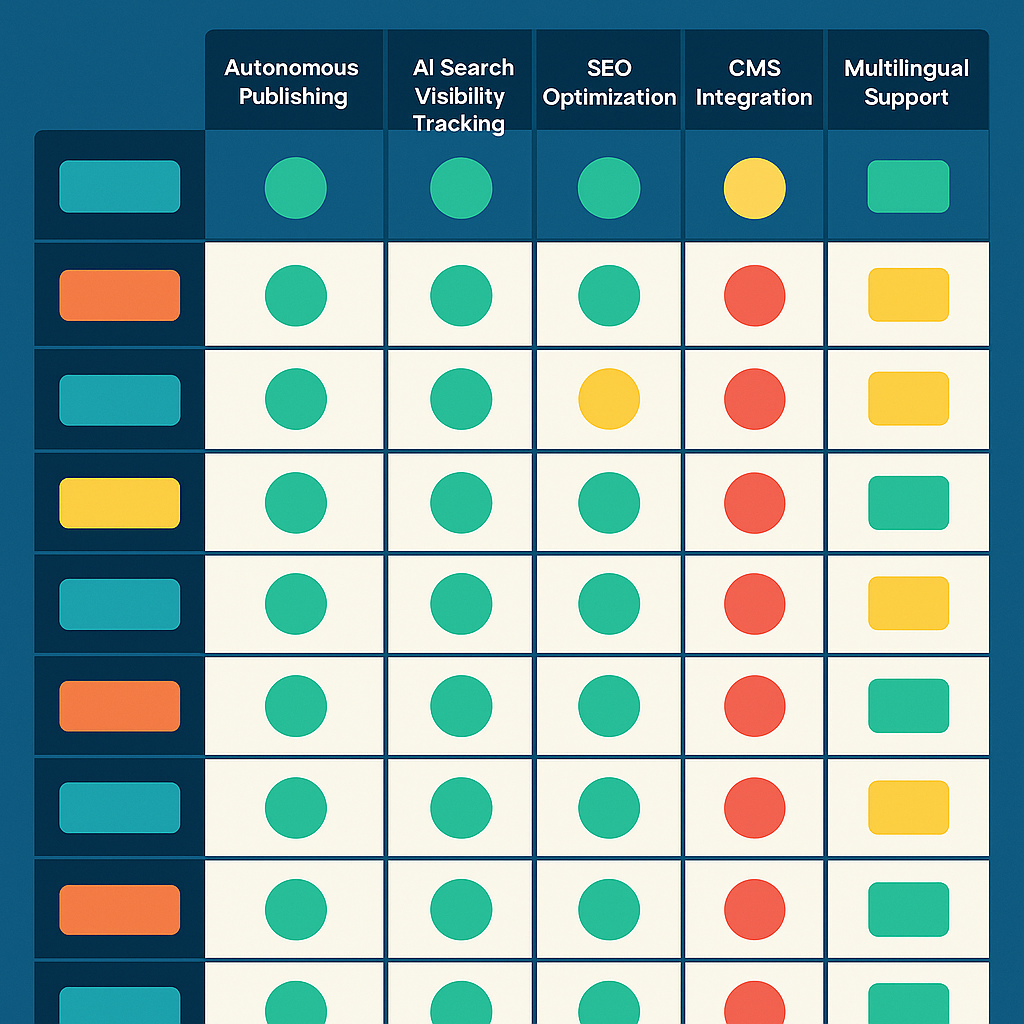
Prioritize in this order: autonomous publishing capability (does it push directly to your CMS without manual steps?), AI search visibility tracking (does it measure citations on ChatGPT, Claude, Perplexity, and Gemini?), SEO structure quality (does it include schema, internal links, and FAQ blocks by default?), and volume capacity (how many articles per month at what quality floor?). Teams that only optimize for writing quality often end up with well-written content that nobody — human or AI — finds.
How does Gofylo differ from standalone AI writing tools?
Standalone AI writing tools like Jasper or Writesonic produce a draft and stop there — a human then handles SEO optimization, internal linking, schema markup, image insertion, and CMS upload. Gofylo's six autonomous agents execute all of those steps as a continuous loop: the keyword agent feeds the writing agent, which feeds the optimization and schema layer, which triggers the CMS publish — all in under 4 minutes per article. The AI Visibility Tracker then monitors whether published content is being cited on ChatGPT, Claude, Perplexity, and Gemini. It's the difference between a writing assistant and a content infrastructure platform.
Ready to move from assisted to autonomous? Gofylo's 3-day free trial gives you access to the full Content Engine, AI Visibility Tracker, and all six agents — no credit card required. Start your trial at gofylo.com or run your brand through the free AI Search Grader to see where you stand on ChatGPT, Claude, Perplexity, and Gemini right now.