AIO optimization is the work of making your brand and your pages show up inside the answers that AI systems write. When a buyer asks ChatGPT which tools handle SOC 2 evidence collection, or asks Claude to compare two analytics platforms, the model assembles a response from what it learned in training and, often, from pages it retrieves on the spot. AIO is the discipline of being one of those sources.
I want to skip the vocabulary debate here. You likely already know the acronyms overlap. What I want to explain is the mechanism: how a generative system decides what to say about your category, which properties of a page make it easy to lift into an answer, how that interacts with classic Google ranking, and how a small team can measure any of it. If you run growth at a B2B SaaS company with one or two people on content, this is the part that decides whether the work pays off.
AIO (artificial intelligence optimization) is the practice of improving how often and how accurately AI systems such as ChatGPT, Claude, Perplexity and Gemini mention and cite your brand in their generated answers. It matters most to B2B SaaS teams whose buyers now research vendors by asking an AI assistant before they ever open a search results page.

Where AIO Sits Among the Acronyms
AIO is one name for the same broad practice that others call generative engine optimization or answer engine optimization. Wikipedia's entry on the topic treats them as variants of one discipline: generative engine optimization, also known as answer engine optimization, covers improving visibility in responses produced by generative AI systems. The labels differ by who coined them and which surface they emphasise, but the work underneath is the same.
The academic framing is recent. The term "generative engine optimization" was introduced in a 2023 paper by Pranjal Aggarwal and co-authors, later presented at the KDD 2024 conference. That paper tested whether changes to source content could raise its visibility in generated answers, and it gave the field a vocabulary for something marketers had started noticing in referral logs. By 2026, the practice has moved from research curiosity to a budget line at many SaaS companies.
One naming trap is worth flagging. "AI optimization" also describes something unrelated: using machine learning to optimise ad bids, supply chains or pricing models. Gurobi's survey work is a good example of that other meaning. Its 2026 report found 79% of respondents now use GenAI or large language models (LLMs) in their optimization work, up from 30% in 2025. That figure describes operations research teams adopting AI tools, not brands being cited by AI. When you read AIO content, check which meaning the author is using, because a lot of articles blend the two without saying so.
For the rest of this piece, AIO means visibility inside AI answers. If you want the wider context on how Google's own generative layer fits in, What AI Overviews Actually Mean covers that surface specifically. Here I stay on the mechanics that apply across assistants.
How AI Systems Decide What to Say About Your Category
An AI assistant decides what to say about your category from two inputs: what the model absorbed during training, and what it retrieves from the web at answer time. AIO has to work on both, and they respond to different levers on different timescales.
Training memory versus live retrieval
Training memory is the model's baked-in picture of the world. If your brand appeared often and consistently across documentation, reviews, forums, comparison pages and your own site before a model's training cutoff, the model is more likely to name you unprompted. You cannot edit this memory directly. You influence it slowly, by being described the same way in many places over months.
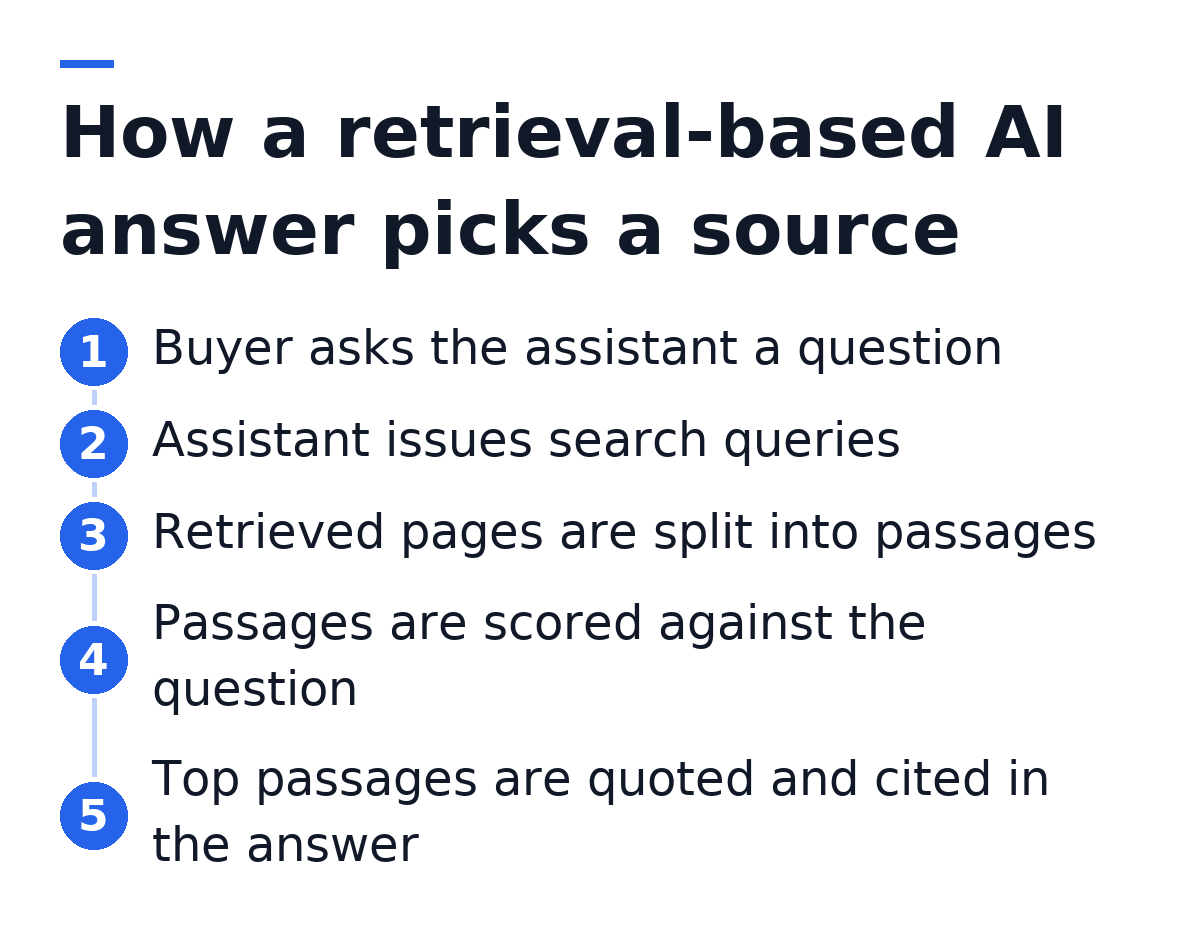
Live retrieval is faster and more controllable. When ChatGPT browses, when Perplexity runs its search step, or when Gemini grounds an answer in Google's index, the system issues queries, pulls a handful of pages, and reads passages from them to compose a reply. A page you publish in March of 2026 can appear in a retrieved answer within weeks, provided the retrieval layer finds it and the passage fits the question.
The practical consequence: brand recall in a model's memory is a lagging indicator, and retrieved citations are a leading one. Teams that only watch whether ChatGPT names them from memory tend to conclude AIO does nothing, because memory moves slowly. Teams that watch retrieved citations see movement sooner and can tie it to specific pages.
Why the selection unit is a passage
Retrieval systems rarely use a whole page. They split documents into chunks, score chunks against the query, and hand the best ones to the model. That changes how you should think about a page. Google ranks a URL. An AI answer engine effectively ranks paragraphs.
I see the failure mode often in SaaS blogs. A post about "how to reduce churn" has a strong answer buried in paragraph nine, after a long story about the founder's first company. Google may still rank the page, because the page as a whole is relevant. A retrieval system scoring paragraph nine in isolation finds that it starts with "That's why we eventually changed it," which means nothing without the paragraphs above. The chunk loses to a competitor's plainer paragraph that states the answer in its first sentence.
Several things follow from passage-level selection:
- Each section should open with a sentence that answers its heading without depending on earlier text.
- Pronouns that point back across a heading ("this approach", "it") break when a chunk is read alone, so name the subject again.
- Definitions, numbers and comparisons should sit in short paragraphs where a chunker is likely to keep them intact.
- Headings phrased the way a buyer asks a question make it easier for a retrieval step to match a chunk to a prompt.
What Makes a Page Citable
A citable page gives an AI system a passage it can quote with confidence, attribute to a clear source, and fit into a wider answer. Three properties do most of the work: structure that survives extraction, evidence the model can trust, and coverage that shows the source understands the whole topic.
Structure that survives extraction
Answer-first writing is the single most reliable change. When a heading asks "How long does a SOC 2 Type II audit take?", the next sentence should state the range and the conditions, and only then explain. Models reward that pattern because the opening sentence can be lifted cleanly.
Tables help when a reader compares options on the same attributes, because a model can read a row as a self-contained fact. FAQ blocks help because each question and answer pair is already a ready-made chunk. Schema markup (FAQPage, Article, Organization, Product) gives crawlers explicit labels for what each part of a page is. None of these are tricks. They make the content easier to parse for any machine, and Google's own systems read the same signals.
Evidence and entity clarity
Models hedge on claims they cannot ground. A sentence like "most teams see faster onboarding" gives an assistant nothing to cite. A sentence that names a source, a figure and a date gives it something it can repeat with attribution. The Aggarwal paper's experiments pointed in this direction: adding citations and statistics to content was among the changes that raised visibility in generated answers.
Entity clarity is the other half. An assistant needs to know exactly what your company is, what category it sits in, and what it does. If your homepage calls the product a "growth OS", your docs call it an "analytics layer" and G2 lists it under "product analytics", the model holds three fuzzy pictures instead of one sharp one. Consistent naming across your site, structured Organization data, and the same one-sentence description in every profile all reduce that ambiguity.
A concrete example. Suppose a SaaS company sells usage-based billing software. Its pricing page says "metered billing platform", its blog says "revenue infrastructure", and its LinkedIn says "fintech for SaaS". A buyer asks Claude for usage-based billing tools. Claude has to infer that all three descriptions point to the same product, and often it does not. When the company aligns on "usage-based billing platform for SaaS" everywhere, the match between the buyer's wording and the brand's description becomes direct.
Coverage across a topic
One strong page rarely carries a category. Assistants answer follow-up questions, and a buyer researching billing software will ask about proration, revenue recognition, migration from a homegrown system and tax handling in quick succession. A site with a well-linked page on each of those questions gets retrieved again and again through the conversation. A site with a single overview page gets one shot.
This is where topic clusters stop being an SEO habit and become an AIO requirement. Internal links between related pages help crawlers map the cluster, and the volume of consistent, specific coverage tells both Google and retrieval systems that the source knows the territory.
How AIO and Google SEO Feed Each Other
AIO and Google SEO are linked mostly through retrieval: several AI assistants find pages by running web searches, so pages that rank well are more likely to be retrieved and then cited. Strong SEO raises the odds of being in the candidate pool, and AIO work raises the odds of being chosen from it.
Gemini grounds answers in Google's index. Perplexity and ChatGPT run their own search steps against web indexes. That means crawlability, indexation, page speed and backlinks still matter for AIO, because a page that never gets indexed or never surfaces for the query is never read. The overlap between top organic results and cited sources is real but partial, and the gap is where passage quality decides the outcome.
The influence runs the other way too. The changes that make a page citable (direct answers, clear headings, structured data, sourced claims) are the same changes Google has described in its guidance on helpful, people-first content. I have rarely seen an AIO edit hurt organic rankings. I have seen plenty of SEO-only habits, such as padding intros to hit a word count, hurt citations. The case for running both as one program is laid out in SEO and GEO Together, and the short version is that splitting them into separate teams usually means duplicated briefs and conflicting edits.
Here is how the two disciplines compare on the points a SaaS team has to plan around:
| Point | Google SEO | AIO |
|---|---|---|
| Unit that gets selected | Whole URL | Passage or chunk |
| Main outcome | Ranked position and click | Mention or citation inside an answer |
| Fastest lever | On-page and technical fixes | Answer-first rewrites of key sections |
| Slow lever | Backlinks and authority | Brand consistency in training data |
| Measurement | Search Console clicks and impressions | Sampled prompts across assistants |
| Shared foundation | Indexation, structure, sourced claims | Indexation, structure, sourced claims |
The bottom row is the one I would put on a whiteboard. Most of the effort is shared. The differences are in where you look for results and how much attention you give to individual paragraphs.
Measuring AIO Without Fooling Yourself
Measuring AIO means sampling prompts across assistants on a schedule and tracking how often your brand is mentioned, how it is described and which of your pages are cited. There is no Search Console equivalent from OpenAI or Anthropic, so every number you see is an estimate built from repeated queries.
That sampling has weaknesses you should know before you trust a dashboard:
- Answers vary between runs of the same prompt, so a single check proves little and you need repeated samples.
- Assistants personalise and use conversation context, so a clean test prompt differs from what a real buyer sees mid-conversation.
- Phrasing matters a lot: "best billing tool" and "usage-based billing for a seed-stage startup" can return different vendor sets.
- Model updates can shift results overnight with no change on your side.
- Referral traffic from assistants is real but undercounted, because many users read the answer and never click.
A workable approach is to pick a fixed set of buyer-intent prompts, run them on a regular cadence across ChatGPT and Claude at minimum, and record three things: whether you are named, whether you are described accurately, and which competitor is named instead when you are absent. Accuracy deserves its own column. A model that names you but describes last year's pricing or a discontinued feature is doing you harm, and the fix is usually to update the pages it is likely retrieving.
Tooling for this has grown fast, and the categories differ: some products only track, some only write, a few do both. If you are evaluating trackers, Top 9 AEO Tools Ranked breaks them down by assistant coverage. For a quick baseline before you commit to anything, Gofylo's free AI Search Grader scores a brand's current AI search visibility and returns actionable scoring without a trial.
Track description accuracy alongside mention rate. Being named with wrong pricing or outdated features can cost more deals than not being named at all, and it is usually fixed by refreshing the pages assistants retrieve.
Why manual workflows stall on AIO
The hardest part of AIO for a small team is volume combined with upkeep. Coverage across a topic means dozens of pages. Passage quality means every one of them has to be written answer-first, sourced and structured. Accuracy means they have to be refreshed when the product, pricing or data changes. A solo marketer can do this for a handful of pages and then falls behind.
This is the structural reason we built Gofylo as an autonomous system rather than a writing assistant that waits for prompts. Gofylo researches keywords from competitors and live search results, groups them into topic clusters, writes in your brand voice and publishes to your CMS: 30 articles a month on the standard plan, each written in a few minutes, in 18+ languages. Every article ships with schema markup, internal links, FAQ blocks and verified source citations, formatted to be cited by AI assistants. The Search Console refresh rewrites published articles that sit just off page one and keeps the earlier version so you can restore it. The AI Visibility Score shows how ChatGPT and Claude see your brand.
Tools in adjacent categories take different approaches. Clearscope grades drafts for human writers, which suits teams that already have writers and want an editorial check. Semrush adds AI visibility reporting inside a broad SEO suite, which suits teams that live in that suite for research. The difference I care about is mechanism: a grader or a report still needs a person to act on it, while an autonomous engine closes the loop from research to publishing to refresh. For more on how generative search reshapes the buyer journey, GEO AI Search Explained covers the marketer's view.
Frequently Asked Questions
What is AIO strategy?
An AIO strategy is a plan for raising how often and how accurately AI assistants mention and cite your brand. In practice it combines four parts: choosing the buyer questions you want to be part of the answer for, building topic coverage that answers those questions and their follow-ups, writing each page answer-first with sourced claims and structured data, and sampling assistants regularly to measure mentions, accuracy and citations. A good AIO strategy shares its foundation with Google SEO, so most teams run it as one program with an extra measurement layer.
What are some effective strategies for generative engine optimization?
The most effective generative engine optimization strategies are the ones that make passages easy to extract and trust. Open every section with a direct answer, add named sources and specific figures to claims, use FAQ blocks and schema markup, keep your brand description identical across your site and external profiles, build linked clusters that cover follow-up questions, and refresh pages when facts change. Then measure with repeated prompt sampling across ChatGPT and Claude rather than one-off checks, and treat description accuracy as seriously as mention rate.
Want to see where you stand first? Run your brand through Gofylo's free AI Search Grader, then start the 3-day free trial of Gofylo ($79/month, cancel anytime) to publish 30 AI-citable articles a month to your CMS and track how ChatGPT and Claude see your brand.